
Map of Ireland, with the Aran Islands highlighted

The Aran Islands, on the west coast of Ireland
From west to east the islands are:
Inishmore (
Árainn Mhór/Inis Mór[1]—
[ˈɑːrənʲ woːr] or
[ˈiniʃ moːr]), the largest;
Inishmaan (
Inis Meáin/Inis Meadhóin—
[ˈɪnɪɕ mʲɑːn]), the second-largest; and
Inisheer (
Inis Thiar/Inis Oírr/Inis Oirthir—
[ˈiniʃ hiər / iːrʲ / erʲhirʲ]), the smallest.
The 1,200 inhabitants primarily speak Irish, the language used in local placenames. Most islanders are also fluent in English.
Location and access[edit]
The approaches to the bay between the Aran Islands and the mainland are as follows:
- North Sound / An Súnda ó Thuaidh (more accurately Bealach Locha Lurgan) lies between Inishmore and Lettermullen, County Galway.
- Gregory's Sound / Súnda Ghríoghóra (formerly known as Bealach na h-Áite) lies between Inishmore and Inishmaan.
- Foul Sound / An Súnda Salach (formerly known as Bealach na Fearbhaighe) lies between Inishmaan and Inisheer.
- South Sound / An Súnda ó Dheas (formerly known as Bealach na Fínnise) lies between Inisheer and County Clare.
- Ferries operate to all 3 Islands from Rossaveal in Co. Galway (Year Round) and Doolin in Co. Clare (Seasonal). Flights operated by Aer Arann Islands also operate fromInverin.
Geology[edit]
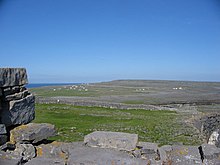
A view over the
karst landscape on Inishmore, from
Dún Aengus, an ancient stone fort.
The islands' geology is mainly
karst limestone, related to the
Burren in Co. Clare (to the east), not the granites of
Connemara to the north. This is most obvious in the construction of the walls around the fields.
The limestones date from the
Visean period (Lower Carboniferous), formed as sediments in a tropical sea approximately 350 million years ago, and compressed into horizontal strata with fossil
corals,
crinoids,
sea urchins, and
ammonites. Glaciation following the
Namurianphase facilitated greater denudation. The result is that the Aran islands are one of the finest examples of a Glacio-
Karst landscape in the world. The effects of the
last glacial period (the Midlandian) are most in evidence, with the islands overrun by ice during this glaciation. The impact of earlier
Karstification (solutional erosion) has been eliminated by the
last glacial period. So any Karstification now seen dates from approximately 11,000 years ago and the island Karst is thus recent.
Solutional processes have widened and deepened the grykes of the limestone pavement. Pre-existing lines of weakness in the rock (vertical joints) contribute to the formation of extensive fissures separated by clints (flat pavement like slabs). The rock karstification facilitates the formation of sub-terrainean drainage.
Huge boulders up to 25 metres (80 ft) above the sea at parts of the west facing cliffs are in some cases an extreme form of
storm beach, cast there by giant waves that occur on average once per century, though more are
glacial erratics.
[2]
Climate and agriculture[edit]
The islands have an unusually temperate climate. Average air temperatures range from 15 °C in July to 6 °C in January. The soil temperature does not usually drop below 6 °C (the winter of 2010 recorded a prolonged period of snow, the first in living memory). Since grass will grow once the temperature rises above 6 °C, this means that the island (like the neighbouring
Burren) has one of the longest growing seasons in Ireland or Britain, and supports diverse and rich plant growth. Late May is the sunniest time
[3] and also likely the best time to view flowers, with the gentians and avens peaking (but orchid species blooming later).
Flora and fauna[edit]
The islands supports
arctic,
Mediterranean and
alpine plants side-by-side, due to the unusual environment. Like the Burren, the Aran islands are renowned for their remarkable assemblage of plants and animals.
[4]
The grikes (crevices) provide moist shelter, thus supporting a wide range of plants including dwarf shrubs. Where the surface of the pavement is shattered into gravel, many of the hardier Arctic or Alpine plants can be found. But when the limestone pavement is covered by a thin layer of soil, patches of grass are seen, interspersed with plants like the gentian and orchids.
Traditional life and Irish language[edit]
On the cliff tops, ancient forts such as
Dún Aonghasa (Dún Aengus) on Inishmór and Dún Chonchúir (Fort of
Conchobar) on Inishmaan are some of the oldest archaeological remains in Ireland. A lacework of ancient stone walls (1,600 km or 1,000 mi in all) enfolds all three islands to contain local livestock. Also found are early clocháns (dry-stone beehive huts from the early-Christian period).
Enda of Aranfounded the first true Irish
monastery near Killeany (Cill Éinne or Church of Enda). In time there were a dozen monasteries on Inishmór alone. Many Irish saints had some connection with Aran:
St. Brendan was blessed for his voyage there; Jarlath of Tuam,
Finnian of Clonard, and
St. Columba called it the "Sun of the West".
The islands were first populated in larger numbers probably at the time of the
Cromwellian conquest of Ireland in the mid-17th century, when the Catholic population of Ireland had the choice of going "to hell or to
Connacht". Many fled to the numerous islands off the west coast of Ireland where they adapted themselves to the raw climatic conditions, developing a survival system of total self-sufficiency. Their methods included mixing layers of sand and seaweed on top of rocks to create fertile soil, a technique used to grow potatoes and other vegetables.
[5] The same seaweed method also provided grazing grass within stone-wall enclosures for cattle and sheep, which in turn provided wool and yarn to make handwoven trousers, skirts and jackets, hand-knitted
sweaters,
shawls, caps, and hide shoes. The islanders also constructed unique boats for fishing, building their thatched cottages from the materials available or trading with the mainland.
The Aran Islands are an official
Gaeltacht, which gives full official status to Irish as the medium of all official services including education. An unusually high rate of Irish-language
monolingualism was found among senior natives until the end of the 20th century, in large part because of the isolating nature of the traditional trades practised and the natural isolation of the islands in general from mainland Ireland over the course of the Islands' history. Young Islanders can take their leaving examination at 18 on the islands and then most leave for third level education
[citation needed]. Many blame the decline of
Irish-speaking among young members of the island community on English-language television, available since the 1960s; furthermore, many younger islanders leave for the mainland when they come of age.
Transport[edit]
Year-round ferry services exist, but it should be noted that all ferries are passenger only, with no car ferry available. None presently operates from
Galway Harbour, and only Aran Island
Ferries[6] operate a year round service from
Rossaveal in
County Galway, connected by a bus service from
Galway city.
Ferries are also available to the Aran Islands from
Doolin in
County Clare (Seasonal 1 April – 31 October).
A road network exists on each of the islands and a speed limit of 50 km/h applies. Cars on the islands are exempt from road-worthiness testing. Most visitors to the island hire bikes as it is the most convenient way to see the islands.

Road in Inishmore, County Galway, Ireland
Tourism[edit]
Visitors and attractions[edit]
Visitors come in large numbers, particularly in the summer time. There are several
Bronze Age and
Iron Age forts and attractions on the islands:
- Dun Aengus (Dún Aonghasa, Aran Islands Dialect: dūn aŋgəs) is a Bronze Age and Iron Age fort situated on the edge of a cliff at a height of 100 metres (330 ft) overlooking the Atlantic Ocean on Inishmore. It consists of a series of concentric circular walls, the innermost—the citadel—encloses an area approximately 50 meters in diameter with 4 m thick walls of stone.[7]
- Black Fort (Dún Dúchathair)
- O'Brien's Castle on Inis Oírr in the Aran Islands was built in the 14th century. The castle was taken from the O'Briens by the O'Flaherty clan of Connemara in 1582.
- Teampull Bheanáin is considered the smallest church in the world[citation needed] and is notable for its orientation: north–south instead of east–west.
- Teampall an Cheathrair Álainn has a holy well which inspired J. M. Synge's play The Well of the Saints.
Local artists[edit]
Visiting artists[edit]
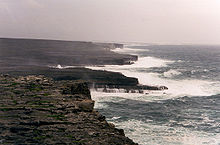
View of Inishmore coastline.
The islands have had an influence on world literature and arts disproportionate to their size. The unusual cultural and physical history of the islands has made them the object of visits by a variety of writers and travellers who recorded their experiences. Beginning around the late 19th Century, many Irish writers travelled to the Aran Islands;
Lady Gregory, for example, came to Aran in the late nineteenth century to learn
Irish. At the start of the 20th century and throughout his life one of Ireland's leading artists,
Seán Keating, spent time every year on the islands translating on to canvas all the qualities that make the inhabitants of these Atlantic Islands so unusual and in many respects remarkable.
Many wrote of their experiences in a personal vein, alternately casting them as narratives about finding, or failing to find, some essential aspect of Irish culture that had been lost to the more urban regions of Ireland. A second, related kind of visitor were those who attempted to collect and catalogue the stories and folklore of the island, treating it as a kind of societal "
time capsule" of an earlier stage of Irish culture. Visitors of this kind differed in their desires to integrate with the island culture, and most were content to be considered observers. The culmination of this mode of interacting with the island might well be
Robert J. Flaherty's 1934 classic documentary
Man of Aran.
One might consider
John Millington Synge's
The Aran Islands as a work that straddles these first two modes, it being both a personal account and also an attempt at preserving information about the pre- (or a-) literate Aran culture in literary form. The motivations of these visitors are exemplified by
W. B. Yeats' advice to Synge: "Go to the Aran Islands, and find a life that has never been expressed in literature."
[8]
In the second half of the twentieth century, up until perhaps the early 1970s, one sees a third kind of visitor to the islands. These visitors came not necessarily because of the uniquely "Irish" nature of the island community, but simply because the accidents of geography and history conspired to produce a society that some found intriguing or even beguiling and that they wished to participate in directly. At no time was there a single "Aran" culture: any description is necessarily incomplete and can be said to apply completely only to parts of the island at certain points in time. However, visitors that came and stayed were mainly attracted to aspects of Aran culture such as:
- Isolated from mainstream print and electronic media, and thus reliant primarily on local oral tradition for both entertainment and news.
- Rarely visited or understood by outsiders.
- Strongly influenced in its traditions and attitudes by the unusually savage weather of Galway Bay.
- In many parts characterised by subsistence, or near-subsistence, farming and fishing.
- Adapted to the absence of luxuries that many parts of the Western world had enjoyed for decades and in some cases, centuries.
For these reasons, the Aran Islands were "decoupled" from cultural developments that were at the same time radically changing other parts of Ireland and Western Europe. Though visitors of this third kind understood that the culture they encountered was intimately connected to that of Ireland, they were not particularly inclined to interpret their experience as that of "Irishness". Instead, they looked directly towards ways in which their time on the islands put them in touch with more general truths about life and human relations, and they often took pains to live "as an islander", eschewing help from friends and family at home. Indeed, because of the difficult conditions they found—dangerous weather, scarce food—they sometimes had little time to investigate the culture in the more detached manner of earlier visitors. Their writings are often of a more personal nature, being concerned with understanding the author's self as much as the culture around him.
This third mode of being in Aran died out in the late 1970s due in part to the increased tourist traffic and in part to technological improvements made to the island, that relegated the above aspects to history. A literary product of this third kind of visitor is
An Aran Keening, by Andrew McNeillie, who spent a year on Aran in 1968. Another,
Pádraig Ó Síocháin, a Dublin author and lawyer, learning to speak
Gaelic to the fluency of an islander became inextricably linked to the Aran
handknitters and their
Aran Sweaters, extensively promoting their popularity and sale around the world for nearly forty years.
A fourth kind of visitor to the islands, still prominent today, comes for spiritual reasons often connected to an appreciation for
Celtic Christianity or more modern
New Age beliefs, the former of which finds sites and landscapes of importance on the islands. Finally, there are many thousands of visitors who come for broadly
touristic reasons: to see the ruins, hear Irish spoken (and Irish music played) in the few pubs on the island, and to experience the often awe-inspiring geology of cliffs. Tourists today far outnumber visitors of the four kinds discussed above. Tourists and visitors of the fourth kind, however, are under-represented as creators of literature or art directly connected to the island; there are few ordinary "travelogues" of note, perhaps because of the small size of the islands, and there are no personal accounts written about Aran that are primarily concerned with spirituality. Tim Robinson's
Stones of Aran: Pilgrimage (1986) and
Stones of Aran: Labyrinth (1995), and his accompanying detailed map of the islands, are another resource on the Aran Islands. Robinson's work is an exhaustive, but not exhausting, survey of the Aran geography and its influence on Aran culture from the Iron Age up to recent times. Robinson also has written, and continues to write, about the Connemara region that faces the Aran Islands on the Galway mainland.
Island crafts[edit]

The wreck of the
Plassey sits on the shore of Inisheer, one of the Aran Islands. Fishing is a small but important part of the area's economy.
Aran Island sweater[edit]
Main article:
Aran sweater
The islands are the home of the
Aran sweater, which gained worldwide appeal during the course of the 20th century.
[9]
Many of the sweaters sold in the islands are made elsewhere in Ireland.
[10]
Aran currach[edit]
The (modern) Aran version of the lightweight boat called the
currach (
Aran Islands Dialect:
kørəx, korəx) is made from canvas stretched over a sparse skeleton of thin laths, then covered in
tar. It is designed to withstand the very rough seas that are typical of islands that face the open
Atlantic. Indeed, it is said that the Aran fishermen would not learn to swim, since they would certainly not survive any sea that swamped a currach and so it would be better to drown quickly. Despite the undoubted strength of these boats, they are very vulnerable to puncture.
The islanders were always totally self-sufficient. In calmer weather the currachs would go out and spend the night fishing under the
Cliffs of Moher, returning after dawn full with fish. Nowadays they are only used inshore, tending lobster-pots. More modern versions are still built for racing at the many local
regattas, or "Cruinnithe" up and down the west coast of Ireland during the summer months.
In popular culture[edit]
- John Millington Synge (J.M. Synge) wrote a book-length journal, The Aran Islands, completed in 1901 and published in 1907.
- The Aran Islands were mentioned in James Joyce's short story "The Dead" (1914) as a place where native Irish is spoken.
- The 1934 documentary film Man of Aran.
- Seamus Heaney's first book of poems, Death of a Naturalist (1966), contains a poem entitled "Lovers on Aran".
- The 1984 hit song "The Riddle" by Nik Kershaw includes the line, "Near a tree by a river there's a hole in the ground where an old man of Aran goes around and around."
- The Aran Islands featured in the television comedy Father Ted from 1995 to 1998, set on the fictional Craggy Island, with real local sights such as the shipwreck of the steam trawler Plassey in the opening sequence. The island of Inishmore hosted a Friends of Ted festival in 2007.
- The 1996 play, The Cripple of Inishmaan by Martin McDonagh, is set on the Aran Islands. The play is the first in The Aran Islands Trilogy, followed in 2001 by The Lieutenant of Inishmore, and the unpublished The Banshees of Inisheer.
- The 1997 romantic comedy The MatchMaker with Janeane Garofalo is partially set on the Aran Islands.
- The 2000 song "El Pozo de Aran" by Spanish Celtic musician Carlos Núñez, with lead vocals by Portuguese singer Anabela, is about a mother's pilgrimage to a holy well in the islands to heal her sickly child.
- The songs from the album "Man of Aran" by the group British Sea Power all relate to the Aran Islands


