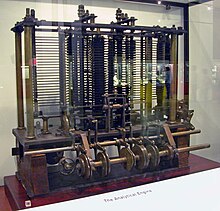
Trial model of a part of the Analytical Engine, built by Babbage, as displayed at the Science Museum (London)
[1]
It was first described in 1837 as the successor to Babbage's
difference engine, a design for a mechanical computer. The Analytical Engine incorporated an
arithmetic logic unit,
control flow in the form of
conditional branching and
loops, and integrated
memory, making it the first design for a general-purpose computer that could be described in modern terms as
Turing-complete.
[4][5] In other words, the logical structure of the Analytical Engine was essentially the same as that which has dominated computer design in the electronic era.
[6]
Babbage was never able to complete construction of any of his machines due to conflicts with his chief engineer and inadequate funding.
[7][8] It was not until the 1940s that
the first general-purpose computers were actually built, more than a century after Babbage had proposed the pioneering Analytical Engine in 1837.
[9]
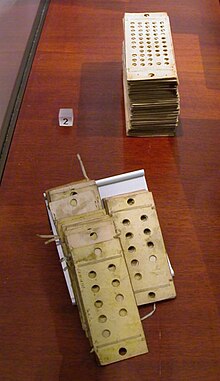
Two types of
punched cards used to program the machine. Foreground: "operational cards", for inputting
instigonometric functions by evaluating finite differences to create approximating
polynomials. Construction of this machine was never completed; Babbage had conflicts with his chief engineer,
Joseph Clement, and ultimately the British government withdrew its funding for the project.
[10][11]
During Babbage's
difference engine project, he realized that a much more general design, the Analytical Engine, was possible. The input (programs and data) was to be provided to the machine via
punched cards, a method being used at the time to direct mechanical
looms such as the
Jacquard loom. For output, the machine would have a printer, a curve plotter and a bell. The machine would also be able to punch numbers onto cards to be read in later. It employed ordinary
base-10 fixed-point arithmetic.
There was to be a store (that is, a memory) capable of holding 1,000 numbers of 40 decimal digits each (ca. 16.7
kB). An
arithmetical unit (the "mill") would be able to perform all four
arithmetic operations, plus comparisons and optionally
square roots. Initially it was conceived as a
difference engine curved back upon itself, in a generally circular layout,
[12] with the long store exiting off to one side. (Later drawings depict a regularized grid layout.)
[13] Like the
central processing unit (CPU) in a modern computer, the mill would rely upon its
own internal procedures, to be stored in the form of pegs inserted into rotating drums called "barrels", to carry out some of the more complex instructions the user's program might specify.
[7]
The programming language to be employed by users was akin to modern day
assembly languages. Loops and conditional branching were possible, and so the language as conceived would have been
Turing-complete as later defined by
Alan Turing. Three different types of punch cards were used: one for arithmetical operations, one for numerical constants, and one for load and store operations, transferring numbers from the store to the arithmetical unit or back. There were three separate readers for the three types of cards.
In 1842, the Italian mathematician
Luigi Menabrea, whom Babbage had met while travelling in Italy, wrote a description of the engine in French. In 1843, the description was translated into English and extensively annotated by
Ada King (née Byron), Countess of Lovelace, who had become interested in the engine eight years earlier. In recognition of her additions to Menabrea's paper, which included a way to calculate
Bernoulli numbers using the machine, she has been described as the first
computer programmer. The modern computer programming language
Ada is named in her honor.
Construction[edit]
Late in his life, Babbage sought ways to build a simplified version of the machine, and assembled a small part of it before his death in 1871.
[7]
In 1910, Babbage's son Henry Prevost Babbage reported that a part of the mill and the printing apparatus had been constructed, and had been used to calculate a (faulty) list of multiples of
pi. This constituted only a small part of the whole engine; it was not programmable and had no storage. (Popular images of this section have sometimes been mislabelled, implying that it was the entire mill or even the entire engine.) Henry Babbage's "Analytical Engine Mill" is on display at the Science Museum in London.
[14] Henry also proposed building a demonstration version of the full engine, with a smaller storage capacity: "perhaps for a first machine ten (columns) would do, with fifteen wheels in each".
[15] Such a version could manipulate 20 numbers of 25 digits each, and what it could be told to do with those numbers could still be impressive. "It is only a question of cards and time", wrote Henry Babbage in 1888, "... and there is no reason why (twenty thousand) cards should not be used if necessary, in an Analytical Engine for the purposes of the mathematician".
[15]
In 1991, the
London Science Museum built a complete and working specimen of Babbage's
Difference Engine No. 2, a design that incorporated refinements Babbage discovered during the development of the Analytical Engine.
[4] This machine was built using materials and
engineering tolerances that would have been available to Babbage, quelling the suggestion that Babbage's designs could not have been produced using the manufacturing technology of his time.
[16]
In October 2010,
John Graham-Cumming started a campaign to raise funds by "public subscription" to enable serious historical and academic study of Babbage's plans, with a view to then build and test a fully working virtual design which will then in turn enable construction of the physical Analytical Engine.
[17][18] As of October 2013, no actual construction had been reported.
Instruction set[edit]
Babbage is not known to have written down an explicit set of instructions for the engine in the manner of a modern processor manual. Instead he showed his programs as lists of states during their execution, showing what operator was run at each step with little indication of how the control flow would be guided. Bromley (see below) has assumed that the card deck could be read in forwards and backwards directions as a function of conditional branching after testing for conditions, which would make the engine Turing-complete:
The introduction for the first time, in 1845, of user operations for a variety of service functions including, most importantly, an effective system for user control of looping in user programs.
There is no indication how the direction of turning of the operation and variable cards is specified. In the absence of other evidence I have had to adopt the minimal default assumption that both the operation and variable cards can only be turned backward as is necessary to implement the loops used in Babbage’s sample programs. There would be no mechanical or microprogramming difficulty in placing the direction of motion under the control of the user.
From Bromley, A.G. Babbage's Analytical Engine Plans 28 and 28a. The programmer's interface. Annals of the History of Computing, IEEE. 2000
In their emulator of the engine,
Fourmilab say:
The Engine's Card Reader is not constrained to simply process the cards in a chain one after another from start to finish. It can, in addition, directed by the very cards it reads and advised by the whether the Mill's run-up lever is activated, either advance the card chain forward, skipping the intervening cards, or backward, causing previously-read cards to be processed once again.
This emulator does provide a written symbolic instruction set, though this has been constructed by its authors rather than based on Babbage's original works. For example a factorial program would be written as:
N0 6
N1 1
N2 1
×
L1
L0
S1
-
L0
L2
S0
L2
L0
CB?11
where the CB is the conditional branch instruction or "combination card' used to make the control flow jump, in this case backwards by 11 cards.
Influence[edit]
Predicted influence[edit]
Babbage understood that the existence of an automatic computer would kindle interest in the field now known as
algorithmic efficiency, writing in his
Passages from the Life of a Philosopher, "As soon as an Analytical Engine exists, it will necessarily guide the future course of the science. Whenever any result is sought by its aid, the question will then arise—By what course of calculation can these results be arrived at by the machine in the
shortest time?"
[19]
Computer science[edit]
Swedish engineers
Georg and Edvard Scheutz, inspired by a description of the difference engine, created a mechanical calculation device based on the design in 1853. Table-sized instead of room-sized, the device was capable of calculating tables, but imperfectly.
[8][20]
From 1872 Henry continued diligently with his father's work and then intermittently in retirement in 1875.
[21] Percy Ludgate wrote about the engine in 1915 and even designed his own Analytical Engine (it was drawn up in detail, but never built). Ludgate's engine would be much smaller than Babbage's of about 8 cubic feet (230 L), and hypothetically would be capable of multiplying two 20-decimal-digit numbers in about six seconds.
Despite this ground work, Babbage's work fell into historical obscurity, and the Analytical Engine was unknown to builders of electro-mechanical and electronic computing machines in the 1930s and 1940s when they began their work, resulting in the need to re-invent many of the architectural innovations Babbage had proposed.
Howard Aiken, who built the quickly-obsoleted electromechanical calculator, the
Harvard Mark I, between 1937 and 1945, praised Babbage's work likely as a way of enhancing his own stature, but knew nothing of the Analytical Engine's architecture during the construction of the Mark I, and considered his visit to the constructed portion of the Analytical Engine "the greatest disappointment of my life".
[22] The Mark I showed no influence from the Analytical Engine and lacked the Analytical Engine's most prescient architectural feature,
conditional branching.
[23] J. Presper Eckert and
John W. Mauchly similarly were not aware of the details of Babbage's Analytical Engine work prior to the completion of their design for the first electronic general-purpose computer, the
ENIAC.
[24][25]

Comparison to other early computers[edit]
If the Analytical Engine had been built, it would have been
digital,
programmable and
Turing-complete. It would, however, have been very slow.
Ada Lovelace reported in her notes on the Analytical Engine: "Mr. Babbage believes he can, by his engine, form the product of two numbers, each containing twenty figures, in three minutes". By comparison the
Harvard Mark I could perform the same task in just six seconds. A modern PC can do the same thing in well under a millionth of a second. It should be noted however, that the Analytical Machine was described by Babbage more than one hundred years before any of the aforementioned computational devices and therefore, it is no surprise that it was much slower.

In popular culture[edit]
- The cyberpunk novelists William Gibson and Bruce Sterling co-authored a steampunk novel of alternative history titled The Difference Engine in which Babbage's Difference and Analytical Engines became available to Victorian society. The novel explores the consequences and implications of the early introduction of computational technology.
- There is also mention of the Analytical Engine (or the Clockwork Ouroboros as it is also known there) in The Book of the War, a Faction Paradox anthology edited byLawrence Miles. This machine was used to calculate a way into the "Eleven Day Empire". Its use resulted in the destruction of the original Houses of Parliament.
- In the novel Perdido Street Station, by British author China Miéville, engines similar to Babbage's serve as "brains" for the robotic constructs of the city of New Crobuzon. One such engine even develops sentient thought due to a recursive algorithmic loop.
- The British Empire of The Peshawar Lancers by S. M. Stirling features a massive water-powered analytical engine at Oxford, used by two of the main characters. It is noted that most of the engines run on steam, and that an even larger one is under construction at the British Capital in Delhi.
- In the Michael Flynn novel In the Country of the Blind, a secret society calling itself the Babbage Society secretly financed the building of Babbage Engines in the mid-19th century. In the novel, the Society uses the Babbage engines along with a statistical science called Cliology to predict and manipulate future history. In the process, they predict the rise of the Nazis and accidentally start the US Civil War.
- In the Neal Stephenson novel The Diamond Age, ubiquitous molecular nanotechnology is described to make use of "rod logic" similar to that imagined by Babbage's design for the Analytical Engine.
- Moriarty by Modem, a short story by Jack Nimersheim, describes an alternate history where Babbage's Analytical Engine was indeed completed and had been deemed highly classified by the British government. The characters of Sherlock Holmes and Moriarty had in reality been a set of prototype programs written for the Analytical Engine. This short story follows Holmes as his program is rebooted on modern computers and he is forced to compete against his nemesis yet again in the modern counterparts of Babbage's Analytical Engine.[29]
- A similar setting is used by Sydney Padua in the webcomic The Thrilling Adventures of Lovelace and Babbage.[30][31] It features a pocket universe where Ada Lovelace and Babbage have built the Analytical Engine and use it to fight crime at Queen Victoria's request.[32] The comic is based on thorough research on the biographies and correspondence between Babbage and Lovelace, which is then twisted for humorous effect.
- Georgia on My Mind is a novelette by Charles Sheffield which involves two major themes: being widowed and the quest for a legendary Babbage computer.
- Hugh Cook's fantasy novels The Wishstone and the Wonderworkers and The Wazir and the Witch feature an Analytical Engine created by the scientist Ivan Petrov. It is used to calculate income tax.
- The Orion's Arm online project features the Machina Babbagenseii, fully sentient Babbage inspired mechanical computers. Each is the size of a large asteroid, only capable surviving in microgravity conditions, and processes data at 0.5% the speed of a human brain.[33]
- The flying ships in the anime Last Exile are seen to have analytical engines inside of them. Although some have more advanced technology, the common ships use analytical engines, and even some of the advanced ships are seen to have clockwork mechanisms as well.
- A working version of the Analytical Engine, created by fictional inventor Ernest Harding (and based on the Babbage concept) was featured on the Murdoch Mysteries (also called The Artful Detective), in Season 5, Episode 9, Invention Convention.[34]


.jpg)


