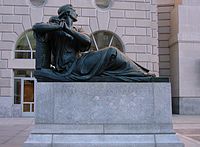
Monument honoring the right to worship, Washington, D.C.
Legal and public foundation[edit]
Colonial precedents[edit]
Freedom of religion was first applied as a principle in the founding of the colony of Maryland, also founded by the Catholic
Lord Baltimore, in 1634.
[3] Fifteen years later (1649), the first enactment of religious liberty, the
Maryland Toleration Act, drafted by Lord Baltimore, provided: "No person or persons...shall from henceforth be any waies troubled, molested or discountenanced for or in respect of his or her religion nor in the free exercise thereof." The Maryland Toleration Act was repealed with the assistance of Protestant assemblymen and a new law barring Catholics from openly practicing their religion was passed.
[4] In 1657, Lord Baltimore regained control after making a deal with the colony's Protestants, and in 1658 the Act was again passed by the colonial assembly. This time, it would last more than thirty years, until 1692,
[5] when after Maryland's
Protestant Revolution of 1689, freedom of religion was again rescinded.
[3][6] In addition in 1704, an Act was passed "to prevent the growth of Popery in this Province", preventing Catholics from holding political office.
[6] Full religious toleration would not be restored in Maryland until the
American Revolution, when Maryland's
Charles Carroll of Carrollton signed the
American Declaration of Independence.
Rhode Island (1636),
Connecticut (1636),
New Jersey, and
Pennsylvania (1682), founded by Baptist
Roger Williams, Congregationalist
Thomas Hooker, and Quaker
William Penn, respectively, combined religious freedom with the democratic form of government that Separatist
Congregationalists (
Pilgrim Fathers) and
Puritans had developed in
Plymouth Colony (1620) and
Massachusetts Bay Colony (1628).
[7][8][9][10][11] These colonies became safe havens for persecuted religious minorities. Catholics and Jews also had full citizenship and free exercise of their faiths.
[12][13][14] Williams, Hooker, Penn, and their friends were firmly convinced that democracy and freedom of conscience were the will of God. Williams gave the most profound theological reason: As
faith is the free gift of the
Holy Spirit, it cannot be forced upon a person. Therefore, strict
separation of church and state has to be kept.
[15] Pennsylvania was the only colony that retained unlimited religious freedom until the foundation of the United States. The inseparable connection of
democracy, freedom of religion, and the other forms of freedom became the political and legal basis of the new nation. In particular,
Baptists and
Presbyterians demanded vigorously and successfully the
disestablishment of the
Anglican and Congregational
state churches that had existed in most colonies since the seventeenth century.
[16]
The First Amendment[edit]
Congress shall make no law respecting an establishment of religion, or prohibiting the free exercise thereof; or abridging the freedom of speech, or of the press; or the right of the people peaceably to assemble, and to petition the Government for a redress of grievances.
The "
Establishment Clause," stating that "Congress shall make no law respecting an establishment of religion," is generally read to prohibit the Federal government from establishing a national church ("religion") or excessively involving itself in religion, particularly to the benefit of one religion over another. Following the ratification of the
Fourteenth Amendment to the United States Constitution and through the doctrine of
incorporation, this restriction is held to be applicable to state governments as well.
The "
Free Exercise Clause" states that Congress cannot "prohibit the free exercise" of religious practices. The
Supreme Court of the United States has consistently held, however, that the right to free exercise of religion is not absolute. For example, in the 19th century, some of the members of
The Church of Jesus Christ of Latter-day Saintstraditionally practiced
polygamy, yet in
Reynolds v. United States (1879), the Supreme Court upheld the criminal conviction of one of these members under a federal law banning polygamy. The Court reasoned that to do otherwise would set precedent for a full range of religious beliefs including those as extreme as human sacrifice. The Court stated that "
Laws are made for the government of actions, and while they cannot interfere with mere religious belief and opinions, they may with practices." For example, if one were part of a religion that believed in
vampirism, the First Amendment would protect one's belief in vampirism, but not the practice.
The Fourteenth Amendment[edit]
The
Fourteenth Amendment to the United States Constitution guarantees the religious civil rights.
[17] Whereas the First Amendment secures the free exercise of religion, section one of the Fourteenth Amendment prohibits discrimination, including on the basis of religion, by securing "the equal protection of the laws" for every person:
| “ | All persons born or naturalized in the United States, and subject to the jurisdiction there of, are citizens of the United States and of the State where in they reside. No state shall make or enforce any law which shall abridge the privileges or immunities of citizens of the United States; nor shall any State deprive any person of life, liberty, or property, without due process of law; nor deny to any person within its jurisdiction the equal protection of the laws. | ” |
Religious tests[edit]
The affirmation or denial of specific religious beliefs had, in the past, been made into qualifications for public office; however, the
United States Constitution states that the inauguration of a President may include an "affirmation" of the faithful execution of his duties rather than an "oath" to that effect — this provision was included in order to respect the religious prerogatives of the
Quakers, a
Protestant Christian denomination that declines the swearing of
oaths. The U.S. Constitution also provides that "No religious Test shall ever be required as a Qualification of any Office or public Trust under the United States." Several states have language included in their constitutions that requires state office-holders to have particular religious beliefs.
[18] These include
Arkansas,
[19] Maryland,
[19] Massachusetts,
[20] North Carolina,
[20] Pennsylvania,
[20] South Carolina,
[20]Tennessee,
[20] and
Texas.
[20][21] Some of these beliefs (or oaths) were historically required of jurors and witnesses in court. Even though they are still on the books, these provisions have been rendered unenforceable by
U.S. Supreme Court decisions.
[18]
With reference to the use of animals, the U.S. Supreme Court decision in the case of the
Church of Lukumi Babalu Aye v. City of Hialeah in 1993 upheld the right of Santeria adherents to practice ritual animal sacrifice with Justice Anthony Kennedy stating in the decision, “religious beliefs need not be acceptable, logical, consistent or comprehensible to others in order to merit First Amendment protection”. (quoted by Justice Kennedy from the opinion by Justice Burger in
Thomas v. Review Board of the Indiana Employment Security Division 450
U.S. 707 (1981))
[22] Likewise in Texas in 2009, issues that related to
animal sacrifice and
animal rights were taken to the
5th U.S. Circuit Court of Appealsin the case of
Jose Merced, President Templo Yoruba Omo Orisha Texas, Inc., v. City of Euless. The court ruled that the free exercise of religion was meritorious and prevailing and that Merced was entitled under the Texas Religious Freedom and Restoration Act (TRFRA) to an injunction preventing the city of
Euless, Texas from enforcing its ordinances that burdened his religious practices relating to the use of animals.
[23]
The "wall of separation"[edit]
Thomas Jefferson wrote that the First Amendment erected a "
wall of separation between church and state" likely borrowing the language from
Roger Williams, founder of the
First Baptist Church in America and the Colony of Rhode Island, who used the phrase in his 1644 book,
The Bloody Tenent of Persecution.
[24] James Madison, often regarded as the "Father of the Bill of Rights",
[25] also often wrote of the "perfect separation",
[26] "line of separation",
[27] "strongly guarded as is the separation between religion and government in the Constitution of the United States",
[28] and "total separation of the church from the state".
[29] Controversy rages in the United States between those who wish to restrict government involvement with religious institutions and remove religious references from government institutions and property, and those who wish to loosen such prohibitions. Advocates for stronger
separation of church and state emphasize the plurality of faiths and non-faiths in the country, and what they see as broad guarantees of the
federal Constitution. Their opponents emphasize what they see as the largely Christian heritage and history of the nation (often citing the references to "Nature's God" and the "Creator" of men in the
Declaration of Independence). Some more socially conservative Christian sects, such as the Christian Reconstructionist movement, oppose the concept of a "wall of separation" and prefer a closer relationship between church and state.
Problems also arise in U.S. public schools concerning the teaching and display of religious issues. In various counties,
school choice and
school vouchers have been put forward as solutions to accommodate variety in beliefs and freedom of religion, by allowing individual school boards to choose between a secular, religious or multi-faith vocation, and allowing parents free choice among these schools. Critics of American voucher programs claim that they take funds away from public schools, and that the amount of funds given by vouchers is not enough to help many middle and working class parents.
U.S. judges often ordered alcoholic defendants to attend
Alcoholics Anonymous or face imprisonment. However, in 1999, a federal appeals court ruled this unconstitutional because the A.A. program relies on submission to a "Higher Power".
[30]
Thomas Jefferson also played a large role in the formation of freedom of religion. He created the
Virginia Statute for Religious Freedom, which has since been incorporated into the Virginia State Constitution.
Other statements[edit]
Unalienable rights[edit]
We hold these truths to be self-evident: That all men are created equal; that they are endowed by their Creator with certain unalienable rights; that among these are life, liberty, and the pursuit of happiness; that, to secure these rights, governments are instituted among men, deriving their just powers from the consent of the governed;
(based on Thomas Jefferson's draft.)
Religious institutions[edit]
- “Religious Liberty shall be interpreted to include freedom to worship according to conscience and to bring up children in the faith of their parents; freedom for the individual to change his religion; freedom to preach, educate, publish and carry on missionary activities; and freedom to organize with others, and to acquire and hold property, for these purposes.”[32]
Freedom of religion restoration[edit]
Following increasing government involvement in religious matters, Congress passed the 1993
Religious Freedom Restoration Act.
[33] A number of states then passed corresponding acts (e.g., Missouri passed the Religious Freedom Restoration Act).
[34]
Treaty of Tripoli[edit]
Signed on November 4, 1796, the
Treaty of Tripoli was a document that included the following statement:
As the Government of the United States of America is not, in any sense, founded on the Christian religion; as it has in itself no character of enmity against the laws, religion, or tranquility, of Mussulmen [Muslims]; and as the said States never entered into any war or act of hostility against any Mahometan [Mohammedan] nation, it is declared by the parties that no pretext arising from religious opinions shall ever produce an interruption of the harmony existing between the two countries.
This treaty was submitted to the Senate and was ratified unanimously on June 7, 1797, and then signed by President John Adams on June 10, 1797. In accordance with
Article VIof the Constitution, on that date this treaty became incorporated as part of "the supreme Law of the Land".
Supreme Court rulings[edit]
Jehovah's Witnesses[edit]
Since the 1940s, the Jehovah's Witnesses have often invoked the First Amendment's freedom of religion clauses to protect their ability to engage in the proselytizing (or preaching) that is central to their faith. This series of litigation has helped to define civil liberties case law in the United States and Canada.
In the United States of America and several other countries, the legal struggles of the Jehovah's Witnesses have yielded some of the most important judicial decisions regarding
freedom of religion,
press and
speech. In the
United States, many
Supreme Court cases involving Jehovah's Witnesses are now landmark decisions of
First Amendment law. Of the 72 cases involving the Jehovah's Witnesses that have been brought before the U.S. Supreme Court, the Court has ruled in favor of them 47 times. Even the cases that the Jehovah's Witnesses lost helped the U.S. to more clearly define the limits of First Amendment rights. Former Supreme Court Justice
Harlan Stone jokingly suggested "The Jehovah's Witnesses ought to have an endowment in view of the aid which they give in solving the legal problems of civil liberties." "Like it or not," observed American author and editor Irving Dilliard, "Jehovah's Witnesses have done more to help preserve our freedoms than any other religious group."
Professor C. S. Braden wrote: "They have performed a signal service to democracy by their fight to preserve their civil rights, for in their struggle they have done much to secure those rights for every minority group in America."
[35]
"The cases that the Witnesses were involved in formed the bedrock of 1st Amendment protections for all citizens," said Paul Polidoro, a lawyer who argued the Watchtower Society's case before the Supreme Court in February 2002. "These cases were a good vehicle for the courts to address the protections that were to be accorded free speech, the free press and free exercise of religion. In addition, the cases marked the emergence of individual rights as an issue within the U.S. court system.
However, the cases brought before the Court by the Jehovah's Witnesses allowed the Court to consider a range of issues: mandatory flag salute, sedition, free speech, literature distribution and military draft law. These cases proved to be pivotal moments in the formation of
constitutional law. Jehovah’s Witnesses’ court victories have strengthened rights including the protection of religious conduct from federal and state interference, the right to abstain from patriotic rituals and military service and the right to engage in public discourse.
During the World War II era, the U.S. Supreme Court ruled in favor of Jehovah's Witnesses in several landmark cases that helped pave the way for the modern civil rights movement. In all, Jehovah's Witnesses brought 23 separate First Amendment actions before the U.S. Supreme Court between 1938 and 1946.
Lemon test[edit]
The
Supreme Court has consistently held fast to the rule of strict separation of church and state when matters of prayer are involved. In
Engel v. Vitale (1962) the Court ruled that government-imposed nondenominational prayer in public school was unconstitutional. In
Lee v. Weisman (1992), the Court ruled prayer established by a school principal at a middle school graduation was also unconstitutional, and in
Santa Fe Independent School Dist. v. Doe (2000) it ruled that school officials may not directly impose student-led prayer during high school football games nor establish an official student election process for the purpose of indirectly establishing such prayer. The distinction between force of government and individual liberty is the cornerstone of such cases. Each case restricts acts by government designed to establish prayer while explicitly or implicitly affirming students' individual freedom to pray.
The Court has therefore tried to determine a way to deal with church/state questions. In
Lemon v. Kurtzman (1971), the Court created a three-part test for laws dealing with religious establishment. This determined that a law was constitutional if it:
- Had a secular purpose
- Neither advanced nor inhibited religion
- Did not foster an excessive government entanglement with religion.
Some examples of where inhibiting religion has been struck down:
- In Widmar v. Vincent, 454 U.S. 263 (1981), the Court ruled that a Missouri law prohibiting religious groups from using state university grounds and buildings for religious worship was unconstitutional. As a result, Congress decided in 1984 that this should apply to secondary and primary schools as well, passing the Equal Access Act, which prevents public schools from discriminating against students based on "religious, political, philosophical or other content of the speech at such meetings". In Board of Education of Westside Community Schools v. Mergens, 496 U.S. 226, 236 (1990), the Court upheld this law when it ruled that a school board's refusal to allow a Christian Bible club to meet in a public high school classroom violated the act.
- In Good News Club v. Milford Central School, 533 U.S. 98 (2001), the Court ruled that religious groups must be allowed to use public schools after hours if the same access is granted to other community groups.
- In Rosenberger v. Rector and Visitors of the University of Virginia, 515 U.S. 819 (1995), the Supreme Court found that the University of Virginia was unconstitutionally withholding funds from a religious student magazine.
State constitutions[edit]

A Christian flag displayed alongside the flag of the
USA next to the pulpit in a church in California. Note the eagle and cross
finials on the flag poles.
Under the doctrine of
Incorporation, the first amendment has been made applicable to the states. Therefore, the states must guarantee the freedom of religion in the same way the federal government must.
Many states have freedom of religion established in their constitution, though the exact legal consequences of this right vary for historical and cultural reasons. Most states interpret "freedom of religion" as including the freedom of long-established
religious communities to remain intact and not be destroyed. By extension,
democracies interpret "freedom of religion" as the right of each individual to freely choose to
convert from one religion to another,
mix religions, or
abandon religion altogether.
In office and at work[edit]
Requirements for holding a public office[edit]
Issues at the workplace[edit]
Problems sometimes arise in the workplace concerning religious observance when a private employer discharges an employee for failure to report to work on what the employee considers a
holy day or a day of rest. In the United States, the view that has generally prevailed is that firing for any cause in general renders a former employee ineligible for unemployment compensation, but that this is no longer the case if the 'cause' is religious in nature, especially an employee's unwillingness to work during
Jewish Shabbat,
Christian Sabbath, or
Muslim jumu'ah.
After reports in August 2010 that soldiers who refused to attend a Christian band's concert at a Virginia military base were essentially punished by being banished to their barracks and told to clean them up, an Army spokesman said that an investigation was underway and "If something like that were to have happened, it would be contrary to Army policy."
[46][47]
Situation of minority groups[edit]
Situation of Catholics[edit]

Famous 1876 editorial cartoon by
Thomas Nast showing bishops as
crocodiles attacking public schools, with the connivance of Irish Catholic politicians
John Highham described anti-Catholicism as "the most luxuriant, tenacious tradition of paranoiac agitation in American history".
[48] Anti-Catholicism which was prominent in the United Kingdom was exported to the
United States. Two types of anti-Catholic rhetoric existed in colonial society. The first, derived from the heritage of the Protestant Reformation and the
religious wars of the 16th century, consisted of the "Anti-Christ" and the "Whore of Babylon" variety and dominated Anti-Catholic thought until the late 17th century. The second was a more secular variety which focused on the supposed intrigue of the Catholics intent on extending medieval despotism worldwide.
[49]
Because many of the British colonists, such as the
Puritans and
Congregationalists, were fleeing religious persecution by the Church of England, much of early American religious culture exhibited the more extreme anti-Catholic bias of these Protestant denominations. Monsignor
John Tracy Ellis wrote that a "universal anti-Catholic bias was brought to Jamestown in 1607 and vigorously cultivated in all the thirteen colonies from
Massachusetts to
Georgia."
[51] Colonial charters and laws contained specific proscriptions against Roman Catholics. Monsignor Ellis noted that a common hatred of the Roman Catholic Church could unite
Anglican clerics and Puritan ministers despite their differences and conflicts.
Some of America's
Founding Fathers held anti-clerical beliefs. For example, in 1788,
John Jay urged the
New York Legislature to require office-holders to renounce foreign authorities "in all matters ecclesiastical as well as civil.".
[52] Thomas Jefferson wrote: "History, I believe, furnishes no example of a priest-ridden people maintaining a free civil government,"
[53] and, "In every country and in every age, the priest has been hostile to liberty. He is always in alliance with the
despot, abetting his abuses in return for protection to his own."
[54]
Some states devised
loyalty oaths designed to exclude Catholics from state and local office.
[55] The public support for American independence and the
First Amendment of the U.S. Constitution by prominent American Catholics like
Charles Carroll of Carrollton, the only Catholic signer of the Declaration of Independence, and his second cousins, Bishop
John Carroll and
Daniel Carroll, allowed Roman Catholics to be included in the constitutional protections of civil and religious liberty.
[56]
Anti-Catholic animus in the United States reached a peak in the 19th century when the Protestant population became alarmed by the influx of Catholic immigrants. Some American Protestants, having an increased interest in prophecies regarding the end of time, claimed that the Catholic Church was the
Whore of Babylon in the Book of Revelation.
[57] The resulting "nativist" movement, which achieved prominence in the 1840s, was whipped into a frenzy of anti-Catholicism that led to mob violence, the burning of Catholic property, and the killing of Catholics.
[58] This violence was fed by claims that Catholics were destroying the culture of the United States. The nativist movement found expression in a national political movement called the
Know-Nothing Party of the 1850s, which (unsuccessfully) ran former president
Millard Fillmore as its presidential candidate in 1856.
The founder of the Know-Nothing movement,
Lewis C. Levin, based his political career entirely on anti-Catholicism, and served three terms in the U.S. House of Representatives (1845–1851), after which he campaigned for Fillmore and other "nativist" candidates.
After 1875 many states passed constitutional provisions, called "
Blaine Amendments, forbidding tax money be used to fund parochial schools.
[59][60] In 2002, the
United States Supreme Court partially vitiated these amendments, when they ruled that vouchers were constitutional if tax dollars followed a child to a school, even if it were religious.
[61]
Anti-Catholicism was widespread in the 1920s; anti-Catholics, including the Ku Klux Klan, believed that Catholicism was incompatible with democracy and that parochial schools encouraged separatism and kept Catholics from becoming loyal Americans. The Catholics responded to such prejudices by repeatedly asserting their rights as American citizens and by arguing that they, not the nativists (anti-Catholics), were true patriots since they believed in the right to freedom of religion.
[62]
The 1928 presidential campaign of
Al Smith was a rallying point for the Klan and the tide of anti-Catholicism in the U.S. The Catholic
Church of the Little Flower was first built in 1925 in
Royal Oak, Michigan, a largely Protestant area. Two weeks after it opened, the Ku Klux Klan burned a cross in front of the church.
[63] The church burned down in a fire in 1936.
[64] In response, the church built a fireproof crucifixion tower, as a "cross they could not burn".
[65]
In 1922, the voters of
Oregon passed an
initiative amending
Oregon Law Section 5259, the Compulsory Education Act. The law unofficially became known as the Oregon School Law. The citizens' initiative was primarily aimed at eliminating
parochial schools, including Catholic schools.
[66] The law caused outraged Catholics to organize locally and nationally for the right to send their children to Catholic schools. In
Pierce v. Society of Sisters (1925), the United States Supreme Court declared the Oregon's Compulsory Education Act unconstitutional in a ruling that that has been called "the Magna Carta of the parochial school system."
In 1928,
Al Smith became the first Roman Catholic to gain a major party's nomination for President, and his religion became an issue during the
campaign. Many Protestants feared that Smith would take orders from church leaders in Rome in making decisions affecting the country.
A key factor that hurt
John F. Kennedy in his
1960 campaign for the presidency of the United States was the widespread prejudice against his Roman Catholic religion; some
Protestants, including
Norman Vincent Peale, believed that, if he were elected President, Kennedy would have to take orders from the
Pope in Rome.
[67] To address fears that his Roman Catholicism would impact his decision-making,
John F. Kennedy famously told the Greater Houston Ministerial Association on September 12, 1960, "I am not the Catholic candidate for President. I am the Democratic Party's candidate for President who also happens to be a Catholic. I do not speak for my Church on public matters — and the Church does not speak for me."
[68] He promised to respect the separation of church and state and not to allow Catholic officials to dictate public policy to him. Kennedy also raised the question of whether one-quarter of Americans were relegated to second-class citizenship just because they were Catholic.
Kennedy went on to win the national popular vote over
Richard Nixon by just one tenth of one percentage point (0.1%) – the closest popular-vote margin of the 20th century. In the
electoral college, Kennedy's victory was larger, as he took 303 electoral votes to Nixon's 219 (269 were needed to win).
The New York Times, summarizing the discussion late in November, spoke of a “narrow consensus” among the experts that Kennedy had won more than he lost as a result of his Catholicism,
[69] as Catholics flocked to Kennedy to demonstrate their group solidarity in demanding political equality.
Situations of the Latter Day Saint movement 1820–90[edit]
Main article:
Anti-Mormonism
Historically, the
Latter Day Saint movement, which is often called
Mormonism, has been the victim of
religious violence beginning with reports by founder
Joseph Smithimmediately after his
First Vision 1820
[70] and continuing as the movement grew and migrated from its inception in western
New York to
Ohio,
Missouri, and
Illinois. The violence culminated when Smith was
assassinated by a mob of 200 men in
Carthage Jail in 1844. Joseph Smith had surrendered himself previously to the authorities, who failed to protect him. As a result of the violence they were faced with in
the East, the
Mormon pioneers, led by
Brigham Young, migrated westwards and eventually founded
Salt Lake City, and many other communities along the
Mormon Corridor.
Smith and his followers experienced relatively low levels of persecution in New York and Ohio,
[71][clarification needed] although one incident involved church members being
tarred and feathered.
[72] They would eventually move on to Missouri, where some of the worst atrocities against Mormons would take place. Smith declared the area around
Independence, Missouri to be the site of
Zion, inspiring a massive influx of Mormon converts. Locals, alarmed by rumors of the strange, new religion (including rumors of polygamy),
[citation needed] attempted to drive the Mormons out. This resulted in the
1838 Mormon War, the
Haun's Mill massacre, and the issue of the
Missouri Executive Order 44by Governor
Lilburn Boggs, which ordered "
... Mormons must be treated as enemies, and must be exterminated or driven from the state ...".
[73] The majority of Mormons would flee to Illinois, where they were received warmly by the village of Commerce, Illinois. The Mormons quickly expanded the town and renamed it
Nauvoo, which was one of the largest cities in Illinois at the time.
[74] The economic, political, and religious dominance of the Mormons (Smith was mayor of the city and commander of the local militia, the
Nauvoo Legion) inspired mobs to attack the city, and Smith was arrested for ordering the destruction of an anti-Mormon newspaper, the
Nauvoo Expositor, although he acted with the consent of the city council.
[75] He was imprisoned, along with his brother
Hyrum Smith, at Carthage Jail, where they were attacked by a mob and murdered.
After a
succession crisis, most of the Mormons united under
Brigham Young, who organized an evacuation from Nauvoo and from the United States itself after the federal government refused to protect the Mormons.
[76] Young and an eventual 50,000–70,000 would cross the
Great Plains to settle in the
Salt Lake Valley and the surrounding area. After the events of the
Mexican-American War, the area became a
United States territory. Young immediately petitioned for the addition of the
State of Deseret, but the federal government declined. Instead, Congress carved out the much smaller
Utah Territory. Over the next 46 years, several actions of the federal government were directed at Mormons, specifically to curtail the practice of polygamy and to reduce their political and economic power. These included the
Utah War,
Morrill Anti-Bigamy Act,
Poland Act,
Edmunds Act, and
Edmunds-Tucker Act. In 1890, LDS Church
president Wilford Woodruff issued the
Manifesto, ending polygamy.
With the concept of
plural marriage, from 1830 to 1890 the Mormon faith allowed its members to practice
polygamy; after 1843 this was limited to
polygyny (one man could have several wives). The notion of polygamy was not only generally disdained by most of Joseph Smith's contemporaries,
[77] it is also contrary to the traditional
Christian understanding of marriage. After 1844 the United States government passed legislation aimed specifically at the Mormon practice of
polygamy until
The Church of Jesus Christ of Latter-day Saints (LDS Church) officially renounced it. In the case of
Reynolds v. United States, the U.S. supreme court concluded that "religious duty" was not a suitable defense to an indictment for polygamy; therefore, a law against polygamy is not legally considered to
discriminate against a religion that endorses polygamy. When their appeals to the courts and lawmakers were exhausted and once church leaders were satisfied that God had accepted what they saw as their sacrifice for the principle, the prophet leader of the church announced that he had received inspiration that God had accepted their obedience and rescinded the commandment for plural marriage. In 1890, an
official declaration was issued by the church prohibiting further plural marriages.
[78] Utah was admitted to the Union on January 4, 1896.
Situation of Native Americans[edit]
With the practice of the
Americanization of Native Americans, Native American children were
sent to Christian boarding schools where they were forced to worship as Christians and traditional customs were banned.
[79] Until the Freedom of Religion Act 1978, "spiritual leaders [of Native Americans] ran the risk of jail sentences of up to 30 years for simply practicing their rituals."
[80] The traditional
indigenous Sun Dance was illegal from the 1880s (Canada) or 1904 (USA) to the 1980s.
Continuing charges of religious discrimination have largely centered on the
eagle feather law, the use of ceremonial
peyote, and the
repatriation of Native American human remains and cultural and religious objects:
- The eagle feather law, which governs the possession and religious use of eagle feathers, was written with the intention to protect then dwindling eagle populations on one hand while still protecting traditional Native American spiritual and religious customs, to which the use of eagle feather is central, on the other hand. As a result, the possession of eagle feathers is restricted to ethnic Native Americans, a policy that is seen as controversial for several reasons.
- Peyote, a spineless cactus found in the desert southwest and Mexico, is commonly used in certain traditions of Native American religion and spirituality, most notably in theNative American Church. Prior to the passage of the American Indian Religious Freedom Act (AIRFA) in 1978, and as amended in 1994, the religious use of peyote was not afforded legal protection. This resulted in the arrest of many Native Americans and non-Native Americans participating in traditional indigenous religion and spirituality.
- Native Americans often hold strong personal and spiritual connections to their ancestors and often believe that their remains should rest undisturbed. This has often placed Native Americans at odds with archaeologists who have often dug on Native American burial grounds and other sites considered sacred, often removing artifacts and human remains – an act considered sacrilegious by many Native Americans. For years, Native American communities decried the removal of ancestral human remains and cultural and religious objects, charging that such activities are acts of genocide, religious persecution, and discrimination. Many Native Americans called on the government, museums, and private collectors for the return of remains and sensitive objects for reburial. The Native American Graves Protection and Repatriation Act (NAGPRA), which gained passage in 1990, established a means for Native Americans to request the return or "repatriation" of human remains and other sensitive cultural, religious, and funerary items held by federal agencies and federally assisted museums and institutions.
Situation of atheists[edit]
A 2006 study at the
University of Minnesota showed atheists to be the most distrusted minority among Americans. In the study,
sociologists Penny Edgell, Joseph Gerties and Douglas Hartmann conducted a survey of American public opinion on attitudes towards different groups. 40% of respondents characterized atheists as a group that "does not at all agree with my vision of American society", putting atheists well ahead of every other group, with the next highest being Muslims (26%) and
homosexuals (23%). When participants were asked whether they agreed with the statement, "I would disapprove if my child wanted to marry a member of this group," atheists again led minorities, with 48% disapproval, followed by Muslims (34%) and
African-Americans (27%).
[81][82] Joe Foley, co-chairman for Campus Atheists and Secular Humanists, commented on the results, "I know atheists aren't studied that much as a sociological group, but I guess atheists are one of the last groups remaining that it's still socially acceptable to hate."
[83]
Several private organizations, the most notable being the
Boy Scouts of America, do not allow atheist members.
[84] However, this policy has come under fire by organizations who assert that the Boy Scouts of America do benefit from taxpayer money and thus cannot be called a truly private organization, and thus must admit atheists, and others currently barred from membership. An organization called
Scouting for All, founded by
Eagle Scout Steven Cozza, is at the forefront of the movement.
Court cases[edit]
In
Elk Grove Unified School District v. Newdow, after atheist
Michael Newdow challenged the phrase "under God" in the United States
Pledge of Allegiance, the
Ninth Circuit Court of Appeals found the phrase unconstitutional. Although the decision was stayed pending the outcome of an appeal, there was the prospect that the pledge would cease to be legally usable without modification in schools in the western United States, over which the Ninth Circuit has jurisdiction. This resulted in political furor, and both houses of Congress passed resolutions condemning the decision, unanimously.
[88] On June 26, a Republican-dominated group of 100–150 congressmen stood outside the capital and recited the pledge, showing how much they disagreed with the decision.
[88] The Supreme Court subsequently reversed the decision, ruling that Newdow did not have
standing to bring his case, thus disposing of the case without ruling on the constitutionality of the pledge.
Case studies[edit]
- The Eagle Feather Law, which governs the possession and religious use of eagle feathers, was officially written to protect then dwindling eagle populations while still protecting traditional Native American spiritual and religious customs, of which the use of eagles are central. The Eagle Feather Law later met charges of promoting racial and religious discrimination due to the law’s provision authorizing the possession of eagle feathers to members of only one ethnic group, Native Americans, and forbidding Native Americans from including non-Native Americans in indigenous customs involving eagle feathers—a common modern practice dating back to the early 16th century.
- Charges of religious and racial discrimination have also been found in the education system. In a recent example, the dormitory policies at Boston University and TheUniversity of South Dakota were charged with racial and religious discrimination when they forbade a university dormitory resident from smudging while praying. The policy at The University of South Dakota was later changed to permit students to pray while living in the university dorms.
- In 2004, a case involving five Ohio prison inmates (two followers of Asatru (a modern form of Norse paganism), a minister of the Church of Jesus Christ Christian, a Wiccanwitch (neopaganism), and a Satanist) protesting denial of access to ceremonial items and opportunities for group worship was brought before the Supreme Court.[89] TheBoston Globe reports on the 2005 decision of Cutter v. Wilkinson[90] in favour of the claimants as a notable case. Among the denied objects was instructions for runic writing requested by an Asatruar.[91] Inmates of the "Intensive Management Unit" at Washington State Penitentiary who are adherents of Asatru in 2001 were deprived of their Thor's Hammer medallions.[92] In 2007, a federal judge confirmed that Asatru adherents in US prisons have the right to possess a Thor’s Hammer pendant. An inmate sued the Virginia Department of Corrections after he was denied it while members of other religions were allowed their medallions.[93]


