| John Boehner |
|---|
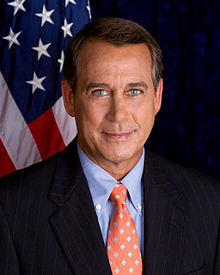
Boehner in 2009
|
|
| 61st Speaker of the United States House of Representatives |
|---|
|
|
Assumed office
January 5, 2011 |
| President | Barack Obama |
|---|
| Preceded by | Nancy Pelosi |
|---|
| House Minority Leader |
|---|
In office
January 3, 2007 – January 3, 2011 |
| Deputy | Roy Blunt
Eric Cantor |
|---|
| Preceded by | Nancy Pelosi |
|---|
| Succeeded by | Nancy Pelosi |
|---|
| House Majority Leader |
|---|
In office
February 2, 2006 – January 3, 2007 |
| Deputy | Roy Blunt |
|---|
| Preceded by | Roy Blunt (Acting) |
|---|
| Succeeded by | Steny Hoyer |
|---|
| Chairman of the House Education Committee |
|---|
In office
January 3, 2001 – January 3, 2006 |
| Preceded by | William F. Goodling |
|---|
| Succeeded by | Howard McKeon |
|---|
| Chairman of the House Republican Conference |
|---|
In office
January 3, 1995 – January 3, 1999 |
| Preceded by | Dick Armey |
|---|
| Succeeded by | J. C. Watts |
|---|
Member of the U.S. House of Representatives
from Ohio's 8th district |
|---|
|
|
Assumed office
January 3, 1991 |
| Preceded by | Buz Lukens |
|---|
Member of the Ohio House of Representatives
from the 57th district |
|---|
In office
January 3, 1985 – December 31, 1990 |
| Preceded by | Bill Donham |
|---|
| Succeeded by | Scott Nein |
|---|
| Personal details |
|---|
| Born | John Andrew Boehner
November 17, 1949 (age 65)
Reading, Ohio, U.S. |
|---|
| Political party | Republican |
|---|
| Spouse(s) | Deborah Gunlack (1973–present) |
|---|
| Children | Lindsay
Tricia |
|---|
| Alma mater | Xavier University |
|---|
| Religion | Roman Catholicism |
|---|
| Signature |  |
|---|
| Website | Official website
Campaign website
House website |
|---|
| Military service |
|---|
| Allegiance |  United States of America United States of America |
|---|
| Service/branch |  United States Navy United States Navy |
|---|
| Years of service | 1968 (8 weeks) |
|---|
On September 25, 2015, Boehner announced he will resign the Speakership and retire from Congress effective October 30.
[3]
Early life, education, and career
Boehner was born in
Reading, Ohio, the son of Mary Anne (née Hall) and Earl Henry Boehner, the second of twelve children. His father was of
German descent and his mother had German and
Irish ancestry.
[4][5][6][7][8] He grew up in modest circumstances, having shared one bathroom with his eleven siblings in a two-bedroom house in Cincinnati. His parents slept on a pull-out couch.
[9]He started working at his family's bar at age 8, a business founded by their grandfather Andy Boehner in 1938.
[9] He has lived in Southwest Ohio his entire life. All but two of his siblings still live within a few miles of one another; two are unemployed and most of the others have blue-collar jobs.
[10][11]
Shortly after his graduation in 1977, Boehner accepted a position with Nucite Sales, a small sales business in the packaging and plastics industry. He was steadily promoted and eventually became president of the firm, resigning in 1990 when he was elected to Congress.
[6]
Early political career
U.S. House of Representatives
In 1990, Boehner ran against incumbent congressman
Buz Lukens, who was under fire for having a sexual relationship with a minor. He trounced Lukens in the primary, taking 49 percent of the vote. This was tantamount to election in the heavily Republican 8th District. He has been reelected 10 times with no substantial opposition, and even ran unopposed in 1994 and 2012.
Gang of Seven and Contract with America
Boehner, along with
Newt Gingrich and several other Republican lawmakers, was one of the engineers of the
Contract with Americain 1994 that politically helped Republicans during the 1994 congressional elections during which they won the majority in Congress for the first time in four decades.
Republican leadership
During his time as Conference Chairman, Boehner championed the
Freedom to Farm Act that, among other provisions, revises and simplifies direct payment programs for crops and eliminates milk price supports through direct government purchases.
In the summer of 1997 several House Republicans, who saw
Speaker Newt Gingrich's public image as a liability, attempted to replace him as Speaker. The attempted "coup" began July 9 with a meeting between Republican conference chairman Boehner and Republican leadership chairman
Bill Paxon of New York. According to their plan,
House Majority Leader Dick Armey,
House Majority Whip Tom DeLay, Boehner and Paxon were to present Gingrich with an ultimatum: resign, or be voted out. However, Armey balked at the proposal to make Paxon the new Speaker, and told his chief of staff to warn Gingrich about the coup.
[22]
On July 11, Gingrich met with senior Republican leadership to assess the situation. He explained that under no circumstance would he step down. If he was voted out, there would be a new election for Speaker, which would allow for the possibility that Democrats—along with dissenting Republicans—would vote in
Dick Gephardt as Speaker. On July 16, Paxon offered to resign his post, feeling that he had not handled the situation correctly. Paxon was the only unelected member of the leadership group, having been appointed to his position by Gingrich.
[23]
In 1998, Boehner was ousted as the chairman of the House Republican Conference, after his party lost five congressional seats.
[24]
Chairman of Committee on Education and Labor
Boehner and Senator
Ted Kennedy authored the passage of the
No Child Left Behind Act of 2001, which was signed by President George W. Bush in 2002.
[26] Boehner said that it was his "proudest achievement" in two decades of public service.
[27] Boehner was friends with Kennedy, also a Roman Catholic, and every year they chaired fundraisers for cash-strapped Catholic schools.
[28]
House Republican Leader
In an upset, Boehner was elected by his colleagues to serve as House Majority Leader on February 2, 2006. The election followed
Tom DeLay's resignation from the post after being indicted on criminal charges. Boehner campaigned as a reform candidate who wanted to reform the so-called "
earmark" process and rein in government spending. He defeated Majority Whip
Roy Blunt of
Missouri and Representative
John Shadegg of
Arizona, even though he was considered an underdog candidate to Blunt. In the second round of voting by the House Republican Conference, Boehner defeated Blunt with 122 to 109 votes. Blunt kept his previous position as
Majority Whip, the No. 3 leadership position in the House. (There was some confusion on the first ballot for Majority Leader as the first count showed one more vote cast than Republicans present,
[29] due to a misunderstanding as to whether the rules allowed Resident Commissioner
Luis Fortuño of Puerto Rico to vote).
[30]
After the Republicans lost control of the House in the 2006 elections, the House Republican Conference chose Boehner as Minority Leader. While as Majority Leader he was second-in-command behind Speaker
Dennis Hastert, as Minority Leader he was the leader of the House Republicans. As such, he was the Republican nominee for Speaker in 2006 and 2008, losing both times to Pelosi.
According to the 2008 Congress.org Power Ranking, Boehner was the 6th most powerful congressman (preceded by Speaker Pelosi, Majority Leader Hoyer, Ways and Means Committee Chairman
Sander M. Levin, Dean of the House
John Dingell, and Appropriations Committee Chairman
Dave Obey, all Democrats) and the most powerful Republican.
[31] As Minority Leader, Boehner served as an
ex officio member of the
Permanent Select Committee on Intelligence.
Speaker of the House
The Republicans won a majority in the House of Representatives during the 2010 midterm elections, with a net gain of 63 seats. During his solemn victory speech, Boehner broke into tears when talking about "economic freedom, individual liberty and personal responsibility...I hold these values dear because I've lived them...I've spent my whole life chasing the American Dream".
[28] November 17, 2010, Boehner was unanimously chosen by the House Republicans as their nominee for Speaker,
[32][33] all but assuring his formal election to the post when the new Congress convened with a Republican majority in January 2011. He received the gavel from outgoing Speaker Pelosi on Wednesday, January 5, 2011.
[34] He is the first Speaker from Ohio since fellow Republicans
Nicholas Longworth (1925 to 1931) and
J. Warren Keifer (1881 to 1883). He is also the first Speaker who has served both as majority and minority floor leader for his party since Texas Democrat
Sam Rayburn.
[citation needed]
As Speaker, he is still the leader of the House Republicans. However, by tradition, he normally does not take part in debate, although he has the right to do so, and almost never votes from the floor.
[35] He is not a member of any House committees.
Boehner appeared on
The Tonight Show with Jay Leno on January 23, 2014. When asked by Leno if he would ever run for president, the Speaker said no, adding, "I like to play golf. I like to cut my own grass. I do drink red wine, I smoke cigarettes. And I'm not giving that up to be President of the United States."
[38]
In July 2014, Boehner moved forward on a
lawsuit to force the President to impose penalties on companies who failed to provide health care coverage for their employees.
[39] Boehner had pressed for legislation to delay this mandate the previous year.
[40] The day after voting to sue the President for what he saw as ignoring a law passed by Congress, Boehner called on the President to ignore another law passed by Congress.
[41] The third law firm selected finally filed the suit in November 2014, after Boehner criticized Obama's unilateral moves on immigration policy.
[42]
Resignation
On September 25, 2015, Boehner announced that he would step down as Speaker and resign from Congress at the end of October 2015. Boehner's resignation took place after
Pope Francis' address to Congress the day before, an event considered by Boehner as a high point in his legislative career. Sources in his office indicated he was stepping aside in the face of increasing discord while trying to manage passage of a continuing resolution to fund the government. Conservative opposition to funding
Planned Parenthood as part of the resolution, and stronger threats to Boehner's leadership on account of the controversy, prompted the abrupt announcement.
[3]
Controversies
Connections to lobbyists
In June 1995, Boehner distributed campaign contributions from
tobacco industry lobbyists on the House floor as House members were weighing how to vote on tobacco subsidies.
[43] In a 1996 documentary by
PBS called
The People and the Power Game, Boehner said "They asked me to give out a half dozen checks quickly before we got to the end of the month and I complied. And I did it on the House floor, which I regret. I should not have done. It's not a violation of the House rules, but it's a practice that‘s gone on here for a long time that we're trying to stop and I know I'll never do it again."
[44] Boehner eventually led the effort to change House rules and prohibit campaign contributions from being distributed on the House floor.
[45]
A September 2010
New York Times story said Boehner was "Tightly Bound to Lobbyists" and "He maintains especially tight ties with a circle of lobbyists and former aides representing some of the nation’s biggest businesses, including Goldman Sachs, Google, Citigroup, R.J. Reynolds, MillerCoors and UPS.".
[46]
Smithsonian
In November 2010, Boehner, along with Minority Whip Eric Cantor, called for the cancellation of an exhibit in the
Smithsonian's
National Portrait Gallery after he learned that it featured a video by
David Wojnarowicz,
A Fire in My Belly, that contained an image of a
crucifix with ants crawling on it. Boehner spokesman Kevin Smith said, "Smithsonian officials should either acknowledge the mistake and correct it, or be prepared to face tough scrutiny beginning in January when the new majority in the House moves [in]."
[47]
Fiscal cliff and Hurricane Sandy relief bill
On January 1, 2013, after passing the
fiscal cliff deal, Boehner adjourned the house without passing the $60 million
Hurricane Sandy relief bill. Some Representatives, especially from the Northeast and including Republicans as well as Democrats, and
New Jersey Governor
Chris Christie harshly criticized Boehner.
[48] Boehner later promised to pass the bill.
[49] However, some commentators praised Boehner for not passing a bill they saw as full of
pork barrel.
[50]
Cromnibus and 2015 House Chair election
Many
Republicans were ready for a new
House of Representatives Chairman following the 2014 mid-term elections.
EMC Research reported 60% of participants in their telephone survey wanted a new chairman.
[51] Conservatives including
Sarah Palin also criticized Boehner for not stopping the Cromnibus spending package in 2014 after being re-elected, stating "It stinks to high heaven.".
[52] WND then launched a campaign to elect a new chairman which gained the support of 500,000 individual letters being sent to congress in protest of Boehner.
[53] In the end there were a total of 25 votes against Boehner, 29 were needed in order to choose a new speaker.
[54] Boehner responded by removing those who opposed him from influential committees.
[55]
Political positions
Boehner has been classified as a "hard-core conservative" by
OnTheIssues.
[58] Although Boehner has a conservative voting record, when he was running for House leadership, religious conservatives in the GOP expressed that they were not satisfied with his positions. According to the
Washington Post: "From
illegal immigration to sanctions on China to an overhaul of the pension system, Boehner, as chairman of the House Committee on Education and the Workforce, took ardently pro-business positions that were contrary to those of many in his party. Religious conservatives – examining his voting record – see him as a policymaker driven by small-government economic concerns, not theirs."
[59]
On May 25, 2006, Boehner issued a statement defending his agenda and attacking his "
Democrat friends" such as Minority Leader
Nancy Pelosi. Boehner said regarding national security that voters "have a choice between a Republican Party that understands the stakes and is dedicated to victory, and a Democrat Party with a non-existent national security policy that sheepishly dismisses the challenges of a post-
9/11 world and is all too willing to concede defeat on the battlefield in
Iraq."
Financial crisis
On September 18, 2008, Congressman Boehner attended a closed meeting with congressional leaders, then-Treasury Secretary Henry Paulson and Federal Reserve Chairman Ben Bernanke, and was urged to craft legislation to help financially troubled banks. That same day (trade effective the next day), Congressman Boehner cashed out of an equity mutual fund.
[66]

Speaker Boehner meets with President Obama at the White House during the 2011 debt ceiling increase negotiations
Boehner has been highly critical of several initiatives by the Democratic Congress and President
Barack Obama, including the "
cap and trade" plan that Boehner says would hurt job growth in his congressional district and elsewhere. He opposed the
Patient Protection and Affordable Care Act and said that, if Republicans took control of the House of Representatives in the 2010 elections, they would do whatever it takes to stop the act. One option would be to defund the administrative aspect of the Act, not paying "one dime" to pay the salaries of the workers who would administer the plan.
[68] He also led an opposition to the 2009 stimulus and to Obama's first budget proposal, promoting instead an alternative economic recovery plan
[69] and a Republican budget (authored by Ranking Rep.
Paul Ryan, R-
WI).
[70] He has advocated for an across-the-board
spending freeze, including
entitlement programs. Boehner favors making changes in
Social Security, such as by raising the retirement age to 70 for people who have at least 20 years until retirement, as well as tying cost-of-living increases to the
consumer price index rather than
wage inflation, and limiting payments to those who need them.
[68]
In 2013, Boehner led his caucus in a strategy to hold Defense spending hostage in order to avoid reducing the deficit with revenue increases.
[73]
Political campaigns
 | This section is incomplete. (June 2015) |
2006
2008
2010
As Republican House Leader, Boehner is a Democratic target for criticism of Republican views and political positions. In July 2010, President
Barack Obama began singling out Boehner for criticism during his speeches.
[77] In one speech, Obama mentioned Boehner's name nine times
[78] and accused him of believing that police, firefighters, and teachers were jobs "not worth saving."
[79]
Electoral history
Ohio's 8th congressional district: Results 1990–2012[80][81]
| Year | | Democratic | Votes | Pct | | Republican | Votes | Pct | | Other | Party | Votes | Pct | | Other | Party | Votes | Pct | |
|---|
| 1990 | | Gregory Jolivette | 63,584 | 38.9% | | John Boehner | 99,955 | 61.1% | | | | | | | | | | | |
| 1992 | | Fred Sennet | 62,033 | 26% | | John Boehner | 176,362 | 74% | | | | | | | | | | | |
| 1994 | | No candidate | | | | John Boehner | 148,338 | 100% | | | | | | | | | | | |
| 1996 | | Jeffrey Kitchen | 52,912 | 26% | | John Boehner | 127,979 | 70% | | William Baker | Natural Law | 8,613 | 4% | | | | | | |
| 1998 | | John W. Griffin | 52,912 | 29% | | John Boehner | 127,979 | 71% | | | | | | | | | | | |
| 2000 | | John G. Parks | 66,293 | 26% | | John Boehner | 179,756 | 71% | | David Shock | Libertarian | 7,254 | 3% | | | | | | |
| 2002 | | Jeff Hardenbrook | 49,444 | 29% | | John Boehner | 119,947 | 71% | | | | | | | | | | | |
| 2004 | | Jeff Hardenbrook | 90,574 | 31% | | John Boehner | 201,675 | 69% | | | | | | | | | | | |
| 2006 | | Mort Meier | 77,640 | 36% | | John Boehner | 136,863 | 64% | | | | | | | | | | | |
| 2008 | | Nicholas Von Stein | 95,510 | 32% | | John Boehner | 202,063 | 68% | | | | | | | | | | | |
| 2010 | | Justin Coussoule | 65,883 | 30% | | John Boehner | 142,731 | 66% | | David Harlow | Libertarian | 5,121 | 2% | | James Condit | Constitution | 3,701 | 2% | |
| 2012 | | No candidate | | | | John Boehner | 246,378 | 99.2% | | James Condit | Constitution | 1,938 | 0.8% |
| 2014 | | Tom Poetter | 51,534 | 27.4% | | John Boehner | 126,539 | 67.2% | | James Condit | Constitution | 10,257 | 5.4% | | | | | | |
Speakership of the United States House of Representatives
U.S. House of Representatives speaker election, 2007
| Party | Candidate | Votes | % |
|---|
| Democratic | Nancy Pelosi | 233 | 53.6% |
| Republican | John Boehner | 202 | 46.4% |
| Total | 435 | 100% |
U.S. House of Representatives speaker election, 2009
| Party | Candidate | Votes | % |
|---|
| Democratic | Nancy Pelosi | 255 | 58.6% |
| Republican | John Boehner | 174 | 40.1% |
| Didn't vote | 5 | 0.9% |
| Total | 434[b] | 100% |
U.S. House of Representatives speaker election, 2011
U.S. House of Representatives speaker election, 2013
U.S. House of Representatives speaker election, 2015
Campaign finance
Top 10 organizations funding
The top 10 contributors (not including political parties or other candidates) to John Boehner's campaign for the period of January 1, 2011 – December 31, 2012 represent a variety of interests.
[87]
| Organization | Contributions |
|---|
| AT&T | $156,750 |
| FirstEnergy | $89,050 |
| Sallie Mae | $86,750 |
| Paulson & Co. | $81,050 |
| American Electric Power | $54,450 |
| Moore Capital Management | $51,500 |
| Swisher International Group | $50,000 |
| Cantor Fitzgerald | $46,000 |
| Goldman Sachs | $42,500 |
| Chicago Mercantile Exchange | $39,200 |
Legacy
In reporting his pending retirement,
Politico summarized his Speakership:
- Boehner came into power on the momentum of the 2010 tea party wave. But it was that movement that gave him constant problems. He clashed with the right over the debt limit, government funding, Obamacare and taxes. But his tenure will also be remembered for his complicated relationship with President Barack Obama. He and Obama tried — but repeatedly failed — to cut a deal on a sweeping fiscal agreement. But Boehner has had some significant victories, including the trade deal that Congress passed this year, and changes to entitlement programs.[88]
Paul Kane in the Washington Post emphasizes how none of the "big deals" he sought were ever reached:
- Boehner never landed the really big deal he craved. Not the $4 trillion tax-and-entitlement deal he reached for in 2011, not the repackaged version a year later and not the immigration overhaul he sought in 2014.[89]
Furthermore, Kane argues, Boehner's persona alienated conservative Republicans who demanded more vigorous attacks on Obama and instead perceived, "a country club Republican who loved to play 18 holes of golf and drink merlot afterward while cutting deals. In an era of shouting and confrontation, on talk radio or cable TV, Boehner’s easygoing style did not fit."
[90]
Personal life


