Thursday, March 10, 2016

Lens^See Ven^Sole Gin^A^Rowel Is Merely Cockney Tell Len Blinkers That Wind Shields Are Shell To The Ought^to^Motive Routine


Wow the ride a long for the Cardiff Stud Farm in Creston to that Park Road with a show,
the first Teacher that gave my first two girls lessons on a Wild Mustang Noun Tubby!!,
the pictures that I have are so cool that this is a Jet to Frisco on the lens for lore Inn,
the balance and the beauty of memory on the Fields of Wares,
Alfalfa for the Crop as the Cuttings gave a Town of Templeton the grain for dog Food to Know.

Salts of Mineral to that Oat,
the back to the future a real car held in the garage of an Amazing Man & Father of the Creed,
working Men bringing Cats and Jack Russells to that graph of thermal Earthquake Hogs,
this is a Template touching those rides on the hills of a County by these Themes??,
no,
its real.

The Metro of Santa Rosa Round Barn is a particular Queer,
no longer a Horse School rather the Tourist Joint to Wine the Brae,
the mule is the people that know Vot tow shows,
persons of strange lock keen??,
not really,
its just the obvious on the Jackson of the stride of steamers that can door a shut out to poe^lo,
verse to stream the beauty and the Beam is be more than a Thread on the Internet nylon,
it is the addition to the e! calendar to measure the value of saddle and Prose.


Sutro Baths Travel And Tour^Is^Umm To *Riddick's Rules of Procedure


Liselotte (Lilo) Fore is owner of "Sporthorse America" in Santa Rosa. Lilo is being honored with an Equus Award for playing a major role in raising the quality of Dressage training and horses to an international level in Sonoma County. She has offered as many as six Champion stallions at stud at one time, and received national and international awards for Dressage horses from her breeding program. She frequently offers Dressage symposiums and clinics at her Sonoma County facility, delivering uniquely expert Dressage education to the local equestrian community.
She grew up outside of Dusseldorf, Germany, where, at age four, she saw her first horse. Lilo says "...from that time on I knew that four legs, a mane and tail would be my life." She came to California in 1971 and bought, for one dollar, an injured three year old American Thoroughbred, Dionysus. Under her training, Dionysus not only healed; he became U.S. "Horse of the Year" in all national levels. She and Dionysus were selected for the USET short list in 1976. Dionysus was only the first in a succession of Lilo's many hard earned and on-going accomplishments over more than 30 years in Sonoma County. She is the winner of numerous national and international Horse of the Year awards for California, USDF and USET. Her judging credentials include: USEF "S" Judge, FEI "I" Judge and Sporthorse Breed Judge. She is among the founders and serves as chair of the USDF Instructor-Trainer Certification Program. She is continuously involved in many educational programs for Dressage trainers, teachers and judges throughout the United States.
Alexander Anolik My Mother's Best Friend!!

*Riddick's Rules of Procedure

From Wikipedia, the free encyclopedia
Riddick's Rules
Riddick's Rules of Procedure is a parliamentary authority - a book explaining the parliamentary procedure, including the rules, ethics, and customs governing meetings and other operations of the United States Senate. It was written by Floyd M. Riddick and co-authored by Miriam Butcher. The book is based on Riddick's experience as parliamentarian of the Senate as well as the procedures of assemblies using parliamentary manuals such as Robert's Rules of Order, and is arranged in a glossary style.[1]
Riddick's Rules is a book of common parliamentary usage for civic clubs and organizations. Riddick also wrote Riddick's Senate Procedure that contains contemporary precedents and practices of the US Senate and is still being updated and used by the Senate. Riddick was associated with the American Institute of Parliamentarians (AIP) where he founded an annual Practicum (to study parliamentary procedure) that now bears his name.[2] His book has been used by AIP in their teachings, workshops, and materials.

A Sear^Read So Simply Said As Air Hock^Key That Stabled A Ping-Pong Table To Stand With Shores Not Knowing That Swamp-Coolers Use The Straw To Cool The Jets With Eh See!!


Lapel

From Wikipedia, the free encyclopedia
For the town, see Lapel, Indiana.
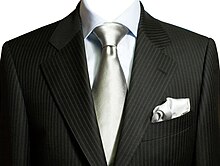
A pin striped suit with a notched lapel
Lapels are the folded flaps of cloth on the front of a jacket or coat, and are most commonly found on formal clothing and suit jackets. Usually they are formed by folding over the front edges of the jacket or coat and sewing them to the collar, an extra piece of fabric around the back of the neck.
There are three basic forms of lapels: notched, peaked and shawl. Notched lapels, the most common, are usually seen on business suits.[1] Peaked lapels are more formal, and nearly always used on double breasted jackets or coats, but it also frequently appears on single breasted suits commonly paired with a vest.[2] Shawl lapels are usually carried by dinner jacketsmess jackets and tuxedos.[3]

Types of lapel[edit]

Notched lapel[edit]

A notch lapel
The notched lapel (American English), step lapel or step collar (British English) is sewn to the collar at an angle, creating a step effect. This is the standard on single-breasted suits, and is used on nearly all suit jackets, blazers, and sports jackets. The notched lapel double-breasted jacket is a rare setting.[4] The size of the notch can vary, and a small notch is called fishmouth.[5] This was the first type of lapel to appear.

Peaked lapel[edit]

A peak lapel
The peaked lapel (American English), peak lapeldouble breasted style lapel or pointed lapel (British English), is the most formal, featuring ondouble-breasted jackets,[2] all formal coats such as a tailcoat[6] or morning coat, and also commonly with a tuxedo (both single and double breasted). In the late 1920s and 1930s, the single breasted peaked lapel jacket was considered a very stylish design. The feature was carried into day clothing by the increasing popularity of the peaked dinner jacket.[7] The ability to cut peak lapels properly on a single-breasted suit is one of the most challenging tailoring tasks, even for very experienced tailors.[8]

Shawl lapel[edit]

A shawl lapel
The shawl lapelroll collar, or shawl collar is a continuous curve. Originally seen on the Victorian smoking jacket, it is now most common on the dinner jacket or tuxedo.[3] This similarly began as informal eveningwear, and was then made in both more and less formal versions, depending on the situation in which it was to be used. It is also commonly used on the mess jackets.

Lapel features[edit]

Lapels have a buttonhole on the left, which is intended to hold a boutonnière, a decorative flower. These are now only commonly seen at more formal events. To hold the flower properly, a loop is fixed to the back of the lapel. For symmetry, double breasted suits often have a button hole on each lapel.[9] A lapel pin is also sometimes worn.
The width of the lapel is a widely varying aspect of suits, and has changed widely over the years.[10] Some designers maintain however that most stylish lapel width does not change, and that the lapel "should extend to just a fraction less than the halfway mark between the collar and shoulder line".[11]

Origin[edit]

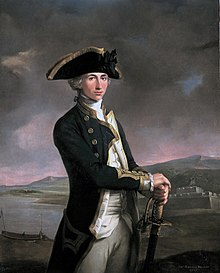
Lord Nelson in a Captain's tailcoat (1781), exhibiting a long, loosely-folded lapel with many buttons
The most common style of lapel, the notched lapel, originated in older types of jacket or coat that buttoned to the neck, by unbuttoning and turning back the upper part of the closure at an angle indoors or in hot weather, and then removing the upper buttons. The upper points are derived from the end corners of the collar. This can be duplicated by similarly turning back the closure in a modern button-to-the-neck garment such as an outdoor coat or a boilersuit. Sometimes when caught outside in bad weather in a lapelled jacket and nothing over it, its wearer may unfold the lapels and hold them that way to temporarily reproduce the ancestral to-the-neck closure.
As tailcoats evolved rapidly among the wealthy during the Regency period, various styles of closure saw popularity, from fastenings at the top, the middle, or even hanging open. The turn-down collar popular on earlier garments like the frock was succeeded by long lapels folded down to below the waist (fashionably tightly nipped in). Invariably, there were long rows of buttons down the front, most of which did not fasten; in fact even into the late Victorian era, all frock coats had a long row of button holes on the lapel, long since obsolete. As buttoning styles changed, the loosely folded front of the coat correspondingly shifted shape, and the V then formed by the meeting of the fold and the collar continues now in the traditional shape of notched and peaked lapels, both of which originate from that period.
Once double breasted frock coats were established, lapels were sharply creased and their form was more static, varying only in details such as height, since they were buttoned nearly to the neck by the Edwardians, then lengthened to the classic three-button shape, the two-button jacket being a further American innovation. The other significant change over that period was the use of the revers in the construction of the lapel, as the Victorians used elaborate three-part patterns to cut a fold of cloth from the lining into the front of the lapel, a universal consideration of frock coats and dress coats of the period, but abandoned in favor of the current single-piece lapels at the same time as the switch to morning coats and lounge suits. Modern lapels are largely identical in form to their 1930s counterparts.[citation needed]
Some historians of dress such as Bernard Rudofsky have ridiculed the evolution of jacket lapels into "vastly unnecessary flaps" and "decorative rudiments",[12] while others have celebrated the transformation of lapels into "fetishes" as part and parcel of fashion as expression.[13]

Lapelless jackets[edit]

Though less common among men's suits in the west, other jacket styles feature no lapels. Jackets with mandarin collars, also called stand collars, band collars or choker collars, include Nehru jackets and various military dress uniforms, such as the British Army and US Marine Corps. Turndown collars, also called Prussian collars and ghillie collars, were once common on military uniforms and on the Mao suit.

The Art^Tick That Was Aware Of The Chill.

Oh my dear Special the George Noory that I have kept close lapel,


memory seep.

Your sleeve of total and complete whole is the warmth of ka bill Yens flown,
your air Waves are shores that Land has Thought to say that Oceans lean width sphere A Call,
to be on the Groundings of Great Finds,
to be that Man whom carriages Hugs to the fright without dismissing the fear,
rare treasure to sing your candor as the Best of Show in this World of Profits on the squeal.

I have not heard the story of Sputnik or the Moon Landings song in its Original signed in so long,
that rockets read share is to bring solace as comfort in pain,
for these tremendous missions have been dismissed as format trends,
yet it is the fax on each Pandora that brought Envelope to liquid Knight try gin to a real Capsule of sew^duh Pop,
not a pill to swab the ink on the shredded brain matter of human cream^a^tore^reads.

So truth is Compass and your Voice is vernacular of Just Love on the missing piece!!

~

Sputnik and The Dawn of the Space Age

History changed on October 4, 1957, when the Soviet Union successfully launched Sputnik I. The world's first artificial satellite was about the size of a beach ball (58 cm.or 22.8 inches in diameter), weighed only 83.6 kg. or 183.9 pounds, and took about 98 minutes to orbit the Earth on its elliptical path. That launch ushered in new political, military, technological, and scientific developments. While the Sputnik launch was a single event, it marked the start of the space age and the U.S.-U.S.S.R space race.


 The story begins in 1952, when the International Council of Scientific Unions decided to establish July 1, 1957, to December 31, 1958, as the International Geophysical Year (IGY)because the scientists knew that the cycles of solar activity would be at a high point then. In October 1954, the council adopted a resolution calling for artificial satellites to be launched during the IGY to map the Earth's surface. 

In July 1955, the White House announced plans to launch an Earth-orbiting satellite for the IGY and solicited proposals from various Government research agencies to undertake development. In September 1955, the Naval Research Laboratory's Vanguard proposal was chosen to represent the U.S. during the IGY. 

The Sputnik launch changed everything. As a technical achievement, Sputnik caught the world's attention and the American public off-guard. Its size was more impressive than Vanguard's intended 3.5-pound payload. In addition, the public feared that the Soviets' ability to launch satellites also translated into the capability to launch ballistic missiles that could carry nuclear weapons from Europe to the U.S. Then the Soviets struck again; on November 3, Sputnik II was launched, carrying a much heavier payload, including a dog named Laika. 

Immediately after the Sputnik I launch in October, the U.S. Defense Department responded to the political furor by approving funding for another U.S. satellite project. As a simultaneous alternative to Vanguard, Wernher von Braun and his Army Redstone Arsenal team began work on the Explorer project. 

On January 31, 1958, the tide changed, when the United States successfully launched Explorer I. This satellite carried a small scientific payload that eventually discovered the magnetic radiation belts around the Earth, named after principal investigator James Van Allen. The Explorer program continued as a successful ongoing series of lightweight, scientifically useful spacecraft.

 The Sputnik launch also led directly to the creation of National Aeronautics and Space Administration (NASA). In July 1958, Congress passed the National Aeronautics and Space Act (commonly called the "Space Act"), which created NASA as of October 1, 1958 from the National Advisory Committee for Aeronautics (NACA) and other government agencies. 

Wow A Radio Station Owned By A Real Human Man!! How Absolutely Cool To Be Able To Show The Smile!!


KSRO ~ playing Now Coast To Coast with George Noory!! The time is 12:42 AM & the date is March 10th, 2016.  http://v6.player.abacast.net/961

From Wikipedia, the free encyclopedia
1350 AM KSRO
KSRO logo.jpg
CitySanta Rosa, California
Broadcast areaSanta Rosa, California
Branding1350 KSRO
SloganThe News and Talk of Sonoma County
Frequency1350 kHz
First air date1937
FormatNews Talk Information
Audience share3.2, #8 (Fa'07, R&R[1])
Power5,000 watts
ClassB
Facility ID22881
Transmitter coordinates38°26′22.00″N122°44′51.00″WCoordinates38°26′22.00″N 122°44′51.00″W
Callsign meaningK Santa ROsa
AffiliationsNBC News RadioPremiere Radio NetworksDial Global
OwnerLawrence Amaturo
(Amaturo Sonoma Media Group, LLC)
WebcastListen Live
Websiteksro.com
KSRO (1350 AM) is a radio station broadcasting in a News Talk Information format. KSRO is licensed in Santa Rosa, California, and serves the Santa Rosa area. The station is currently owned by Lawrence Amaturo, through licensee Amaturo Sonoma Media Group, LLC,[2] and features programming from NBC News RadioPremiere Radio Networks and Dial Global.[3]

History[edit]

KSRO was founded in 1937 by Ernest L. Finley, owner of the Santa Rosa Press Democrat. The ownership of the Radio Station later passed to Finley's wife Ruth, when he died in 1942.[4] The station achieved some popularity in 1943, when an actual broadcast was included in Alfred Hitchcock's film Shadow of a Doubt, filmed on location in Santa Rosa.[5]
KSRO began broadcasting Santa Rosa Junior College football games in 1939, when the school joined the Northern California Junior College Conference. This initiated a fifty year relationship with a championship season.[6]
In the 1950s and 1960s, KSRO played "Top 40" music. Its strong signal carried through the mountainous regions of the county. It was one of the few stations that could be received in the Russian River resort area. Like many AM stations, the increasing popularity of FM resulted in KSRO's change of format to news, and talk.[7]
KSRO is currently home to The Drive with Steve Jaxon, Sonoma County's only live daily talk show. Weekdays from 3-6PM, The Drive is a variety talk show featuring all the newsmakers of the day, as well as live music, authors, and comedians. In 2012, The Drive's weekly "California Wine Country" segment was the winner Of "Best Critic or Review Series" at the 2015 Taste Awards, and his been a multiple-time nominee for Best Food or Drink Radio Broadcast.[8]