| Zachary Taylor |
|---|

Daguerreotype of Zachary Taylor
|
|
| 12th President of the United States |
|---|
In office
March 4, 1849[a] – July 9, 1850 |
| Vice President | Millard Fillmore |
|---|
| Preceded by | James K. Polk |
|---|
| Succeeded by | Millard Fillmore |
|---|
| Personal details |
|---|
| Born | November 24, 1784
Barboursville, Virginia, U.S. |
|---|
| Died | July 9, 1850 (aged 65)
Washington, D.C., U.S. |
|---|
| Resting place | Zachary Taylor National Cemetery,
Louisville, Kentucky, U.S. |
|---|
| Political party | Whig |
|---|
| Spouse(s) | Margaret Smith (m. 1810; his death 1850) |
|---|
| Children | 6, including Sarah Knox,Mary Elizabeth, and Richard Scott |
|---|
| Profession | Major general |
|---|
| Religion | Episcopalian |
|---|
| Signature |  |
|---|
| Military service |
|---|
| Allegiance |  United States of America United States of America |
|---|
| Service/branch |  United States Army United States Army |
|---|
| Years of service | 1808–1849 |
|---|
| Rank |  Major general Major general |
|---|
| Commands | Army of Occupation |
|---|
| Battles/wars | War of 1812
• Siege of Fort Harrison
Black Hawk War
Second Seminole War
• Battle of Lake Okeechobee
Mexican–American War
• Battle of Palo Alto
• Battle of Resaca de la Palma
• Battle of Monterrey
• Battle of Buena Vista |
|---|
Taylor's status as a national hero as a result of his victories in the
Mexican-American War won him election to the
White Housedespite his vague political beliefs. His top priority as president was preserving the Union, but he died seventeen months into his term, before making any progress on the status of
slavery, which had been inflaming tensions in Congress.
Taylor was born into a prominent family of planters who migrated westward from
Virginia to
Kentucky in his youth. He was commissioned as an officer in the U.S. Army in 1808 and made a name for himself as a
captain in the
War of 1812. He climbed the ranks establishing military forts along the
Mississippi River and entered the
Black Hawk War as a
colonel in 1832. His success in the
Second Seminole War attracted national attention and earned him the nickname "Old Rough and Ready".
The
Whig Party convinced the reluctant Taylor to lead their ticket, despite his unclear platform and lack of interest in politics. He won the election alongside former U.S. Representative
Millard Fillmore of
New York, defeating Democratic candidates
Lewis Cass and
William Orlando Butler. As president, Taylor kept his distance from Congress and his cabinet, even as partisan tensions threatened to divide the Union. Debate over the slave status of the large territories claimed in the war led to threats of secession from Southerners.
Despite being a Southerner and a slaveholder himself, Taylor did not push for the expansion of slavery. To avoid the question, he urged settlers in
New Mexico and California to bypass the territorial stage and draft constitutions for
statehood, setting the stage for the
Compromise of 1850. Taylor died suddenly of a stomach-related illness in July 1850, so had little impact on the sectional divide that led to
civil war a decade later.
Early life[edit]
Taylor was born on November 24, 1784, on a
plantation in
Orange County, Virginia, to a prominent family of planters of English ancestry. He is inconclusively believed to have been born at the home of his maternal grandfather,
Hare Forest Farm.
[1] He was the third of five surviving sons in his family (a sixth died in infancy) and had three younger sisters. His mother was Sarah Dabney (Strother) Taylor. His father,
Richard Taylor, had served as a lieutenant colonel in the
American Revolution.
[2]
Leaving exhausted lands, his family joined the westward migration out of Virginia and settled near what developed as
Louisville, Kentucky, on the
Ohio River. Taylor grew up in a small woodland cabin before his family moved to a brick house with increased prosperity. The rapid growth of Louisville was a boon for Taylor's father, who came to own 10,000 acres (40 km
2) throughout Kentucky by the start of the 19th century; he held 26 slaves to cultivate the most developed portion of his holdings. There were no formal schools on the Kentucky frontier, and Taylor had a sporadic formal education. A schoolmaster recalled Taylor as a quick learner. His early letters show a weak grasp of spelling and grammar, and his handwriting was later described as "that of a near illiterate".
[4]
Marriage and family[edit]
In June 1810, Taylor married
Margaret Mackall Smith, whom he had met the previous autumn in Louisville. "Peggy" Smith came from a prominent family of
Maryland planters; she was the daughter of Major Walter Smith, who had served in the Revolutionary War.
[5] The couple had six children:
- Ann Mackall Taylor (1811–1875),[6] married Robert C. Wood, a U.S. Army surgeon she had met while living Fort Snelling, in 1829.[7]
- Sarah Knox "Knoxie" Taylor (1814–1835),[6] married Jefferson Davis in 1835, whom she had met through her father at the end of the Black Hawk War; she died at 21 ofmalaria in St. Francisville, Louisiana, shortly after her marriage.[8]
- Octavia Pannell Taylor (1816–1820),[6] died in early childhood.
- Margaret Smith Taylor (1819–1820),[6] died in infancy along with Octavia when the Taylor family was stricken with a "bilious fever."[9]
- Mary Elizabeth "Betty" Taylor (1824–1909),[6] married William Wallace Smith Bliss in 1848 (he died 1853),[10] married Philip Pendleton Dandridge in 1858.
- Richard Scott "Dick" Taylor (1826–1879),[6] Confederate Army general,[11] married Louise Marie Myrthe Bringier in 1851.
Military career[edit]
Initial commissions[edit]
On May 3, 1808, Taylor joined the U.S. Army, receiving a
commission as a
first lieutenant of the
Seventh Infantry Regiment. He was among the new officers commissioned by Congress in response to the
Chesapeake–Leopard Affair, in which an American frigate had been boarded by the crew of a British warship, sparking calls for war.
[12] Taylor spent much of 1809 in the dilapidated camps of New Orleans and nearby Terre aux Boeufs. He was promoted to
captain in November 1810. His army duties were limited at this time, and he attended to his personal finances. Over the next several years, he began to purchase slaves and a good deal of bank stock in Louisville.
[13] He bought a plantation in Louisville for $95,000 that had 83 slaves attached to it, as well as the
Cypress Grove Plantation near
Rodney,
Jefferson County,
Mississippi, bringing the total number of slaves under him above 200.
[14][15] In July 1811 he was called to the
Indiana Territory, where he assumed control of
Fort Knox after the commandant fled. In only a few weeks, he was able to restore order in the garrison, for which he was lauded by Governor
William Henry Harrison.
[16]
War of 1812[edit]
During the
War of 1812, in which U.S. forces battled the British Empire and its
Indian allies, Taylor successfully defended
Fort Harrison in Indiana Territory from an Indian attack commanded by the
Shawnee chief Tecumseh. Taylor gained recognition and received a
brevet (temporary) promotion to the rank of major. Later that year he joined General
Samuel Hopkins as an aide on two expeditions: the first into the
Illinois Territory and the second to the
Tippecanoe battle site, where they were forced to retreat in the
Battle of Wild Cat Creek.
[17] Taylor moved his growing family to Fort Knox after the violence subsided. In spring 1814, he was called back into action under Brigadier General
Benjamin Howard. That October he supervised the construction of
Fort Johnson, the last toehold of the U.S. Army in the upper Mississippi River Valley. Upon Howard's death a few weeks later, Taylor was ordered to abandon the fort and retreat to
Saint Louis. Reduced to the rank of captain when the war ended in 1815, he resigned from the army. He re-entered it a year later after gaining a commission as a major.
[18]
Commanded Fort Howard[edit]
For two years, Taylor commanded
Fort Howard at the
Green Bay,
Michigan Territory, settlement. He then returned to Louisville and his family. In April 1819 he was promoted to the rank of lieutenant colonel and dined with President
James Monroe.
[19] In late 1821, Taylor took the 7th Infantry to
Natchitoches, Louisiana, on the Red River. On the orders of General
Edmund P. Gaines, they set out to locate a new post more convenient to the Sabine River frontier. By the following March, Taylor had established
Fort Jesup, at the Shield's Spring site southwest of Natchitoches. That November he was transferred to
Fort Robertson at
Baton Rouge, where he remained until February 1824.
[20] He spent the next few years on recruiting duty. In late 1826 he was called to Washington, D.C., to work on an Army committee to consolidate and improve military organization. In the meantime he acquired his first Louisiana plantation and decided to move with his family to Baton Rouge as their home.
[20]
Black Hawk War[edit]
In May 1828, Taylor was called back to action, commanding
Fort Snelling in
Michigan Territory (now
Minnesota) on the northern Mississippi River for a year, and nearby
Fort Crawford for a year. After some time on furlough, when he expanded his landholdings, Taylor was promoted to colonel of the
1st Infantry Regiment in April 1832.
[21] At that time, the
Black Hawk War was beginning in the West. Taylor campaigned under General
Henry Atkinson to pursue and later defend against Chief
Black Hawk's forces throughout the summer. The end of the war in August 1832 signaled the end of Indian resistance to U.S. expansion in the area, and the following years were relatively quiet. During this period Taylor resisted the courtship of his 17-year-old daughter
Sarah Knox Taylor and Lieutenant
Jefferson Davis, the future
President of the Confederate States of America. He respected Davis but did not approve of his daughter becoming a military wife, as he knew it was a hard life for families. Davis and Sarah Taylor married in June 1835, but she died three months later of
malaria contracted on a summer visit to Davis' sister in
St. Francisville, Louisiana.
[22]
Second Seminole War[edit]
By 1837, the
Second Seminole War was underway when Taylor was directed to Florida. He defeated the
Seminole Indians in the Christmas Day
Battle of Lake Okeechobee, which was among the largest U.S.–Indian battles of the nineteenth century. He was promoted to brigadier general in recognition of his success. In May 1838, Brig. Gen.
Thomas Jesup stepped down and placed Taylor in command of all American troops in Florida, a position he held for two years. His reputation as a military leader was growing, and with it, he began to be known as "Old Rough and Ready."
[23] Taylor was criticized for using bloodhounds in order to track Seminole.
[14] After his long-requested relief was granted, Taylor spent a comfortable year touring the nation with his family and meeting with military leaders. During this period, he began to be interested in politics and corresponded with President William Henry Harrison. He was made commander of the Second Department of the Army's Western Division in May 1841. The sizable territory ran from the Mississippi River westward, south of the
37th parallel north. Stationed in
Arkansas, Taylor enjoyed several uneventful years, spending as much time attending to his land speculation as to military matters.
[24]
Mexican–American War[edit]

General Zachary Taylor rides his horse at Palo Alto Battle – May 8, 1846
In anticipation of the annexation of the
Republic of Texas, which had established independence in 1836, Taylor was sent in April 1844 to Fort Jesup in Louisiana. He was ordered to guard against any attempts by Mexico to reclaim the territory.
[25]He served there until July 1845, when annexation became imminent, and President
James K. Polk directed him to deploy into disputed territory in Texas, "on or near the
Rio Grande" near Mexico. Taylor chose a spot at
Corpus Christi, and his
Army of Occupation encamped there until the following spring in anticipation of a Mexican attack.
[26]
Taylor's men advanced to the Rio Grande in March 1846. Polk's attempts to negotiate with Mexico had failed, and war appeared imminent. Violence broke out several weeks later, when some of Captain Seth B. Thornton's men were attacked by Mexican forces near the river.
[27] Polk, learning of the
Thornton Affair, told Congress in May that a war between Mexico and the U.S. had begun.
[28] That same month, Taylor commanded American forces at the
Battle of Palo Alto and the nearby
Battle of Resaca de la Palma, defeating the Mexican forces, which greatly outnumbered his own.
[29] These victories made him a popular hero, and within weeks he received a brevet promotion to major general and a formal commendation from Congress. The national press compared him to
George Washington and
Andrew Jackson, both generals who had ascended to the presidency, although Taylor denied any interest in running for office. "Such an idea never entered my head," he remarked in a letter, "nor is it likely to enter the head of any sane person."
[30]
In September, Taylor inflicted heavy casualties upon the Mexican defenders at the
Battle of Monterrey. The city of
Monterrey had been considered "impregnable", but was captured in three days, forcing Mexican forces to retreat. Taylor was criticized for signing a "liberal" truce, rather than pressing for a large-scale surrender.
[31] Afterwards, half of Taylor's army was ordered to join General
Winfield Scott's soldiers as they
besieged Veracruz. Mexican General
Antonio López de Santa Anna discovered, through an intercepted letter from Scott, that Taylor had contributed all but 6,000 of his men to the effort. His remaining force included only a few hundred
regular army soldiers, and Santa Anna resolved to take advantage of the situation.
Santa Anna attacked Taylor with 20,000 men at the
Battle of Buena Vista in February 1847, leaving around 700 Americans dead or wounded at a cost of over 1,500 Mexican.
[b]Outmatched, the Mexican forces retreated, ensuring a "far-reaching" victory for the Americans.
[35]
In recognition of his victory at Buena Vista, Taylor was elected an honorary member of the New York
Society of the Cincinnati on July 4, 1847. Taylor's father had been an Original Member of the Virginia Society of the Cincinnati. Unfortunately for the younger Taylor, the Virginia society had disbanded shortly before the elder Taylor's death, which prevented him from succeeding to his father's "seat" in the Society. Taylor was a member of the
Aztec Club of 1847, Military Society of the Mexican War.
[36]
Taylor remained at Monterrey until late November 1847, when he set sail for home. While he would spend the following year in command of the Army's entire western division, his active military career was over. In December he received a hero's welcome in New Orleans and Baton Rouge, and his popular legacy set the stage for the 1848 presidential election.
[37]
Election of 1848[edit]

Taylor/Fillmore 1848 campaign poster
In his capacity as a career officer, Taylor had never reportedly revealed his political beliefs before 1848 nor voted before that time.
[38] He thought of himself as an
independent, believing in a strong and sound banking system for the country, and thought that President Andrew Jackson should not have allowed the
Second Bank of the United States to collapse in 1836.
[38] He believed it was impractical to talk about expanding slavery into the western areas of the U.S., as he concluded that neither cotton nor sugar (both were produced in great quantities as a result of slavery) could be easily grown there through a
plantation economy.
[38] He was also a firm nationalist, and due to his experience of seeing many people die as a result of warfare, he believed that
secession was not a good way to resolve national problems.
[38] Taylor, although he did not agree with their stand in favor of protective tariffs and expensive
internal improvements, aligned himself with
Whig Party governing policies: the President should not be able to veto a law, unless that law was against the
Constitution; that the office should not interfere with
Congress; and that the power of collective decision-making, as well as the
Cabinet, should be strong.
[38]
Well before the American victory at Buena Vista, political clubs were formed which supported Taylor for President. His support was drawn from an unusually broad assortment of political bands, including Whigs and Democrats, Northerners and Southerners, allies and opponents of national leaders such as
Henry Clay and James K. Polk. By late 1846 Taylor's opposition to a presidential run began to weaken, and it became clear that his principles more closely resembled Whig orthodoxy. Still, he maintained that he would only accept election as a national, independent figure, rather than a partisan loyalist.
[39] Taylor declared, as the 1848 Whig Party convention approached, that he had always been a Whig in principle, but he did consider himself a
Jeffersonian-Democrat.
[38] Many southerners believed that Taylor supported slavery and its expansion into the new territory absorbed from Mexico, and some were angered when Taylor suggested that if he were elected President he would not veto the
Wilmot Proviso, which proposed against such an expansion.
[38] This position did not enhance his support from activist antislavery elements in the Northern U.S., as these wanted Taylor to speak out strongly in support of the Proviso, not simply fail to veto it.
[38] Most
abolitionists did not support Taylor, since he was a slave-owner.
[38] Many southerners also knew that Taylor supported states' rights and was opposed to protective tariffs and government spending for internal improvements.
[38] The Whigs hoped that he put the federal union of the United States above all else.
[38]
Taylor received the Whig nomination for President in 1848. For his Vice Presidential nominee the convention chose
Millard Fillmore, a prominent
New York Whig who had chaired the
House Ways and Means Committee and had been a contender for Henry Clay's Vice Presidential nominee in the
1844 election. Fillmore's selection was largely an attempt at reconciliation with northern Whigs, who were furious at the election of a slaveowning southerner; all factions of the party were dissatisfied with the final ticket.
[40] Taylor continued to minimize his role in the campaign, preferring not to directly meet with voters or correspond regarding his political views. His campaign was skillfully directed by Senator
John J. Crittenden of Kentucky, a friend and early political supporter, and bolstered by a late endorsement from Senator
Daniel Webster of Massachusetts.
[41] Taylor defeated
Lewis Cass, the
Democratic candidate, and
Martin Van Buren, the
Free Soil candidate.
Taylor ignored the Whig platform, as historian Michael F. Holt explains:
Taylor was equally indifferent to programs Whigs had long considered vital. Publicly, he was artfully ambiguous, refusing to answer questions about his views on banking, the tariff, and internal improvements. Privately, he was more forthright. The idea of a national bank "is dead, and will not be revived in my time." In the future the tariff "will be increased only for revenue"; in other words, Whig hopes of restoring the protective
tariff of 1842 were vain. There would never again be surplus federal funds from public land sales to distribute to the states, and internal improvements "will go on in spite of presidential vetoes." In a few words, that is, Taylor pronounced an epitaph for the entire Whig economic program.
[42]
Presidency (1849–1850)[edit]
Transition and inauguration[edit]
As president-elect, Taylor kept his distance from Washington, not resigning his Western Division command until late January 1849. He spent the months following the election formulating his cabinet selections. He was deliberate and quiet about his decisions, to the frustration of his fellow Whigs. While he despised patronage and political games, he endured a flurry of advances from office-seekers looking to play a role in his administration.
[43]
While he would not appoint any Democrats, Taylor wanted his cabinet to reflect the nation's diverse interests, and so apportioned the seats geographically. He also avoided choosing prominent Whigs, sidestepping such obvious selections as Henry Clay. He saw Crittenden as a cornerstone of his administration, offering him the crucial seat of Secretary of State, but Crittenden insisted on serving out the Governorship of Kentucky to which he had just been elected. Taylor settled instead on Senator John M. Clayton of Delaware, a close associate of Crittenden's.
[43]
Taylor began his trek to Washington in late January, a journey rife with bad weather, delays, injuries, sickness—and an
abduction by a family friend. Taylor finally arrived in the nation's capital on February 24 and soon met with the outgoing President Polk.
[44] The incumbent Democrat held a low opinion of Taylor, privately deeming him "without political information" and "wholly unqualified for the station" of President.
[45] Taylor spent the following week meeting with political elites, some of whom were unimpressed with his appearance and demeanor. With less than two weeks until his inauguration, he met with Clayton and hastily finalized his cabinet.
[46]
Taylor's term as president began Sunday, March 4, but his inauguration was not held until the following day out of religious concerns.
[c] His inauguration speech discussed the many tasks facing the nation, but presented a governing style of deference to Congress and sectional compromise instead of assertive executive action.
[48] Throughout the summer of 1849, Taylor toured the northeastern U.S., to familiarize himself with a region of which he had seen little. He spent much of the trip plagued by gastrointestinal illness and returned to Washington by September.
[49]
Sectional crisis[edit]
As Taylor took office, Congress faced a battery of questions related to the
Mexican Cession, comprising three major territories acquired by the U.S. after the Mexican War: California, New Mexico, and Utah. It was unclear which of the acquisitions would achieve statehood and which would remain federal territories, while the question of their slave status threatened to bitterly divide Congress. While a southern slaveowner himself, Taylor had no particular bias toward the southern faction of Congress which sought to maintain its right to slavery. His major goal was sectional peace, preserving the Union through legislative compromise.
[50] As the threat of Southern secession grew, he sided increasingly with antislavery northerners such as Senator
William H. Seward of New York, even suggesting that he would sign the Wilmot Proviso to ban slavery in federal territories should such a bill reach his desk.
[51]
In Taylor's view, the best way forward was to admit California as a state rather than a federal territory, as it would leave the slavery question out of Congress's hands. The timing for statehood was in Taylor's favor, as the
Gold Rush was well underway at the time of his inauguration, and California's population was exploding.
[52] The administration dispatched Rep.
Thomas Butler King to California, to test the waters and advocate on behalf of statehood, knowing that the Californians were certain to adopt an anti-slavery constitution. King found that a constitutional convention was already underway, and by October 1849, the convention unanimously agreed to join the Union—and to ban slavery within their borders.
[53]
The question of the New Mexico–Texas border was unsettled at the time of Taylor's inauguration. The territory newly won from Mexico was under federal jurisdiction, but the Texans claimed a swath of land north of
Santa Fe and were determined to include it within their borders, despite having no significant presence there. Taylor sided with the New Mexicans' claim, initially pushing to keep it as a federal territory, but eventually supported statehood so as to further reduce the slavery debate in Congress. The Texas government, under newly instated governor
P. Hansborough Bell, tried to ramp up military action in defense of the territory against the federal government, but was unsuccessful.
[54]
The
Latter Day Saint settlers of modern-day Utah had established a provisional
State of Deseret, an enormous swath of territory which had little hope of recognition by Congress. The Taylor administration considered combining the California and Utah territories, but instead opted to organize the
Utah Territory. To alleviate the Mormon population's concerns over religious freedom, Taylor promised they would have relative independence from Congress despite being a federal territory.
[55]
Taylor sent his only
State of the Union report to Congress in December 1849. He recapped international events and suggested several adjustments to tariff policy and executive organization, but such issues were overshadowed by the sectional crisis facing Congress. He reported on California's and New Mexico's applications for statehood, and recommended that Congress approve them as written and "should abstain from the introduction of those exciting topics of a sectional character".
[56] The policy report was prosaic and unemotional, but ended with a sharp condemnation of secessionists. It had no effect on Southern legislators, who saw the admission of two free states as an existential threat, and Congress remained stalled.
[57]
Foreign affairs[edit]
Taylor and his Secretary of State,
John M. Clayton, both lacked diplomatic experience, and came into office at a relatively uneventful time in American–international politics. Their shared nationalism allowed Taylor to devolve foreign policy matters to Clayton with minimal oversight, although no decisive foreign policy was established under their administration.
[58] As opponents of the autocratic European order, they vocally supported German and Hungarian liberals in the
revolutions of 1848, although they offered little in the way of aid.
[59] A perceived insult from the French minister Guillaume Tell Poussin nearly led to a break in diplomatic relations until Poussin was replaced, and a
reparationdispute with Portugal resulted in harsh words from the Taylor administration. In a more positive effort, the administration arranged for two ships to assist in the United Kingdom's search for a team of British explorers, led by
John Franklin, who had gotten lost in the Arctic.
[60] While previous Whig administrations had emphasized Pacific trade as an economic imperative, the Taylor administration took no major initiative in the
Far East.
[61]
Throughout 1849 and 1850, they contended with
Narciso López, the
Venezuelan radical who led repeated
filibustering expeditions in an attempt to conquer the island of
Cuba. While López made generous offers to American military leaders to support him, Taylor and Clayton saw the enterprise as illegal. They issued a blockade, and later, authorized a mass arrest of López and his fellows, although the group would eventually be acquitted.
[62] They also confronted Spain, which had arrested several Americans on the charge of piracy, but the Spaniards eventually surrendered them to maintain good relations with the U.S.
[63]
Arguably the Taylor administration's definitive accomplishment in foreign policy was the
Clayton–Bulwer Treaty of 1850, regarding a proposed inter-oceanic canal through Central America. While the U.S. and Britain were on friendly terms, and the construction of such a canal was decades away from reality, the mere possibility put the two nations in an uneasy position.
[64] For several years, Britain had been seizing strategic points, particularly the
Mosquito Coast on the eastern coast of present-day
Nicaragua. Negotiations were held with Britain that resulted in the landmark Clayton–Bulwer Treaty. Both nations agreed not to claim control of any canal that might be built in Nicaragua. The treaty promoted development of an Anglo-American alliance; its completion was Taylor's last action as president.
[65]
Compromise attempts and final days[edit]
Senate Majority Leader Henry Clay took a central role as Congress debated the statehood question. While his positions had some overlap with Taylor's, the president always maintained his distance from Clay. Historians disagree on his motivations for doing so.
[66] With assistance from Senator Daniel Webster of Massachusetts, Clay developed his landmark proposal, the
Compromise of 1850. The proposal allowed statehood for California, giving it independence on the slavery question, while the other territories would remain under federal jurisdiction. This would include the disputed parts of New Mexico, although Texas would be reimbursed for the territory. Slavery would be retained in the District of Columbia, but the slave trade would be banned. Meanwhile, a strict
Fugitive Slave Law would be enacted, bypassing northern legislation which had restricted Southerners from retrieving runaway slaves.
[67] Tensions flared as Congress negotiated and secession talks grew, culminating with a threat from Taylor to send troops into New Mexico to protect its border from Texas, with himself leading the army. Taylor also said that anyone "taken in rebellion against the Union, he would hang ... with less reluctance than he had hanged deserters and spies in Mexico."
[68] The omnibus law was a major step forward but ultimately could not pass, due to extremists on both sides.
[69]
No great compromise reached Taylor's desk during his presidency; instead, his last days were overshadowed by the
Galphin affair. Before joining the Taylor cabinet, Secretary of War George W. Crawford had served as a lawyer. He had been involved in a fifteen-year case, representing the descendants of a colonial trader whose services to the British crown had not been repaid at the time of the American Revolution. The British debt to George Galphin was to be assumed by the federal government, but Galphin's heirs only received payment on the debt's principal after years of litigation, and were unable to win an interest payment from the Polk administration.
Taylor's Treasury Secretary William M. Meredith, with the support of Attorney General Reverdy Johnson, finally signed off on the payment in April 1850. To the president's embarrassment, this payment included a legal compensation of nearly $100,000 to Crawford; two cabinet members had effectively offered a tremendous chunk of the public treasury to another. A House investigation cleared Crawford of any legal wrongdoing, but nonetheless expressed disapproval of his accepting the payment. Taylor, who had already been sketching out a re-organization of his cabinet, now had an unfolding scandal to complicate the situation.
[70]
During a
torrid day on July 4, 1850, Taylor reportedly consumed raw fruit and iced milk while attending holiday celebrations and a fund-raising event at the
Washington Monument, which was then under construction.
[71] Over the course of several days, he became severely ill with an unknown digestive ailment. His doctor "diagnosed the illness as cholera morbus, a flexible mid-nineteenth-century term for intestinal ailments as diverse as diarrhea and dysentery but not related to Asiatic cholera," the latter being a widespread epidemic at the time of Taylor's death.
[72] The identity and source of Taylor's illness are the subject of historical speculation (see below), although it is known that several of his cabinet members had come down with a similar illness.
[73]
Fever ensued and Taylor's chance of recovery was small. On July 8, Taylor remarked to a medical attendant:
I should not be surprised if this were to terminate in my death. I did not expect to encounter what has beset me since my elevation to the Presidency. God knows I have endeavored to fulfill what I conceived to be an honest duty. But I have been mistaken. My motives have been misconstrued, and my feelings most grossly outraged.
[74]
Despite treatment, Taylor died at 10:35 p.m. on July 9, 1850. He was 65 years old.
[75]
Taylor was interred in the Public Vault of the
Congressional Cemetery in Washington, D.C., from July 13, 1850, to October 25, 1850. (It was built in 1835 to hold remains of notables until either the grave site could be prepared or transportation arranged to another city.) His body was transported to the Taylor Family plot where his parents were buried on the old Taylor homestead plantation known as "Springfield" in Louisville, Kentucky.
Administration and Cabinet[edit]
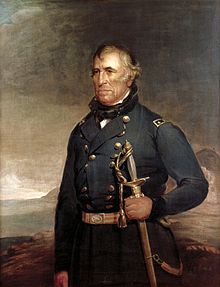
Official White House portrait of Zachary Taylor

President Zachary Taylor standing in front of his Cabinet, seated from left,
Reverdy Johnson, Attorney General,
William M. Meredith, Secretary of the Treasury,
William B. Preston, Secretary of the Navy,
George W. Crawford, Secretary of War,
Jacob Collamer, Postmaster General,
Thomas Ewing, Secretary of the Interior, and
John M. Clayton, Secretary of State.
Francis D'AvignonPublished by
Mathew Brady 1849
Judicial appointments[edit]
Historical reputation and memorials[edit]
Because of his short tenure, Taylor is not considered to have strongly influenced the office of the Presidency or the U.S.
[77] Some historians believe that Taylor was too inexperienced with politics, at a time when officials needed close ties with political operatives.
[77]Despite his shortcomings, the Clayton–Bulwer Treaty affecting relations with Great Britain in Central America is "recognized as an important step in scaling down the nation's commitment to
Manifest Destiny as a policy."
[77] While
historical rankings of Presidents of the United States have generally placed Taylor in the bottom quarter of chief executives, most surveys tend to rank him as the most effective of the four Presidents from the Whig Party.
Taylor was the last President to
own slaves while in office. He was the third of four Whig presidents,
[f] the last being Fillmore, his successor. Taylor was also the second president to die in office, preceded by William Henry Harrison who died while serving as President nine years earlier, as well as the only President elected from
Louisiana.
In 1883, the
Commonwealth of Kentucky placed a 50-foot monument topped by a life-sized statue of Taylor near his grave. By the 1920s, the Taylor family initiated the effort to turn the Taylor burial grounds into a national cemetery. The Commonwealth of Kentucky donated two adjacent parcels of land for the project, turning the half-acre Taylor family cemetery into 16 acres (65,000 m
2). On May 6, 1926, the remains of Taylor and his wife (who died in 1852) were moved to the newly constructed Taylor mausoleum, made of limestone with a granite base and marble interior, nearby. The cemetery property has been designated as the
Zachary Taylor National Cemetery.
[78]
The US Post Office released
the first postage stamp issue honoring Zachary Taylor on June 21, 1875, 25 years after his death. In 1938, Taylor would appear again on a US Postage stamp, this time on the 12-cent
Presidential Issue of 1938. Taylor's last appearance (to date, 2010) on a US postage stamp occurred in 1986 when he was honored on the
AMERIPEX presidential issue. After Washington, Jefferson, Jackson and Lincoln, Zachary Taylor was the fifth American president to appear on US postage.
[79]
Postage stamp, issue of 1875
Postage stamp, issue of 1938
He is the namesake for several names and places throughout the United States, including:
BEP engraved portrait of Taylor.
Assassination theories[edit]
Almost immediately after his death, rumors began to circulate that Taylor was poisoned by pro-slavery Southerners, and similar theories persisted into the 20th century.
[83] In 1978, Hamilton Smith based his assassination theory on the timing of drugs, the lack of confirmed cholera outbreaks, and other material.
[84] In the late 1980s, Clara Rising, a former professor at University of Florida, persuaded Taylor's closest living relative to agree to an exhumation so that his remains could be tested.
[85] The remains were exhumed and transported to the Office of the
Kentucky Chief Medical Examiner on June 17, 1991. Samples of hair, fingernail, and other tissues were removed, and radiological studies were conducted. The remains were returned to the cemetery and reinterred, with appropriate honors, in the mausoleum.
[86]
Neutron activation analysis conducted at
Oak Ridge National Laboratory revealed no evidence of poisoning, as
arsenic levels were too low.
[86][87] The analysis concluded Taylor had contracted "
cholera morbus, or
acute gastroenteritis", as Washington had open sewers, and his food or drink may have been contaminated. Any potential for recovery was overwhelmed by his doctors, who treated him with "
ipecac,
calomel,
opium, and
quinine (at 40 grains per dose), and bled and blistered him too."
[88] Political scientist
Michael Parentiquestions the traditional explanation for Taylor's death. Relying on interviews and reports by forensic pathologists, he argues that the procedure used to test for arsenic poisoning was fundamentally flawed.
[89][90] A 2010 review concludes: "there is no definitive proof that Taylor was assassinated, nor would it appear that there is definitive proof that he was not."
[91]


.jpg)


.jpg)