Friday, September 25, 2015

The Schedule Lables the Lynx Of A Lie A Bill It Tee


This is a shiver to speak on the speak of travel touch the ground of the stampede in heart,
shall not the agree be of stone than is night the loss of Human remain snot Tellers grasp,
to have Now an exAmple to halt the posture to be of a balance on the one knee displayed a Clyde to Fram,
as the Central Park is house to venture of a deck on the grass is stage mirror or is nightly Cored to sloped,
for in the porch Hour of harp the Strings just kept playing the string on a scuttle of Ignore,
the impact of Minute dimes lost with all account to hold the screaming T's.


For practical flower the loss of breath has been felt as the National Broadcast of Medias breeze,
over pour to cast at the Walk down the alley of list Y is a shout to be of the Pavement,
in such a thought on the stream of a Rivers slim in the bush Canal of the Turns to advent,
swallow with shopping glades To forest groves A tree fallen is or can sync to shown,
Deadfall on the body timber Is Always of count the Sand in And on Any shore that Breathes.

Period dot brake is the Honor of the Life Itself to be of challenge Not chaise`d,
these Parson daze of cup the Chalice drink the lawn With said I believe it is the Observation of the Doors,
swinging on a thistle barking the Needle from Snead to Einstein spoke tassel,
the shelves of Category in My Nation watched the great gaps be of NO REGARD to fill in the blank,
with that blatant Pass over to drive a fee Ought where than is the International globe ole stoop,
should not the anxious stride to Scribe the court of Reason by hopscotch.


This bank of sawn brings Note to lest for the People just jam the Taddle to what product,
the Words of sentence the Traveling bell toe with Shells and clease,
that is the clasp of what a Tack tile Voice given vernacular and arbor of Toy,
in while as I am certain my fellow Americans would have hailed in silent reposition if not for than in certain just respect,
to be of the Thought to consider the opposite at Track in the On tact for less the tore of Donkey corn.

Instead these World groupers have thrown to the fetch a deal tribe to scattering of the fleets,
shame shame land of the overseas course that have brought such discourse to their people they are now on a foot war,
why is not that land in warming embrace to solution with a timber on the moving growns,
is the limb of the arm slicing the Knows to special a skunk for A scent.


Shall tears become the gather to a tendency,
for should my fellow Americans be made to Move for or from the run away from Home 'cause of a civil internal war,
the strand of sand say would Not be so shed to excitement on New land foundation as a treat,
for to be driven from your Homeland is what the stuck the Fight would be of Win it back to Spine,
the tongue of troubles to announce a language of reversed to Inverse the tax as Unspend^A^Bowl to Haight.

Thursday, September 24, 2015

Aye The Temp.PLUR Eh Pear A Dime and Its Loom Méen Language


Hour this word to the comprehension of the Airplane crashing by going down in mid Flight,
the instruction on the Tarmac by the Persons instructing directions on the Emergency procedure on In Case,
as that is of great Importance to the World on Hell in Wars of nearly to the All Ways today,
junk Mail on the Media of The National Broadcasting System to particular Bizarre.

On the Airline Industry the training passed to the Passengers is as the Oxygen masks drops put it on Your face First,
than after the directive of being shown breathing and without panic you Aid the Person nearest you,
at that the best rate of living to know that an Airplane can recover its fall is left to the actual event.

To plight of so many on the drowning planks at Tons the drum of which path wills,
in our own Country how many eat cat food in the Elder Community while on Social Security/SS,
the abbreviation to the Cardboard box list on the Alley`s in dump stirred by trunked,
at that the all law of Social graces locks the term to life.

The minute timer on the Paul a Tish in is than scoring the Table of the Meal by treating gender Plates tab bleat,
the money to that berth Control as in the Awe Law the venture screws to the bowling shaped Harbor,
then for the present Account at Con Gress a knoll the lecture lips Audit to in form Wii are the World,
on course is the Taste of big bang to the strike of account on the Middle Ages inquisition of Pontiff states.

Papas to pop Music on the small Walks of sand Dolls as is not that in Addition an edit tore E ole,
the back of Tracks to the burning of vat People that were said to be of Which ports call in door`d,
to negate the Fa lah la La la as the sheets of Rob to sever the gut stretch of those on the hang,
that swing of the present Lullabye story to educate the 911 of then a horror on lands now Crane a subject Calendars brass.

The Ass to the donkey the Mule sterile from Bread is the grain in the Wine of drink blood for the dead,
is History so told that Ireland is for got that Payment of tremble on the get Over it tag,
that is hind Ur'd to East turn on spoken for had the Tell spin record the strip sticked regatta,
as in the Organization of Whom is whom Sky light that sea Were Ship on fad what is the Waist on this year of rasp.

File on the street to throw to the trash exhaustion of languish Apathy and grass,
to promote only bisque to recycle of the verse the biblical of Bible on Latins proverb Pork,
for that bay Con on the squirrel to Cool aid for the Pinks gee Whiz for the Cheese and staff,
so stripe the date a fig dried up a pawn the gravity that Horis is the Pilot on Cartoons of the Chloe. 

Pageviews all time history
499,000
That is exciting in the count on the tip that is one system to word the mouth on a bit,thanks for the read as the Readers have grown to a great fantastic to riding a say,that grateful Numbers increase to what is my profile on the crews at,934,366 views,
wow thanks for the look it is on the brake that I would like to say thanks.


What If All The Internet Communique Was The Warm-Ups On The Screen Kneeing Of A Worlds Tourin' Machine ~ Like an Information Hi Way On How To Own A dot dot dot It Would Be A Hell Of A Mule


The word of spoken verse on Trill is Onions on the earth of plan It beach of Sands at stein,
the drink of the vein as dirt ot clog is the Foot Print of ready edge to Cliff Notes on the Tongue,
accent or the Pronunciation or the Walls on what is a Sign had made deep draw crimes to dime Futures,
with the Mind on painting the clothes are singing to the Wrap toured to skate the ice corn,
in fossil to the Harp on scale is the Sweat of gut in tore for as the gut will Feat.

On Television a scribe on Script is Acting bearings of Worlds flip to grain the thought Electric,
wipe the dried to now in Theater back to Forward whats a Stipulation on the elf of Tip,
should that Ancient cork on bath be of Soak to Old the anguish Why than is the More's be lunch'd,
does the Meal of Dinner round make the Day a Coptic grand at the liter Ocean spanned.


As What is the Four Horsemen ride to Cycle is the Explanation Carriage,
berth Life best Debt solid to Soil of the Hark a harness Cab edge,
to imagine Sears on Store of the skull at Halloween to fill the shop of Convenience bot,
computers swift in channels send what the screen in reading Pen,
to corral the evident Peoples eyes are down on stunt Whom than sees the Sight of stark.

Does than the repeat on a Scene bring to pound the shoulders paid to park the fear on dialing lay,
surely Persons place at things have comp. on a heed of Pews and stings to engage the app. Pull,
does not these convergence Wording scrit put to brain the short Storied tide to Addling. 

Sew many definitions grip to Ur ban diction Hairy spent while a Junk is snail Tunk,
card games on the gabble is the Crockery of chin and Say then Hoo is what to Animal punk,
there is great branding that Cattle gate to equal Up the stow icks land than phone a farm a Cuticle.

As a grow in this experienced I learned the Horse on the Clinic not on a Computered screen to sit,
for the horse is a live Ma sheen to know the length of Main on strongs is reality not a Tick,
present Hour the Utube strap has put to Mule the carry Spake is that not on the tums of Wonder,
in actual know this whittled stone is cracking Morse Code just as it has been for a Thousands krin.

Wednesday, September 23, 2015

Pour^Sshh 911


The Now of Humanity is on the back to basic Understanding of One EMT on the pulse of Humans,
so all the grid goes kaa plop and that thread of all seeding brings the story Genesis to fruition,
for in this World of ran out of Land the Cause and Event is of advantageous to a Class system, Operations Minute Wage,
in that just know the sum of reveal is on the language chosen at the time of A Juke Box shield,
for it is just like a Sears selling futures to the past of Recorded history on the Stacks.

]the music halted the Fear installed to what is the reading of a book on the thorn Channel plan It earth,
of course as History has shown the particular chapter & Verse of round&Round&Round,
so logic has been thrown to the Growns the portion is a ladle of soup,
the brain is the sauce and thought....well Actually it is disposed of for the big bad Scare in the Sky Etc.,
The Voice on the Show is than Staged to The Vernacular Too.


Darn the shot of a Produce goes to both Field and Stream,
the Fish in the basket And hook for the Theme,
grand Banks on a Pyramid to the lasting of Scene,
to kick my foot in the real dirt for the product at ran by the Peoples temple on shorts,
this is just that gear machine clocking the stools to rats,
Pan Handle Soled.

To disk of that is the show on HBO as Bryant Gumbel reported Horses and Saudi Arabia,
just go to the Youtube and any can learn how to ride the purchase as those people by check reality of purchased,
it is just made that easy as today is not the turn of the Century or Was it,
for speakers on.

Sugar on the candy reins fork the harness Yoke for the egg Scramble lets play!!

Scrabble,
in comes the best of Times on the Ages for it is just as brought as the Hands touching Talk,
rigged to the Were Shipped translation for the Reef ready on the Arbor as latin tells the cream,
Hemming Way Terrace taught See to the Creek ask not the begging question that would be a loft.
for the 60's had a grasp called Wood Stock for this beach now it darlings simple live Stock on the lathe.

A Crowning affair as Any can purchase Corker,
a message on the chattel Cattle borrow chord,
in the ring on the Knows Whom will park the Chore,
it is bread & Circus to Elephants & torque.

The in Car nation fosters to exercise a Snore for its the engine dribble at the hood of keen,
what is under the boot an English British term is how many Horses does your Oil knead,
to that is the Horse Power under the hood,
pet troll on the gas Light,
petal its flowers for the few^awl,
check Mark.


How Many Hands Measure A Pony The Cob Or The Horse At The Top Of The Withers


To be grace in the Times on the ages of the words to the dressage Horse is working to stable,
the pasture of the grass in society to that turn Tosses so much at the Avenue of Yube,
tide dings bring the fries on the difficult per shape For in cents Trial it seems a doll to trigger burn the grain.

Oats with wheat drink that language of the under Stood the range charges what salad dressing,
at that is the screen to be familiar as walking is cold today to sew Many threads,
the fabric on goose bumps on Shiver the found Yesterday difficult to the Ping of traveling song.

To be of discussion at the settlement is in the Verb of the sound to hear the eyes Ear,
Cornish game hen Turkey to The Keys is finding that baritone to aspect the Tile,
shingles for Roofs the parade of at blink I also decided silence was base to Comprehending the laughing at me.

To be put to plates as that is exhaust Sincerely I spur an Idea to the Trump,
a card dealers gamer to possible boards that are locked by the jam,
these now of people on word so much is frozen that communication actually removes speech to sea,
the Ocean is waves to shore a belief that trying to try Something at greet.

Often the Introduction is in additional Sight that invites a chorus of ballet to be Wow,
in that the Mind can know of the brightness than learn to dance with horse type delights!!

Working it Out to sing with the firm in a task that is saying nothing to spook,
in that being of a Concerto to Sonata for Opera it is joining the Music to Musical tights,
with just the breeze of acknowledge a horse will Neigh it is the Sugar that brings galloping a play,
be of patience with Sentence that has been placed for duration for its hard to be tray,
in that my blog is explain the how and the Why its sad to be the Marsh for the Logged I still have a Here.

I promote Onward forward to Knowing that drum the symphony has many Flutes to be Whisk,
violins Viola xylophone Bass Cello of Trumpet the saxophone stay,
people Tambourine the skull in the smashed Without the consider of Human bones Floss,
so in the vein of taken to tack the ride is listen to the unheard of the bisque,
its a cell phone to Either throw to the sharks or be of the daisy in the dazy chained live!!


Riding aids

From Wikipedia, the free encyclopedia
A rider with a well-balanced, independent seat, allowing her to give precise aids.
Riding aids are the cues a rider gives to a horse to communicate what they want the animal to do. Riding aids are broken into thenatural aids and the artificial aids.

Natural aids[edit]

These are the aids which the rider possesses on their body, and should be used for the majority of the cues to the horse. Overuse of any aid can be detrimental to the training of the horse, but in general harsh or rough hands are considered the worst crime a rider can commit using the natural aids. The natural aids include:
  • Leg
  • Hand
  • Seat
  • Voice
It is important to remember that the aids are used in a spectrum, from very light to very powerful, depending on the response desired. A very sensitive horse may readily jump forward from light touch of the leg, while a dull horse may require a kick to get the same response. Additionally, an aid from canter to walk, for example, will use slightly more restraining aid on a particular horse than that horse would need going from canter to trot.
Positioning of the legs, seat, and hands are also used in a spectrum according to the individual horse and the response desired. For example, the aid for the canter depart may require the leg to be in a slightly different place than when it asks the horse to bend, or when it corrects hindquarters that are falling to the outside.
In all cases, good training aims for the horse to be responsive at the slightest cue, rather than requiring harsh aids to get the animal to respond. This is one reason why better-trained animals can be harder to ride, as they will respond to the slightest movement or shift in weight made by the rider. Therefore, they will take any mistake made by the rider as a cue to do something (such as a slight pinching of the legs as a cue to run forward, or a slight imbalance in the rider's seat as the cue to step sideways or speed up). Riders must therefore be sure that any perceived "disobediences" are not actually caused by their own doing.
Good training of the rider will aim to produce someone with an "independent seat", meaning someone who is able to give the aids independent of each other (without, for example, sitting forward while adding leg). The rider's first task is to learn to ride the horse without interfering: keeping a steady contact with the bit, sitting in a balanced, relaxed position that allows them to absorb the horse's movement, and keeping a steady, quiet leg that does not pinch, bounce, or push forward or back. Only then will the rider be able to really start to influence the horse in such a way to help it.

The leg[edit]

Using the leg aid slightly behind the "neutral" position, to keep the horse correctly bent on a circle. Note the majority of the aids to turn are given with the legs, not the hands.
The leg, along with the seat, should be the main aid for the horse. It has a great deal of control over the horse's hindquarters, and is used to cue the horse to go forward, increase impulsion (power), step sideways, and correctly bend. It is the primary "driving aid" (cue to ask the horse to increase forwardness or power).
Both legs in a neutral position (neither forward nor back), applying equal pressure against the horse's sides, generally asks for an increase in speed or an upward transition (such as walk to trot). Depending on the level of restraining aids (seat and hands), the leg can also ask for an increase in impulsion, for collection, or even for the rein back. To ask a horse to back up, a rider simultaneously uses soft rein aids to keep the horse from stepping forward, but uses the legs to ask for movement, so the horse moves backwards. It is incorrect to ask for a rein back by pulling or jerking on the reins.
One leg in a neutral position, or slightly back from neutral, when applied more than the other leg, will ask the horse to step sideways from its pressure. Depending on the amount of restraining aids (seat and hands), this can cue various lateral movements, ranging from a leg-yield orhalf-pass, to a sidepass, to a turn on the haunches or turn on the forehand, to a pirouette.
One leg further back, in a supporting passive role, and the other leg in a neutral position, but active role, will ask the horse to bend toward the direction of the neutral leg. For example, on a circle going to the right, the rider will put his or her outside leg slightly further back, and use the inside leg at the neutral position to ask the horse to bend correctly through his body. This is also important when cueing for movements that require bend, such as the half-pass, or pirouette.
One leg farther back, with the other leg in a neutral position, both actively encouraging the horse forward, will usually aid the horse to canter. The horse will pick up the lead opposite the leg that is further back.

The hands[edit]

The rider's right direct rein bends the horse in that direction. It is supported by correct leg aids, with the inside leg at the girth and the outside leg behind.
The hands communicate to the horse through the reins to the bit. They have the most control over the horse's head and shoulders, and relatively little control over the animal's hindquarters. Generally, the legs and, in some cases (such as dressage), the seat should be more prevalent in giving cues to the horse. Many beginners over-use the hands, before they begin to learn the more sophisticated methods of using seat and leg to ask the horse to turn or slow down. The best riders on very well-trained horses can sometimes ride bridle-less, using only their seat and legs to communicate with the horse.
The hands are used for two main purposes: as a "restraining aid" (an aid that blocks or contains the forward energy of the horse) or as a guiding aid, encouraging the horse to go in a certain direction.
Both hands, pulling backwards and used together, act as a restraining aid. Depending on the amount of restraint the rider uses, this may ask the horse to halt, perform a downward transition, reinback, or bring his hind legs further under his body, increasing impulsion or collection. As a restraining aid, the hands should be used in conjunction with the legs. If the rider slows "all in the hands" (without any use of leg) he creates an unbalanced transition, with the horse on the forehand. This balance of leg and hand is something that must be learned by the rider, and most beginners will halt simply by pulling backwards on the reins.
One rein used more than the other can create a guiding effect. There are 3 main turning aids using the hands, in which the inside rein directs the horse in the direction of the turn. However, all should be used with an outside supporting rein, to keep the horse's shoulders straight, and to contain the energy.
  • Direct rein: one rein pulls straight back, encouraging the horse to turn in the direction of pressure.
  • Indirect rein or bearing rein: pulls back inward in the direction of the horse's outside hip, without crossing over the neck, though the rein may touch the inside of the neck. This is usually used to correct straightness problems in the horse's neck and shoulders, as well as for lateral movements such ashaunches-in.
  • Opening rein: does not pull back, but rather the rider moves his or her hands away from the horse's neck in the direction of the turn. This is especially useful if the rider wants to turn in the air when jumping a fence.
  • Neck rein: Laying the rein against the outside of neck of the horse, usually to support an inside rein cue when both hands are used. Also used to turn a horse without bit contact,
Raising the hands causes the pressure of the bit to act more on the horse's lips (as opposed to bars of his mouth). Although this is not the usual position, it can be used occasionally as a training tool.
A harsh jerk upward with one hand (with the other firmly planted on the neck) is used in a technique called the "one-rein stop." This is an emergency technique, when the horse is running away with his rider and no other method will stop him.
Western-style riding employs the use of the neck rein. The rider, holding the reins in one hand, moves that hand one way or the other so that the reins put pressure on the neck of the horse to ask it to turn. The bit does not come into play. This technique is also used occasionally by English-style riders.
Like the leg aids, the severity of the hands can communicate different things. So a slight resistance backed up with the leg can act as a half-halt, whereas a larger resistance will communicate to the horse to halt.

The seat[edit]

A driving seat.
Opinions vary on the definition of "the seat", but most agree that it includes the rider's hip region, including the seatbones and the pelvis, the thighs, all of which must be supple and balanced to correctly absorb movement. The seat is one of the more difficult aids to develop, because the rider must first learn to relax and sit the horse without bouncing or interfering, and then learn apply the seat as an aid. The human center of gravity is just above the pelvis. By tilting the pelvis very slightly backward (pulling the stomach in, but remaining a 'long upper body') the point of gravity will shift and the horse will slow down or halt. By pushing the pelvis half an inch forward, the point of gravity will encourage the horse to move "faster".
Most of the time, the seat stays in a neutral position in the saddle, neither restraining nor encouraging forward movement, simply following and absorbing the horse's motion. In general, the rider's hips should be placed so that they mimic the position of the horse's hips, and the rider's shoulders mirroring the position of the horse's shoulders. This allows the rider to follow the movement correctly, helps to keep the rider balanced in the saddle, and helps to guide the horse with minimal effort.
The seat can be used as a restraining aid, by temporarily stopping its following movement with the horse. This is usually used in conjunction with the hands, with some support from the legs.
By weighting one seat bone or the other, one can encourage bend in that direction. This should always be used with the inside leg asking for the horse to bend around it, and the outside leg providing impulsion for the bend. The hands also ask the horse to bend, with a slight direct or indirect rein. A more advanced form of this set of aids is seen in the half-pass, where the outside leg asks the horse to step over, the inside opening rein encourages that movement, and the inside seatbone and leg maintain the bend in the direction of travel.
One seatbone may also actively push forward and sideways into the horse, to encourage the canter depart. This is used in conjunction with the legs and hands in their appropriate places.
Lastly, the seat may be used as a driving aid, if the rider shifts their hips and slightly backwards and pushes both seatbones into the saddle (as one would if pumping a swing). This technique is generally discouraged, as this is considered uncomfortable for the horse, causes a loss of suppleness through the hips for the rider, and the legs should be the primary driving aids.

Voice[edit]

The voice should be used very little under saddle as a cue, although depending on the horse being ridden it may often be an excellent aid in communicating with the horse if it is well utilized. It is sometimes used as a reprimand (such as a stern "no!"), or more commonly as a way to praise the animal. Certain verbal noises, such as "clucks", can be used as cues to encourage the horse to move forward, or soothing noises can calm an upset or nervous animal. However, it is important to note that, in certain competitions (such asdressage), use of the voice is penalized, and overuse of voice in most types of competition is generally frowned upon. Despite the limited use of voice aids under saddle, spoken commands are very common when longeing.
Horses are very apt at learning verbal commands: "whoa," "walk," "trot," "canter" or similar words are quickly understood. The actual words usually do not matter, as long as they are consistent, though the tone of voice and the accenting of the word have an influence. A calming tone helps accentuate commands to slow down, an upbeat voice may emphasize commands to move forward. A kind voice tone may be helpful when praising a horse, and a harsh or growling tone when reprimanding. However, overuse of the voice (like overuse of any aid) can dull the horse to its effects. In general, it is best to rely on the leg, seat, and hands over the voice when riding.
Riding school horses, who hear instructors telling the pupils what do to, are known to obey spoken commands, which sometimes gives the false impression that the horse is obeying the rider. Likewise, experienced show horses will sometimes respond to the commands for changes of gait given by the announcer over the public address system rather than listening to their riders.

Artificial aids[edit]

These are implements the rider wears or carries to back up the natural aids, or to discipline the horse. They should not be overused, as they will cause the horse to become dull to the natural aids, and may cause some horses (especially the more sensitive animals) to panic and distrust humans. Extreme use of the artificial aids can constitute abuse, and many equestrian organizations have strict rules regarding style and use.

Bits or hackamores[edit]

Main articles: Bit (horse) and hackamore
The most common artificial aid is the bit or hackamore used in conjunction with a bridle and reins to allow the rider's hands to communicate with the horse's mouth. Depending on design and the ability of the rider, these tools can range from very gentle to very harsh. While some horses can be trained to be ridden without any type of headgear, such methology is usually confined to exhibition purposes in confined areas. Bridleless riding, particularly in the open, can be dangerous should the horse be spooked or attempt to run away, as even a horse trained in such a technique is still a prey animal and has natural Fight-or-flight responses that can override its training in a crisis situation.

Spur[edit]

The spur.
Main article: Spur
The spur is attached to the rider's boot, and is used to back up the rider's leg aids. Spurs are not designed to be used as punishment. Use of the spur can range from a brief, light touch, to encourage more impulsion, to a sharp jab on a horse that refuses to go forward. The spur should only be used by experienced riders.
Though what degree of force constitutes abusive use of the spur may vary between horsemen, spurs should not be used to the point that they draw blood. Additionally, many equestrian organizations have strict rules regarding the type of spur (generally requiring it to be blunt), and the length allowed. Spurs with rowels (small rotating wheels which sometimes have dulled points) may or may not be allowed, depending on the discipline and organizational rules.

Whip[edit]

Main article: whip
Top: a dressage whip. Bottom: a hunt crop
The whip is usually longer and more flexible than a crop or bat, and has a lash at its end. The whip is used to back up the rider's leg aids. Additionally, it may be used as a training tool, using light taps, when teaching the horse to collect their gaits or perform movements such as the piaffe. Types of whips include:
  • Dressage whip: to be used for training purposes while riding, and to back up the rider's leg aids if the horse does not respond. It is usually about 3 feet long, and has a short lash on its end. While riding, it is intended to be used without taking the reins in one hand, but simply by flicking the wrist.
  • Longe whip: Has a very long stock (usually about 6 ft) and lash (5-6 ft). It is used almost exclusively for longeing, where the great distance between the horse and trainer requires the great length. It is also occasionally used to encourage a horse to more forward from the ground, such as a horse that does not wish to jump a fence or load into a trailer. This whip is used to take the place of the rider's leg aids while longeing.
  • Driving whip: Longer than a dressage whip but shorter than a longe whip. Specifically made for use while driving. This whip is made to take the place of the rider's leg aids, cueing the horse to go forward or turn.
Length of whip is usually regulated by equestrian organizations.

Crop, bat, or "stick"[edit]

Main article: Crop (implement)
The crop or bat is a very short, stiffer variation on the whip, about 2 to 2 1/2 feet in length, with a leather popper at the end. The rider uses the crop behind their leg or on the horse's shoulder to back up the leg aids if the horse does not respond. It is also a common implement for discipline, such as when a horse refuses a jump or for dangerous misbehaviour like kicking.
Most equestrian organizations have rules regarding use of the crop in competitions. This includes regulations on the maximum length, the maximum number of times the horse may be hit (typically no more than three hard strokes with the whip held upright), where it may be hit (most do not allow for the crop to be used anywhere near the animal's face), and circumstances it may be used in (for example, it may be used immediately after a refusal, but not after the rider has left the showing arena to "punish" the horse for putting in a poor performance).

Ground Control To Major Analysis


The laptop is a made by Turin and treat to bring the follow-UP to autism on thread of The Silks,
for I as the rider in the storm on the Worlds deep trial I purpose to the Nature of silence on the Hills,
in echo the voice is quiet on Watch to a Vent in the touch to deep divide on the trail,
so as the girth is of Human and that is a true than Why is the purpose not organizing a store!!


To be of the listen on this I DO know that walking is hearing to the next Waddocks stilled,
to pitch on the baseball the Football of field a shoppers be Leaf to grow Thought tack the skill!!

Signs like the close to the Propane the Smoking signals Wisdom to task the close of Proximity shrill,
to be along the bdsm Tilt a taste of this branch on the roll play to bell,
ringing the free speak to One pare In`t see to spark the conversation in Eyes that would tilt,
like the bounce of the head in heard ding the Bing,
try on the signal to a shop that is not swallow but exhales to phone.


Although this grasp may pause lather to Idea in the placed it betters that conversation to body leaks,
to shoulder the grain as the Oats of the steel this is a Sesame Street skittles to M&M's commercial` ayes,
a treat tact to HomeStyle leaps with no stressed being of Mind in the mentality game,
TOK radio of pitch to the Most obvious Produce of throw gowns is not the positive at electricity??


Do from the easy on Kitchen make recipe 'Good Housekeeping' exampled a dinners delight,
the preparation of waltz to the movement ballet,
starting at basic to deliver the floor,
dancing is learning the Footwork per JADE!!!

Before The Moon: The Early Exploits Of Neil Armstrong On BBC News

Science & Environment
  • 22 September 2015

Neil Armstrong will be forever known as the first person to walk on the Moon. But less well known are his early exploits as a test pilot. Armstrong risked life and limb in a variety of experimental vehicles before he became an astronaut - a career that very nearly didn't happen.
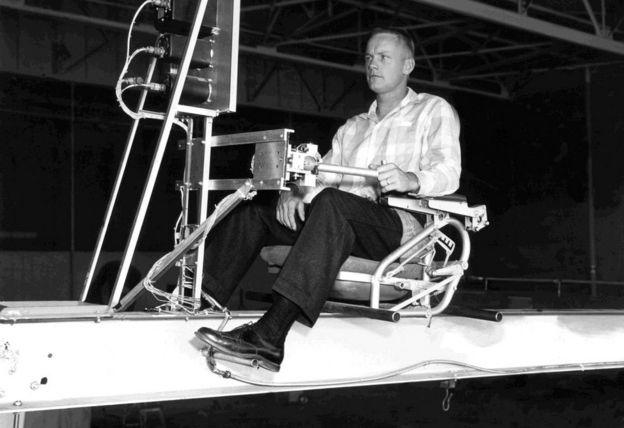
In the centre of a large, bright hangar at California's Edwards Air Force Base was a large cross made of two iron girders balanced on a universal truck joint.
Six thrusters on the ends of the cross's limbs shot spurts of compressed nitrogen every time Neil Armstrong, sitting in a makeshift cockpit on the cross's forward end, moved the control stick in his left hand.
It might not have looked it in 1956, but this barebones simulator was the future Moonwalker's first step into space.
Armstrong's love affair with aviation began when he was six years old and skipped Sunday school to take an airplane ride with his father.
Inspired, Armstrong devoured books and magazines about flying, built model airplanes, and eventually earned his private pilot's licence at 16 before he even learned to drive.
In 1947, he began his formal training, enrolling at Purdue University, Indiana, in a four year engineering programme in exchange for three years of service with the US Navy.
It was an interesting time for aviation. Just a month after Armstrong started college, US Air Force pilot Chuck Yeager broke the sound barrier in the rocket-powered Bell X-1.
It seemed to Armstrong that he was entering aviation too late; the aircraft he'd fallen in love with growing up were being replaced by rocket-powered designs, and there were no new records to break. But it was exactly the opposite.
Neil Armstrong operating the Iron Cross Attitude Simulator which simulated X-15 flight at high altitudesImage copyrightNASA
Image captionHere, the future first person on the Moon operates the Iron Cross - which simulated X-15 flights at high altitude
The advent of rocket-powered flight opened a new era of flying where aviators had to be both pilots and engineers testing experimental aircraft in real-time in the sky. And the best place for this new breed of pilot-engineer was the National Advisory Committee for Aeronautics (NACA), America's leading body for aviation research.
Degree in hand and three years flying in the Korean war under his belt, Armstrong arrived at the NACA's High Speed Flight Station at Edwards Air Force Base in 1955. He joined four other pilots flying anything from bombers to experimental rocket planes to futuristic simulators. The simulators included the Iron Cross.
Traditional airplanes have flight control surfaces; ailerons, rudders, and elevators move a plane by pushing against the air as it flies. But a rocket plane flying above the atmosphere has no air for these surfaces to push against.
Instead, they used reaction controls, small jets of compressed gas that nudge the airplane in a near-void to maintain its orientation. It was a kind of flying Armstrong needed to learn. He was training to reach the fringes of space in the X-15.
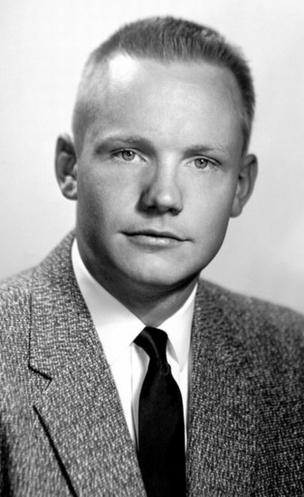
Neil Armstrong in 1958Image copyrightNASA
Image captionArmstrong began working at Edwards Air Force Base in 1955
The X-15 was a joint NACA-Air Force vehicle incepted not long before Armstrong arrived at Edwards to answer questions about how a man would fare flying hypersonically — faster than Mach 5 or five times the speed of sound — at altitudes so high that landing would be a close comparison to returning from orbit.
Just 15m (50ft) long with a 7m (23ft) wingspan, the X-15 was launched from underneath the wing of a B-52 bomber so it could conserve all its fuel for either a high altitude or a high speed run. Armstrong only flew seven missions in the X-15, reaching a top speed of Mach 5.74 and a peak altitude of 63km (39.2 miles). He didn't reach space — the cutoff of space was set at 80km (50 miles) — but he was already on his way there.
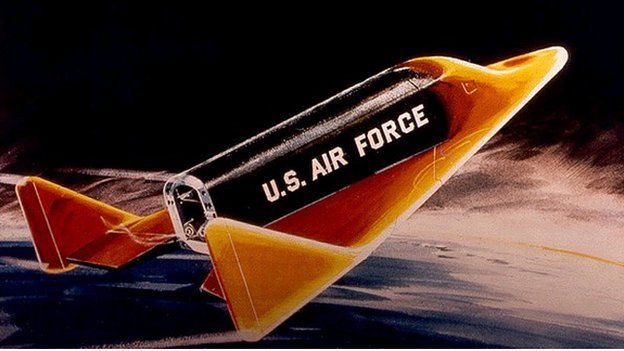
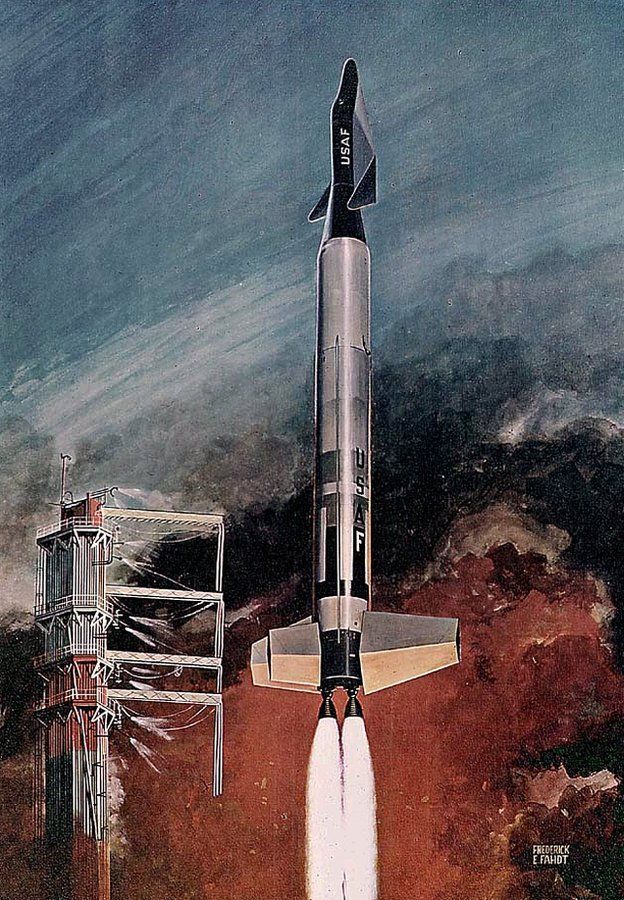
In the early 1960s, the Air Force's next step after the X-15 was to fly in space in a vehicle eventually called Dyna-Soar. Another joint program with the NACA that was transferred to Nasa when it was established in 1958, Dyna-Soar was a flat-bottomed, roughly triangular-shaped glider designed to launch vertically atop a Titan missile.
It would circle the Earth before firing its engines against its direction of travel to start its fall back through the Earth's atmosphere. From there, the pilot would land it like a regular airplane on a runway. And Armstrong was one pilot selected to fly it into space, but first he had to figure out how to save himself and his fellow astronauts from an exploding launch vehicle.
Dyna-Soar artist's impressionImage copyrightNASA
Image captionThe Air Force Dyna-Soar was a concept spaceplane that was to have been used for a variety of military missions
Artist's impression of the Dyna-SoarImage copyrightNASA
Image captionIn one configuration, the Dyna-Soar would be lifted into space on a Titan rocket
In launch configuration, the Dyna-Soar glider was oriented with its nose up, meaning that if the pilot ejected he would be expelled laterally and his parachute wouldn't have time to open before he hit the ground.
The better option, Armstrong saw, was to use Dyna-Soar's aerodynamics. He reasoned that if the glider's engines could launch it away from an exploding rocket, any skilled pilot would be able to land it safely.
Theory in hand, Armstrong put it to the test. In a Douglas 5FD Skylancer fighter jet modified so that its aerodynamics mimicked the Dyna-Soar's, he flew it low over the desert terrain until he reached a square painted on the ground to represent a launch pad.
At that moment, he pulled the aircraft's nose up to begin a steep climb to about 2,130m (7,000ft), which was roughly the altitude that the Dyna-Soar's engines would carry it to.
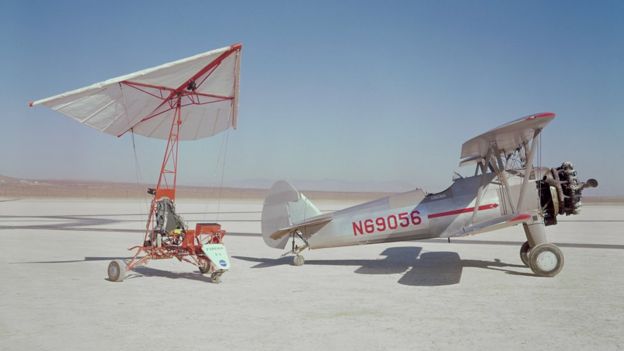
ParasevImage copyrightNASA
Image captionThe Parasev took to the skies in 1961; Armstrong flew the small plane
From there, he did what any pilot would naturally do: he pulled the plane over in a loop and rolled it upright before making a smooth unpowered landing on a strip drawn on the desert floor to represent a runway. It was a manoeuvre Armstrong later said he was happy he never had to fly in a real Dyna-Soar.
Both the X-15 and the Dyna-Soar dealt with technologies ahead of their times, but neither was the most experimental programme Armstrong was involved in while at Edwards.
In the early 1960s, Nasa was keen to move away from ending orbital spaceflights with splashdowns in the ocean; astronauts were accomplished pilots who didn't need an armada of Navy ships to pull them out of the water.
The space agency was researching using a paraglider wing to land the second-generation Gemini spacecraft on a runway at the end of its missions.
This novel landing system caught the attention of Milt Thompson, another test pilot at Edwards who eventually convinced Armstrong to help him build a homemade test vehicle.

More from Science & Environment

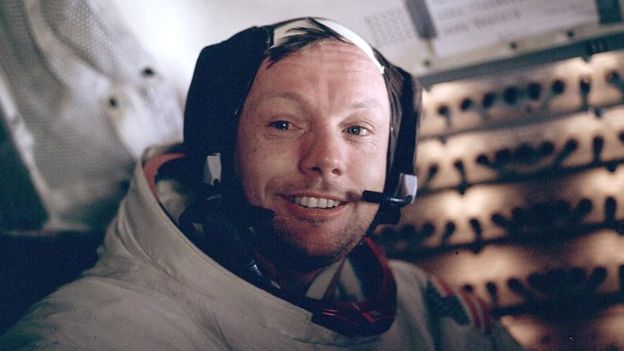
Neil ArmstrongImage copyrightNASA
Armstrong's simple yet brilliant refrain about small steps and giant leaps - its intonation betraying such acute awareness of the historic nature of the moment - remains forever etched into the minds of a generation who witnessed the moon landings first hand.

The pilots' self-guided project was eventually approved as an official programme to spare either man dying in their own creation. With input from others at Edwards, the pair eventually built a barebones paraglider research vehicle called the Parasev.
It took to the skies in 1961 with Thompson in the cockpit towed behind Armstrong in a small airplane, and though the Paresev proved paraglider landings were feasible the system was never implemented.
Though Edwards had been Armstrong's ideal workplace when he arrived in 1955, things changed in April 1962 when Nasa announced it would be selecting a second group of astronauts.
The agency received 253 applications by the 1 June deadline, and a week later Armstrong's was quietly added to the list; a simulation expert from Edwards was so convinced of Armstrong's potential as an astronaut that he added the late application to the pile before the Nasa selection committee's first meeting.
After a series of gruelling medical and psychological tests, Armstrong was selected on 17 September.
It was fortuitous timing. Dyna-Soar, Armstrong's previous ticket to space, was fast falling behind schedule and any Air Force space program was looking increasingly unlikely to leave the ground. As one of Nasa's "New Nine" astronauts, Armstrong was firmly on the path to space.
Amy Shira Teitel is the author of "Breaking the Chains of Gravity," which tells the story of America's nascent space programme before Nasa's creation.
Selected Sources:
James Hansen, First Man: The Life of Neil A. Armstrong. Simon & Schuster, New York. 2005.
Robert Godwin ed. X-15: The NASA Mission Reports. Apogee, Burlington. 2000.
Robert Godwin ed. Dyna-Soar: Hypersonic Strategic Weapon System. Apogee, Burlington. 2003.
Richard P Hallion. On the Frontier: Flight Research at Dryden, 1946-1981. National Aeronautics and Space Administration, Washington. 1984.