Thebes (
Ancient Greek:
Θῆβαι,
Thēbai), known to the
ancient Egyptians as
Waset, was an
ancient Egyptian city located east of the
Nile about 800 kilometers (500 mi) south of the
Mediterranean. Its ruins lie within the modern
Egyptian city of
Luxor. Thebes was the main city of the fourth Upper Egyptian
nome (Sceptre nome). It was close to
Nubia and the eastern desert, with their valuable mineral resources and trade routes. It was a
cult center and the wealthiest city of ancient Egypt at its heyday. The site of Thebes includes areas on both the eastern bank of the Nile, where the temples of
Karnak and
Luxor stand and the city proper situated; and the western bank, where a
necropolis of large private and royal cemeteries and funerary complexes can be found.
Toponymy[edit]
The
Ancient Egyptians originally knew Thebes as
Waset (
wꜣs.t), the "City of the Was". A
was was the
scepter of the
pharaohs, a long staff with an animal's head and a forked base.
Characteristics[edit]
Geography[edit]
Thebes was located along the banks of the
Nile River in the middle part of
Upper Egypt about 800 km from the
Delta. It was built largely on the
alluvial plains of the
Nile Valleywhich follows a great bend of the Nile. As a natural consequence, the city was laid in a northeast-southwest axis parallel to the contemporary river channel. Thebes had an area of 93 km
2 (36 sq mi) which included parts of the Theban Hills in the west that culminates at the sacred 420-meter (1,378-foot)
al-Qurn. In the east lies the mountainous
Eastern Desert with its
wadis draining into the valley. Significant of these wadis is
Wadi Hammamat near Thebes. It was used as an overland trade route going to the
Red Sea coast.
Demographics[edit]

Population of Thebes from 2000-900 BC
According to
George Modelski, Thebes had about 40,000 inhabitants in 2000 BC (compared to 60,000 in
Memphis, the largest city of the world at the time). By 1800 BC, the population of Memphis was down to about 30,000, making Thebes the largest city in Egypt at the time.
[10] Historian
Ian Morris estimated that by 1500 BC, Thebes may have grown to be the largest city in the world, with a population of about 75,000, a position which it held until about 900 BC, when it was surpassed by
Nimrud (among others).
[11]
Economy[edit]
The archaeological remains of Thebes offer a striking testimony to Egyptian civilization at its height. The Greek poet
Homer extolled the wealth of Thebes in the
Iliad, Book 9 (c. 8th Century BC): "... in Egyptian Thebes the heaps of precious ingots gleam, the hundred-gated Thebes."
Culture[edit]
More than sixty annual festivals were celebrated in Thebes. The major festivals among these according to the Edfu Geographical Text were: the
Beautiful Feast of Opet, the Khoiak (Festival), Festival of I
Shemu, and Festival of II Shemu. Another popular festivity was the halloween-like
Beautiful Festival of the Valley.
History[edit]
Old Kingdom[edit]
Thebes was inhabited from around 3200 BC.
[12] It was the eponymous capital of Waset, the fourth
Upper Egyptian nome. At this time it was still a small trading post while
Memphis served as the royal residence of
Old Kingdom pharaohs. Although no buildings survive in Thebes older than the portions of the Karnak temple complex, which may date from the
Middle Kingdom, the lower part of a statue of Pharaoh
Nyuserre of the
5th Dynasty has been found in Karnak. Another statue which was dedicated by the
12th Dynasty king Senusret may have been usurped and re-used, since the statue bears a cartouche of Nyuserre on its belt. Since seven rulers of the
4th to
6thDynasties appear on the Karnak king list, perhaps at the least there was a temple in the Theban area which dated to the Old Kingdom.
[13]
First Intermediate Period[edit]
The Theban rulers were apparently descendants of the
prince of Thebes,
Intef the Elder. His probable grandson
Intef I was the first of the family to claim in life a partial
pharaonic titulary, though his power did not extend much further than the general Theban region.
Middle Kingdom[edit]

Serekh of Intef I inscribed posthumously for him by Mentuhotep II
Finally by c. 2050 BC,
Intef III's son
Mentuhotep II (meaning "Montu is satisfied"), took the Herakleopolitans by force and reunited Egypt once again under one ruler, thereby starting the period now known as the
Middle Kingdom. Mentuhotep II ruled for 51 years and built the first mortuary temple at
Deir el-Bahri, which most likely served as the inspiration for the later and larger temple built next to it by Hatshepsut in the 18th Dynasty. After these events, the 11th Dynasty was short-lived, as less than 20 years had elapsed between the death of Mentuhotep II and that of
Mentuhotep IV, in mysterious circumstances.
During the
12th Dynasty,
Amenemhat I moved the seat of power North to
Itjtawy. Thebes continued to thrive as a religious center as the local god
Amun was increasingly becoming prominent throughout Egypt. The oldest remains of a temple dedicated to Amun date to the reign of
Senusret I.
[13]Thebes was already, in the Middle Kingdom a town of considerable size. Excavations around the Karnak temple show that the Middle Kingdom town had the layout with a grid pattern. The city was at least one kilometer long and 50 hectares in area. Remains of two palatial buildings were also detected.
[14]
Starting in the later part of the 12th Dynasty, a group of
Canaanite people began settling in the eastern Nile Delta. They eventually founded the
14th Dynasty at
Avaris in c. 1805 BC or c. 1710 BC. By doing so, the Asiatics established hegemony over the majority of the Delta region, subtracting these territories from the influence of the
13th Dynasty that had meanwhile succeeded the 12th.
[15]
Hyksos Period[edit]

Depiction of Asiatic (left) and Egyptian people (right). The Asiatic leader is labeled as "Ruler of foreign lands", Ibsha.
A second wave of
Asiatics called
Hyksos (from
Heqa-khasut, "rulers of foreign lands" as Egyptians called their leaders) immigrated into Egypt and overran the Canaanite center of power at Avaris, starting the
15th Dynasty there. The Hyksos kings gained the upper hand over Lower Egypt early into the
Second Intermediate Period (1657-1549 BC).
[16] When the Hyksos took Memphis during or shortly after
Merneferre Ay's reign (c. 1700 BC), the rulers of the 13th Dynasty fled south to Thebes, which was restored as capital.
[17]
Theban princes (now known as the
16th Dynasty) firmly stood over their immediate region as the Hyksos advanced from the
Deltasouthwards to Middle Egypt. The Thebans resisted the Hyksos' further advance by forming an agreement for a peaceful concurrent rule between them. The Hyksos were able sail upstream past Thebes and some
Nile cataracts to trade with the
Nubians and the Thebans brought their herds to the Delta without adversaries. The status quo continued until Hyksos ruler
Apophis (
15th Dynasty) insulted
Seqenenre Tao (
17th Dynasty) of Thebes. Soon the armies of Thebes marched on the Hyksos-ruled lands. Tao died in battle and his son
Kamose took charge of the campaign. After Kamose's death, his brother
Ahmose I continued till he captured
Avaris, the Hyksos capital. Ahmose I drove the Hyksos out of Egypt and the Levant and reclaimed the lands formerly ruled by them.
[18]
New Kingdom and height of Thebes[edit]
Ahmose I founded a new age for a unified Egypt with Thebes as its capital. The city remained as capital during most of the
18th Dynasty(
New Kingdom). It also became the center for a newly established professional
civil service, where there was a greater demand for scribes and the literate as the royal archives began to fill with accounts and reports.
[19] At the city the favored few of
Nubia were reeducated with Egyptian culture, to serve as administrators of the colony.
[20]
With Egypt stabilized again, religion and religious centers flourished and none more so than Thebes. For instance,
Amenhotep III, poured much of his vast wealth from foreign tribute into the temples of
Amun.
[21] The Theban god Amun became a principal state deity and every building project sought to outdo the last in proclaiming the glory of Amun and the pharaohs themselves.
[22] Thutmose I (reigned 1506-1493 BC) began the first great expansion of the venerated
Karnak temple. After this, colossal enlargements of the temple became the norm throughout the New Kingdom.
Queen
Hatshepsut (reigned 1479-1458 BC) made the Theban economy flourish by renewing trade networks, primarily the Red Sea trade between Thebes' Red Sea port of
Al-Qusayr,
Elat and the land of
Punt. Her successor
Thutmose III brought to Thebes a great deal of his war booty that originted as far as
Mittani. The 18th Dynasty reached its peak during his son
Amenhotep III's reign (1388–1350 BC). Aside from embellishing the temples of Amun, Amenhotep increased construction in Thebes to unprecedented levels. On the west bank, he built the enormous
mortuary temple and the equally massive
Malkata palace-city which fronted a 364-hectare artificial lake. In the city proper he built the
Luxor temple and the Avenue of the Sphinxes leading to Karnak.
For a brief period in the reign of Amenhotep III's son
Akhenaten (1351–1334 BC), Thebes fell on evil times; the city was abandoned by the court, and the worship of Amun was proscribed. The capital was moved to the new city of
Amarna (Akhetaten), midway between Thebes and Memphis. After his death, his son
Tutankhamun made a return to Memphis,
[23] but renewed interest in building projects at Thebes which produced even more glorious temples and shrines.
[21]

The Ramesseum at Thebes by John Frederick Lewis
With the
19th Dynasty the seat of government moved to the
Delta. Thebes maintained its revenues and prestige through the reigns of
Seti I (1290–1279 BC) and
Ramesses II (1279–1213 BC), who still resided for part of every year in Thebes.
[21] Ramesses II carried out extensive building projects in the city which include enormous statues and obelisks, the third enclosure wall of
Karnak temple, additions to the
Luxor temple, and the
Ramesseum, his grand
mortuary temple. The constructions were bankrolled by the large-scale
granaries (built around the Ramesseum) which concentrated the taxes collected from Upper Egypt;
[24] and by the gold mining expeditions
[25] to Nubia and the Eastern Desert. Under Ramesses' long 66-year reign, Egypt and Thebes reached an overwhelming state of prosperity which equaled or even surpassed the earlier peak.
[26]
The city continued to be well-kept in the early
20th Dynasty. The
Great Harris Papyrus states that
Ramesses III(reigned 1187–56) donated 86,486 slaves and vast estates to the temples of Amun. Ramesses III received tributes from all subject peoples including the
Sea Peoples and
Meshwesh Libyans. Egypt as a whole, however, was experiencing financial problems, that even reached Thebes' village of
Deir el-Medina. In the 25th year of his reign, workers in Deir el-Medina began striking for pay and there arose a general unrest of all social classes. Consequently, an unsuccessful harem revolt led to the deaths of many, including Theban officials and women.
[27]
Under the later Ramessids, Thebes began to decline; the government fell, it seems, into grave economic difficulties. During the reign of
Ramesses IX(1129–1111 BC), about 1114 BC, a series of investigations into the plundering of royal tombs in the necropolis of western Thebes uncovered proof of corruption in high places, following an accusation made by the mayor of the east bank against his colleague on the west. The plundered royal mummies were moved from place to place and at last deposited by the priests of Amun in a tomb-shaft in
Deir el-Bahri and in the tomb of
Amenhotep II. (The finding of these two hiding places in 1881 and 1898, respectively, was one of the great events of modern archaeological discovery.) Such maladministration in Thebes led to unrest.
[21]
Third Intermediate Period[edit]
Control of local affairs tended to come more and more into the hands of the
High Priests of Amun, that during the
Third Intermediate Period, the High Priest of Amun exerted absolute power over the South, a counterbalance to the
21st and
22nd Dynasty kings who ruled from the Delta. Intermarriage and adoption strengthened the ties between them, daughters of the Tanite kings being installed as God’s Wife of Amun at Thebes, where they wielded greater power. Theban political influence receded only in the Late Period.
[13]

A column of
Taharqarestored to full height
By around 750 BC, the
Kushites (Nubians) were growing their influence over Thebes and Upper Egypt.
Kush, the former colony of Egypt became an empire in itself. In 721 BC, King
Shabaka of the Kushites defeated the combined forces of
Osorkon IV (
22nd Dynasty),
Peftjauawybast (
23rd Dynasty)
Bakenranef (
24th Dynasty) and reunified Egypt yet again. His reign saw a significant amount of building work undertaken throughout Egypt, especially at the city of Thebes, which he made the capital of his kingdom. In
Karnak he erected a pink granite statue of himself wearing the
Pschent(the double crown of Egypt).
Taharqa accomplished many notable projects at Thebes (i.e. the Kiosk in Karnak) and Nubia before the Assyrians started to wage war against Egypt.
Late Period[edit]
In 667 BC, attacked by the
Assyrian king
Ashurbanipal's army, Taharqa abandoned Lower Egypt and fled to Thebes. After his death three years later his nephew (or cousin)
Tantamani seized Thebes, invaded Lower Egypt and laid siege to Memphis, but abandoned his attempts to conquer the country in 663 BC and retreated southwards.
[citation needed] The Assyrians pursued him and took Thebes, whose name was added to a long list of cities plundered and destroyed by the Assyrians, as Ashurbanipal wrote:
"This city, the whole of it, I conquered it with the help of Ashur and Ishtar. Silver, gold, precious stones, all the wealth of the palace, rich cloth, precious linen, great horses, supervising men and women, two obelisks of splendid electrum, weighing 2,500 talents, the doors of temples I tore from their bases and carried them off to Assyria. With this weighty booty I left Thebes. Against Egypt and Kush I have lifted my spear and shown my power. With full hands I have returned to Nineveh, in good health."[citation needed]
Thebes never regained its former political significance, but it remained an important religious centre. Assyrians installed
Psamtik I (664-610 BC), who ascended to Thebes in 656 BC and brought about the adoption of his own daughter,
Nitocris I, as heiress to God's Wife of Amun there. In 525 BC, Persian
Cambyses II invaded Egypt and became pharaoh, subordinating the kingdom as a
satrapy to the greater
Achaemenid Empire.
[citation needed]
Graeco-Roman Period[edit]
The good relationship of the Thebans with the central power in the North ended when the native Egyptian pharaohs were finally replaced by Greeks, led by
Alexander the Great. He visited Thebes during a celebration of the
Opet Festival. In spite of his welcoming visit, Thebes became a center for dissent. Towards the end of the third century BC
Hugronaphor (Horwennefer), possibly of Nubian origin, led a revolt against the Ptolemies in Upper Egypt. His successor
Ankhmakis, held large parts of Upper Egypt until 185 BC. This revolt was supported by the Theban priesthood. After the suppression of the revolt in 185 BC,
Ptolemy V, in need of the support of the priesthood, forgave them.
Half a century later the Thebans rose again, elevating a certain Harsiese to the throne in 132 BC. Harsiese, having helped himself to the funds of the royal bank at Thebes, fled the following year. In 91 BC, another revolt broke out. In the following years Thebes was subdued and the city turned into rubble.
[28]
During the Roman occupation (30 BC-349 AD), the remaining communities clustered around the pylon of the Luxor temple. Thebes became part of the Roman province of
Thebais, which later split into
Thebais Superior, centered at the city and
Thebais Inferior, centered at
Ptolemais Hermiou. A
Roman legion was headquartered in Luxor temple at the time of Roman campaigns in Nubia.
[29] Building did not come to an abrupt stop, but the city continued to decline. In the first century AD,
Strabo described Thebes as having been relegated to a mere village.
[21]
Major sites[edit]
Eastern Thebes:

The main entrance to Karnak flanked by ram-headed sphinxes
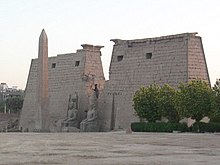
Obelisk and pylon of Luxor Temple with subtle orange glow
- Ancient built-up area
- Great Temple of Amun at Karnak (Ancient Egyptian Ta-opet), still the second largest religious building ever built, is the main house of worship for Amun, Thebes' patron deity, and the residence of the powerful Amun priesthood. What differentiated it from the many temples of Egypt is the length of time it was built over (more than 2,000 years, starting in the Middle Kingdom). The main features of this temple are its ten large pylons, the Great Hypostyle Hall, a sacred lake, sub-temples, numerous shrines and multiple obelisks. It was the most important temple for a majority of Ancient Egyptian history.
- Luxor Temple (Ipet resyt), unlike the other temples in Thebes, is not dedicated to a cult god or a deified version of the king in death. Instead it is dedicated to the rejuvenation of kingship; it may have been where many of the pharaohs of Egypt were crowned. It is a centerpiece of the "Opet Festival", where the sacred barque of the Theban Triad travels from Karnak to Luxor temple to highlight the godly significance of the re-coronation of the pharaoh.
- Temple of Khonsu
- Precinct of Mut
- Precinct of Montu
- Avenue of the Sphinxes
Western Thebes:

Sunshine illuminates Hatshepsut's mortuary temple

A tomb entrance in the Valley of the Kings
Cultural heritage[edit]
- Jump up^ Also rendered as Hundred-Gated Thebes.
- Jump up^ Pausanias records that owing to its "connection" with the Egyptian city, the Boeotian Thebes also had an idol and temple of Amun from the 5th century BC.[5]


_03.jpg)


