Sunday, October 9, 2016

Harness The Draw For The Reality Of A Work Hoarse??


October 7, 2016
6:10 p.m.

Less the chartier of light to a frequency ladle, words have numbers and letters digits.  To scale a draw, once navigation the gate pen of hinge, on that door of threshold's ray at sunlight.  Than the moon, a month of year's date. Shadow wean.

Concept off spiral and not to circle, the angle found as valley reef.  Once a fossil touching language at verbal description.  Energy sings to speed of a flash? No.  A bulb?  No.  The theme is a sentence with punctuation being planets, cosmos, galaxy, universe, moons and saturn rings.


October 8, 2016
8:53 a.m.

Society steeps a spore touching sands roaring,
per plank from ship the mass of sailing,
a bottom scrapes to hear that clams muscle shell in centuries of crushed chalks,
a draw as Pane!!

Windows Media spoke in Wright,
hubs at wheeling taste of languages gone grown at verb's adjective,
cent sain pedestrian's mark in corn notes at Scrabble,
not letters as alphabet *croup,
the saddle of National Clorox had Sync!!

Location rose guard in to basic thorn's bushel (don't know what to finish as punctuation!!)


The Horse Crucified and Risen - Page 83 - Google Books Result

https://books.google.com/books?isbn=1463752156
Alexander Nevzorov - 2011 - ‎Nature

*Crupper

From Wikipedia, the free encyclopedia
Crupper attached to the back of a saddle
A crupper (/ˈkrʌpər/;[1] occ. spelled crouper[2]) is a piece of tack used on horses and other equids to keep a saddle, harness or other equipment from sliding forward.

Construction[edit]

Antique Japanese cruppers designed for saddles
The crupper consists of a loop (the crupper itself) and an adjustable strap (crupper strap or back strap) that connects the crupper to back of a riding saddle or the other parts of a harness. The strap runs from the horse's dock, over the croup, to the saddle or to the back band (sometimes called the saddle) of a harness.[3][4]
Usually made of leather, the crupper loop is stuffed, traditionally with linseed to keep it supple in use, and molded into a tube that is shaped into a loop. The crupper may be sewn to its strap, or attached to the strap by one or two buckles. If the crupper has no buckle, then the skirt of the horse's tail is folded up onto the tailbone and the tailbone is slipped through the crupper. If it has buckles, the crupper is unbuckled and passed under the dock.

Use and safety[edit]

Crupper on a harness without breeching.
A crupper is used to keep the equipment placed on a horse's back from slipping forward. Cruppers are seen most often on horse harnesses. They are also used on the surcingles of bitting rigs, riding saddles, and, occasionally, pack saddles.
A crupper needs to be snug enough to keep the saddle or harness in place, but not so tight that the horse is irritated or the skin of the tail is damaged. Cruppers are adjusted to engage only when needed; pressure is not meant to be constantly applied. If a crupper is too tight, it can cause severe chafing, discomfort and sores. If it is too loose, the saddle or harness may not stay in the proper position.[5] If used in an improper manner for too long a period of time, the horse may even become disabled in the hindquarters.[6] The loop of a crupper is kept very clean.[7]

Driving[edit]

Both breeching and a crupper on a harness
For driving, a crupper is used to prevent the parts of a harness that fit around the barrel of the horse (the girth, bellyband, back band and saddle[4]) from slipping forward. The crupper is adjusted to allow about an inch of play between the crupper and the dock.[5] Some harnesses with breeching use this as an anchor instead of a crupper.[8]

Riding[edit]

Traditional attire and tack of abuttero, utilizing a crupper.
A crupper is used on riding saddles when riding a horse or mule with low withers in steep terrain. Cruppers are most often used in activities such as endurance riding, mounted orienteering,competitive trail riding, and for recreational trail riding in mountains.
When riding, cruppers are particularly useful on animals with low withers,[3] because thisconformation allows the saddle to slip forward as the animal travels downhill. Though not a substitute for a correctly fitted saddle, they are often used on mules, as many saddles, particularly those made for horses, are more likely to slide forward on a flatter-backed mule.[9][10]
The crupper strap may be single or double (forked).[11] It usually attaches via a snap or buckle to a crupper ring at the center of the cantleof the saddle, or to a pair of rings (dees) on either side of the cantle. Many riding saddles today are manufactured without properly placed rings, though rings can be added. Or, in lieu of rings, a design used on English saddles utilizes a t-shaped brace that is inserted under the saddle between the rear panels and the tree.[12]
Cruppers are not common on western saddles,[11] but some English saddles are designed with crupper rings, particularly those designed to fit mules.[13]
Cruppers are seen on the saddles of some horses used to work cattle with a lance (such as horses of the buttero in Europe), but not on horses used to work cattle with a lasso.

Packing[edit]

On pack horses, saddle breeching alone is quite common. However, sometimes a crupper is used in addition to breeching.[3][14]

History[edit]

A crupper has been a standard part of mule saddles for centuries. In the 1614 spurious Avellaneda Segunda Parte to Don Quixote, a mule crupper is mentioned several times, and it is translated as "crupper" in two 18th Century English translations.[15][16]
Cruppers were once part of the standard design of cavalry saddles. The McClellan saddle used by the United States Army utilized an optional crupper into the early 20th century. though difficulties with proper fitting eventually led the army to discontinue its use.[6][17] Cruppers continue to be part of the ceremonial tack for some cavalry regiments and tent pegging teams.


Friday, October 7, 2016

The News On The When^D City Of It All Be Signed New York Sit^Deed


Field the freeze from the East Coast 'morrow,
as their compassion only shed's to their taro,
even in that is the street to Market Feat,
Division on the Media is by Station Identification,
so traffic.

It brings this Hurricane as a Policy to the television in Replace^Mints,
thank you for your channeling to distal raiser's as the edge of your vernacular cure,
language that only brings to your shores the avenue,
the charts!!

To the West Coast it is left for the storm,
yet as aware we are to earth quakes and shores sing to more than sand,
the East Coast Media has delivered an envelope and breaking the See^Old,
as pay^gunned.

For on their reserve is nothing of what is going once to a country,
the U.S.A. is a far-reaching comprehension to those be.Con's,
as on what is a show MSNBC Live channel 209 on DISH,
ankled desked.

What is that Turmoil on Reporter's,
the see wall for that street of grain,
thus the oats to beans and soy,
such fixed dollar pound to pence singing for the rather round!!!!!!

Film Classes Reality Of The Outrageous First Words Of A Kid?? What Of Those Questions.......


Johno you constantly asked where is Brooklyn,
as you gave rise to the Bridges,
however in New York the bridge and the ferries carry loads to New York City??,
no,
there are trains and the Subway for people to travel the rails.

As in the Oakland City Affair,
commuter's have been hired from out in Wares,
the oxygen of suffocation has greased our on bay to tear the common ground as water in hour city,
to that it has been a pier,
yes to that roster of Hell,
for the traffic gets to get a job calendar,
however it only groans the morning commuter,
sew apropos!!!

As the flavor of Goods is great at the shipping Port,
it is the car that has raised global warming to the world's text,
yet,
there it is plain as day in the find,
the population of Oakland Proper,
as the outed by those traveling from the far and away!!!

To bring photograph to such bearings,
the Oakland/San Francisco Bridge for the compass,
now on that chorus of your sibling,
Rebecca and where is Hallaway??

As a Ross stirred to that darling oldest sister of your's Johno,
mark the date as October 7th, 2016 and her choice of Jobs,
at that envelope her School of chosen to the BART grain,
what is your magnet to True North,
a Hemming Way??

The Bridge So Far Wins Two Emmys http://thebridgesofar.com/emmys/

Emmy winner
Local-Emmy-1“The Bridge So Far – a Suspense Story” won two Emmy Awards from the Academy of Television Arts and Sciences –San Francisco/Northern California Chapter.  The Emmys were for Outstanding Achievement in Documentary and Outstanding Graphics and Animation in a Program.


What Is An Aye Land Should That Amazing Sound Be Of Our Lifelong Scene?????


What is a documentary film.  It is a nonfictional motion picture intended to document some aspect of reality, primarily for the purposes of instruction, education, or maintaining a historical record.[1] Such films were originally shot on film stock—the only medium available—but now includevideo and digital productions that can be either direct-to-video, made into a TV show, or released for screening in cinemas. "Documentary" has been described as a "filmmaking practice, a cinematic tradition, and mode of audience reception" that is co........https://en.wikipedia.org/wiki/Documentary_film

“The Bridge So Far — A Suspense Story” is an entertaining one-hour documentary on the often outrageous and always controversial history and status of the San Francisco-Oakland Bay Bridge. Tragic, frustrating, comical, and historic, this entertaining documentary/news special follows the Bridge from its original construction through the 1989 Loma Prieta earthquake up to the present day. It recounts the progress, delays, setbacks, and politics during the design and construction of a new, safe bridge to re-complete the connection across the Bay between San Francisco and Oakland.
This was much more than a huge design and construction project. It was local, regional, state, and even federal politics; dollars and delays; finances and finger pointing; the U.S. Navy vs. Caltrans; northern vs. southern alignments; skyway vs. suspension bridge, with a bikeway; conceptual changes during construction; and monumental cost increases caused by such far-flung factors as the upcoming Olympics in China.
In other words, it was a doozy of a story, just waiting to be told even while chapters were being added.
Award winning filmmaker David Brown filmed and produced the entertaining story with all the drama, comedy, optimism, dashed hopes, and plot reversals that can only happen in real life. Sponsored by the Professional Engineers in California Government (PECG), Brown filmed the story from the air, from the water, on land, with computerized animation and perspectives, archival footage, original music, and two dozen interviews with key players including former San Francisco Mayor Willie Brown, State Senator Tom Torlakson, Caltrans Director Will Kempton, former MTC Member Mary King, newspaper reporters Lisa Vorderbrueggen and Sean Holstege, Bay Area satirist Will Durst, bridge builder C.C. Myers, a seismologist, a White House lawyer, and many of the engineers and architects who actually worked on the new bridge.
In the end, it’s a story about rebuilding after a disaster, getting the job done despite delays and wrong turns, and ultimately the very human process of using steel and concrete to make a dream a reality.
“The Bridge So Far — A Suspense Story” was sponsored by the Professional Engineers in California Government (PECG). read more at http://thebridgesofar.com/


Key Facts

  • Bay Bridge construction began July 9, 1933
  • The bridge opened November 12, 1936
  • Until 1962 cars drove in both directions on the upper deck, while trucks and trains travelled in both directions on the lower deck
  • The bridge carried 9 million vehicles in its first year (102,200,000 per year today)
  • The cost of the original bridge was $77 million in 1936 (included Transbay Transit Terminal)
  • Key System trains operated on the bridge from 1938 to 1958
  • In 1962 the bridge was reconfigured to carry cars and trucks only 
  • The East Span suffered a partial collapse in the 1989 Loma Prieta earthquake
  • The Bay Bridge was the longest bridge in the world when it was built
  • The center West Span anchorage was larger than any building in San Francisco at the time
  • Opening celebrations around the area lasted four days
The Original Bay Bridge
75th Anniversary logoIn 1936, the East and West communities of the Bay Area came together like never before. While ferries had long carried people across the Bay's often choppy waters, automobiles were the future of transportation. This meant local residents wanted a quick way to drive between the rapidly growing cities of San Francisco and Oakland. As expected, as soon as the San Francisco-Oakland Bay Bridge was built in 1936, it immediately became the favorite way to travel between San Francisco and the East Bay.

Cynics believed that the bridge would be impossible to build due to the potential impact of turbulent waters and gusty winds. Engineers had assumed that the area's high winds posed a greater threat than earthquakes, despite the bridge's proximity to two major fault lines. The varying soils and water depths, the inaccessibility to bedrock, and the unique design challenges inherent in developing a bridge to span eight miles across the Bay led some to believe that building such a bridge was unthinkable.

The largest and most expensive bridge of its time, the Bay Bridge faced not just natural obstacles, but political hurdles as well. There had been discussion of building a bridge between San Francisco and Oakland since the 1870s, but construction did not move forward until the Reconstruction Finance Corporation, with support from President Herbert Hoover, agreed to purchase bonds to be repaid later with bridge tolls.

Bay Bridge Celebrates 79th Anniversary of Groundbreaking

On July 9, 1933, the California Department of Public Works broke ground on the San Francisco-Oakland Bay Bridge. Crowds gathered at Yerba Buena Island to celebrate the world’s longest steel structure. The 1-day ceremony included performances by the Young Women of Bay Cities and the United States Navy Band; an airplane flight that linked Rincon Hill and Oakland with a symbolic bridge of smoke; and a simultaneous detonation of blasts at Yerba Buena Island, San Francisco and Oakland by then-President Franklin D. Roosevelt from the White House.

Thursday, October 6, 2016

President Barack Obama creates vast Pacific Ocean marine reserve. . .

Obama creates vast Pacific Ocean marine reserve


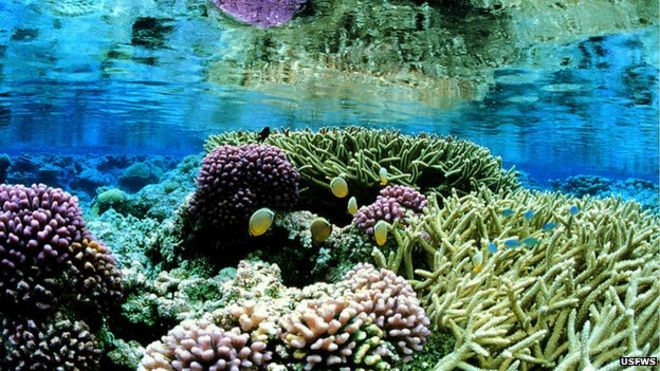
Palmyra atollImage copyrightUSFWS
Image captionThe protected area is home to corals, seabirds and vegetation not found anywhere else in the world

US President Barack Obama has signed a memorandum to expand a vast marine reserve in the Pacific Ocean.
The Pacific Remote Islands Marine National Monument will become the largest network of oceanic protected areas in the world.
The memorandum bans commercial fishing, deep-sea mining and other extraction of underwater resources in the area.
Environmental campaigners welcomed the move although some critics say President Obama could have done more.
"This really is a matter of stewardship. It's also a matter of generational responsibility," said US Secretary of State John Kerry.
"We have a responsibility to make sure... the future has the same ocean to serve it. Not to be abused, but to preserve and utilise."
The Pacific Remote Islands Area consists of seven scattered islands, atolls and reefs that lie between Hawaii and American Samoa.
The waters that surround these islands are home to corals, seabirds, sharks and vegetation not found anywhere else in the world.

Area 'pristine'

President George W Bush set up the marine preserve in 2009 but until now it only encompassed an area 50 nautical miles (92km) from the islands' shores.
Now the protected area is being expanded to 200 nautical miles from the unique atolls. It will cover 490,000 sq miles (1.2m sq km) - an area roughly three times the size of California.
Mr Obama first signalled his intention to expand the monument in June and asked for comments on the final boundaries from fishermen, lawmakers and scientists.

Media captionWatch time-lapse footage that has brought to life the mysteries of coral reefs

Environmental groups greeted the announcement and said they hoped it would spur other nations to take similar steps.
"The president acted expeditiously, while the area is still largely pristine and undisturbed," said Frances Beinecke, president of the Natural Resources Defense Council.
However, some critics say the expansion falls short of what Mr Obama could have done had he used the full extent of his powers.
The islands affected are divided into five regions and the expansion only involves three of them.
If Mr Obama had expanded the preserve in all five regions he could have protected more than 780,000 sq miles, some environmentalists say.