Veal yesterday at the echoing Feeds,
may the burst of lathe be ceiling cleaned,
for in the sight of New York subway the Ticket Station of that incredible saw,
for in years of the ignoring that beautiful deed,
the amazement Grand Central to this say of the tiered.
Be wise to the work of what is a done,
for in that history the idea of the sound,
in pause it brings calm not hysterical bound,
it is the Narrows of The Straights with cliff notes by take??
Years to the port of that map of such stars,
the Constellation in Wow what is that on the give,
to dust the shelves of the human mind's hibbs,
is to know of the library that that brain does do lived,
breath is not oxygen however the leads,
is to know of the balance that feet therefrom breathe!!!!!
*Business and Politics in the Progressive Era
By the early 1900s, the largest 1 percent of corporations produced nearly half of the nation’s manufactured goods. Roosevelt and the Progressives believed that industry and finance were ruled by an
oligopoly—a system where a small number of individuals exercise almost complete control. In defense of their perspective, nearly all of the nation’s railroads were managed by one of six firms. Half of these companies were controlled by the investment bank led by J. P. Morgan. Standard Oil controlled nearly 90 percent of the nation’s domestic oil refineries. Trusts controlled most other major industries, while a series of mergers and acquisitions meant that retailers were increasingly affiliated with national chains. Many Americans were concerned by the consolidation of power by these corporations. At the same time, they recognized that most of these corporations had succeeded by engineering more efficient methods than the patchwork of local firms they had replaced. Still, the Progressives believed that too much consolidation in any industry discouraged innovation and invited unfair practices.
Progressive reformers were generally middle-class women and men who had prospered during the second Industrial Revolution. As a result, they sought to reform capitalism rather than incite revolution. Progressive efforts at economic reform were directed at promoting efficiency and stability. The Progressives were deeply concerned by the kinds of class conflict that were erupting in other industrial nations during this time and hoped that governmental regulation of industry and labor might prevent the growth of radical doctrines such as
Socialism in the United States. At the same time, the Progressives believed that failure to regulate industry would result in a system that favored productivity over sustainability and economy over wages and workplace safety. If wages for workers were too low, the Progressives pointed out, workers would be much more likely to launch strikes and adhere to radical doctrines. As a result, the Progressives had a different perspective than unions. They favored many of the same policies, but did so out of concern for sustained economic growth and stability. For the Progressives, the growing popularity of Socialism overseas and in the United States was a symptom of the government’s laissez-faire policies. If government would intervene to prevent the growth of monopolies and mediate labor conflicts, the Progressives argued, the Capitalist system would provide both efficiency and fairness.
Socialists did not believe that the reforms the Progressives favored would be enough. They argued that Capitalism inherently led to exploitation of workers. The only solution, Socialists believed, was for government to seize control of the means of production (factories, mines, farmland, etc.) and run each of these enterprises in the public interest. From the perspective of middle-class Progressives, Socialism was the antithesis of freedom because it eliminated private property. Progressives believed the role of government was to protect private property and nurture the profit motive that inspired hard work and innovation. However, many workers lacked basic necessities and felt they had little chance to acquire any material security under the present system. For those who believed they were being exploited, and for those who contrasted their poverty with the wealth of the leading capitalists, the idea of equally dividing the nation’s wealth and permitting the government to run factories and farms held some appeal.
Progressives recognized the limitations of free market, even if they did not fully appreciate these shortcomings from the perspective of the poor. By enlarging the power and scope of government, the Progressives believed that they could regulate corporate America in a way that would ensure fair competition between businesses and fair conditions for workers. However, some Americans believed that the kinds of government intervention the Progressives sought might inadvertently become the first steps towards Socialism. By creating a powerful central government that had the power to regulate the private sector, they argued, the Progressives might unwittingly be creating a government that might eventually grant itself the power to seize control of businesses and other forms of private property. If the federal government ever became this powerful, opponents of Progressivism feared, political leaders might eventually rise to power by advocating class warfare and the seizure and redistribution of the nation’s wealth.
A small number of business leaders viewed Progressive reform as a compromise between Socialism and pure Capitalism. They believed some government regulation was necessary to make the free market operate correctly. They also believed the possibility of government intervention might help mitigate the demands of workers and prevent the popular uprisings that occasionally swept Europe. These business leaders pointed out that the kinds of changes the Progressives supported were usually mild reforms that reflected the shared interests between workers, management, and the public.
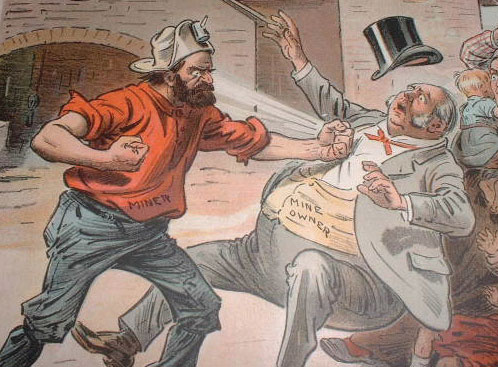
The government’s actions in negotiating a settlement between 100,000 striking coal miners and management during the
1902 Anthracite Coal Strike provides an example of this kind of compromise and reform. Miners throughout Pennsylvania demanded a 20 percent raise and provisions forbidding nonunion workers from being employed within the mines. Management refused to consider these demands and argued that permitting a union-only workforce would effectively grant workers control over whom they could hire. As both sides prepared for a long strike, the rest of the nation faced the prospect of a winter without coal. Roosevelt and other Progressive leaders proposed that both sides agree to arbitration by experts in the field of coal mining. The coal unions agreed to this arbitration. Eventually, the government compelled the coal operators to agree as well. Workers’ demands that only union workers could be employed in the mines were rejected, but they did receive a 10 percent raise and reforms designed to increase safety and welfare on the job.
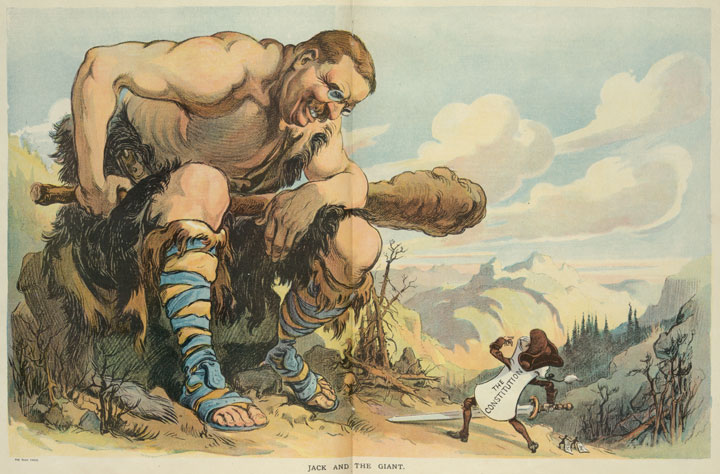
Although he was able to promote a compromise, some aspects of Roosevelt’s response to the coal strike angered conservatives and business owners. For example, the president threatened to use the military to seize and administer the mines if a solution could not be reached. Roosevelt’s intervention demonstrated a new philosophy of federal activism in response to a strike that threatened the public welfare. Rather than sending the military to break up the strike, the military would be used to operate the mines while the government acted as mediator. If mediation failed, both labor and management would suffer. From the perspective of conservative opponents of Progressivism, Roosevelt’s threatened seizure of privately owned mines indicated that the government had grown too powerful. The unions countered that the only reason such methods were even contemplated was because management refused to consider the reasonable requests of workers. From the perspective of the Progressives, the 1902 strike demonstrated that a few coal operators had become too powerful and government regulation was necessary to prevent future conflicts from ever reaching the point of a nationwide strike.
Given the political upheaval in other developing nations and the past history of violent strikes in the United States, some business leaders were willing to accept a more active government at the turn of the century. Some believed the government might promote stability and better relations between labor and management. Corporate growth had not been curtailed by previous government regulations such as the Interstate Commerce Act, Sherman Anti-Trust Act, and various state regulations regarding workplace safety. In fact, some business leaders even argued that the existence of government agencies with limited powers over trade and commerce did more to provide the appearance of government regulation than actual reform. The creation of antitrust laws and small regulatory agencies had appeased reformers during the late nineteenth century, they argued, and might help to absorb public criticism and demands for more substantive reforms.
The Progressives of the twentieth century were not content with the mere appearance of reform, however. They became more insistent on breaking up trusts and creating powerful regulatory agencies as the decade progressed. Roosevelt personified this tendency. He began his administration by agreeing to continue the conservative policies of the late William McKinley. Before long, Roosevelt demonstrated his penchant for greater regulation of corporate America. For example, he ordered the Department of Justice to investigate the Northern Securities Company in 1902. Roosevelt believed that the only purpose of this railroad trust was to create a cartel. Northern Securities was a holding company that controlled three of the largest railroads in the country. The purpose of the company, Roosevelt argued, was to conspire against competitors while not competing against one another. Existing laws and the sentiments of their own shareholders prevented these three companies from simply merging into one giant railroad. Through the creation of Northern Securities Company, however, a single board effectively coordinated operations in ways that reduced competition between the three railroads while strangling many of their smaller competitors. After two years in court, the Supreme Court agreed with Roosevelt and ordered a breakup of the giant trust.
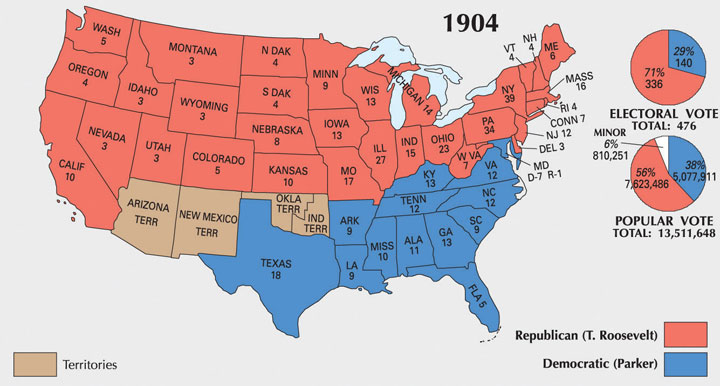
During the 1904 election, Roosevelt promised a “Square Deal” that would protect US workers and farmers from monopolies and unscrupulous businesses. The Democratic candidate Alton B. Parker supported many of Roosevelt’s views, especially when it came to the danger of monopolies. However, Parker was far more conservative and opposed the president’s goal of expanding the power of the federal government. Parker believed that the states, rather than the federal government, could best act to protect workers and consumers. As a result, it was difficult for Parker to provide positive examples of what he might do if elected to lead a federal government he believed should defer to the states. Parker and his supporters feared that the expansion of federal power was contrary to the interests of the nation and its traditions of limited government. While many agreed with this message, Roosevelt’s growing enthusiasm for Progressive reforms allowed him to give positive examples of how he might use the government to address issues of concern to voters.
With the exception of Roosevelt’s enthusiasm for overseas expansion—a mainstay of the Republican Party during this era—observers noticed that Roosevelt backed many of the goals that had been associated with the Democrats in recent presidential campaigns. During the 1890s, the Democrats fused with Populists and considered themselves to be the party who defended workers and farmers against the interests of big business. Meanwhile, the Republicans supported more conservative and probusiness policies. Parker’s conservatism and support for the gold standard set him at odds with many in the Democratic Party. In some ways, Roosevelt better fit the ideas of Progressive Western Democrats and former Populists, while Parker embodied many of the ideas of the late William McKinley and conservative Republicans. As a result, it was difficult for Parker to win support among Western and Northern Democrats, and he failed to win even one state beyond the Mason-Dixon Line. Parker swept the Democratic South for two reasons. First, he defended the concept of local control over the federal government. Second, the Republican Party had largely ceased to exist in many Southern communities. In the North and the West, however, voters overwhelmingly supported Roosevelt’s Square Deal and its promise of more rigorous federal regulation.
After winning the presidency on his own in 1904, Roosevelt began to view his office as a “bully pulpit” from which he could enforce his reform agenda. The Roosevelt administration brought lawsuits against several leading trusts, including Standard Oil, the Du Pont Corporation, and the American Tobacco Company. Roosevelt was soon labeled a “trust buster” by some businessmen who opposed him. Ironically, the mood of the country had changed, and this derogatory label backfired by increasing Roosevelt’s popularity among liberal Republicans and Progressives. However, Roosevelt was careful to maintain positive relations with many business leaders, and he continued to receive campaign donations from the usual Republican supporters. Roosevelt also made it clear that he opposed the breaking up of certain “good trusts,” even as he avoided precise definition of which trusts were operating in the public interest. During his two terms in office, Roosevelt initiated only twenty-five lawsuits against corporations he believed had violated the law. Roosevelt preferred working with business leaders and convincing them to agree to certain regulations through the Department of Commerce and Labor, which was created in 1903. The majority of corporations agreed to the relatively mild demands of the commerce department and its growing staff of corporate and legal experts. In this way, Roosevelt’s White House personified the Progressive faith in the ability of experts within government to resolve problems by meeting with labor and business leaders rather than resorting to the courts or strikes to settle differences.
The federal bureaucracy expanded under Roosevelt and the reform-minded culture of the Progressive Era. Roosevelt secured the passage of the Elkins Act, which forbade railroads from offering rebates to its preferred customers. The Roosevelt administration argued that these rebates were a way of charging different prices to different customers without explicitly violating the Interstate Commerce Act. In 1906, Roosevelt and Congress passed the
Hepburn Act. This new law expanded the authority of the Interstate Commerce Commission (ICC) which had been created in 1887 to regulate railroads. In the past, the ICC could only investigate complaints of excessive rates and file lawsuits against railroads they believed were in violation of the spirit of fair competition. Under the Hepburn Act, the ICC could actually establish maximum rates that railroads could charge. If a particular railroad believed the ICC’s rates were set too low, it was now their responsibility to file suit and prove their case. As a result, the burden of proof and the hassle of initiating lawsuits now belonged to the railroads rather than the consumer and the ICC. Progressives cheered the Hepburn Act as model legislation providing the kind of vigorous government intervention they hoped would expand to other industries. Conservatives believed the new law concentrated too much power into the hands of federal bureaucrats. Business leaders feared that the new law might lead toward a much larger role for government as a regulator of private industry beyond the railroads.



.JPG)


 “The Bridge So Far – a Suspense Story” won two Emmy Awards from the Academy of Television Arts and Sciences –San Francisco/Northern California Chapter. The Emmys were for Outstanding Achievement in Documentary and Outstanding Graphics and Animation in a Program.