Sunday, July 12, 2015

Powered by Siteslike


Pearl of the Indian Ocean


srilankan_map
Set in the Indian Ocean in South Asia, the tropical island nation of Sri Lanka has a history dating back to the birth of time.  It is a place where the original soul of Buddhism still flourishes and where nature’s beauty remains abundant and unspoilt.
Sri-Lanka
Sri Lanka was first settled by modern humans around 35,000 years ago and possibly earlier. The most ancient of the inhabitants may have been the ancestors of the Veddas, an aboriginal people (numbering about 2,000) now living in jungle areas near Maduru Oya National Park, east of the central hills. They were conquered in the 6th cent. B.C. by the Sinhalese, who were originally from N India; the Ramayana, the ancient Hindu epic, probably reflects this conquest. The Sri Lanka chronicle Mahavamsa relates the arrival of Vijaya, the first Sinhalese king, in 483 B.C.
122915J33-2
The Sinhalese settled in the north and developed an elaborate irrigation system. They founded their capital at Anuradhapura, which, after the introduction of Buddhism from India in the 3d cent. B.C., became one of the chief world centers of that religion; a cutting of the pipal tree under which Buddha attained enlightenment at Bodh Gaya was planted there. The Temple of the Tooth at Kandy as well as the Dalada Maligawa are sacred Buddhist sites. Buddhism stimulated the fine arts in Sri Lanka, its classical period lasted from the 4th to the 6th centuries.
temple
The proximity of Sri Lanka to S India resulted in many Tamil invasions. The Chola of S India conquered Anuradhapura in the early 11th cent. and made Polonnaruwa their capital. The Sinhalese soon regained power, but in the 12th cent. a Tamil kingdom arose in the north, and the Sinhalese were driven to the southwest. Arab traders, drawn by the island’s spices, arrived in the 12th and 13th cent.; their descendants are the Muslim Moors.
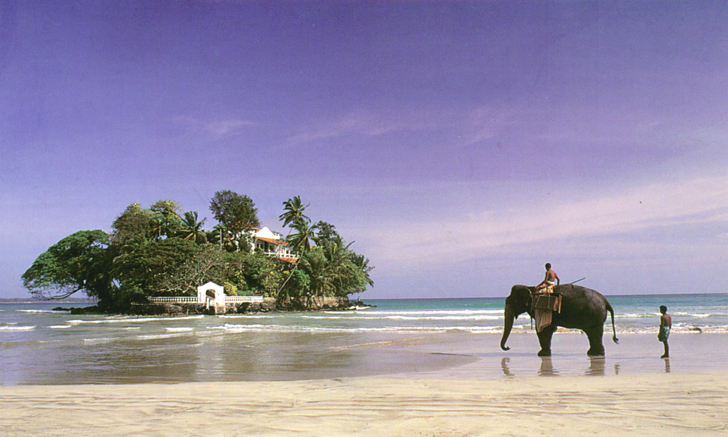
Elephant
The Portuguese conquered the coastal areas in the early 16th cent. and introduced the Roman Catholic religion.
Srilanka South
By the mid-17th cent. the Dutch had taken over the Portuguese possessions and the rich spice trade.
Sri Lanka South
In 1795 the Dutch possessions were occupied by the British, who made the island, then known as Ceylon, a crown colony in 1798. In 1815 the island was brought under one rule for the first time when the central area, previously under the rule of Kandy, was conquered.
Tea Estates
Under the British, tea, coffee, and rubber plantations were developed, and schools, including a university, were opened. A movement for independence arose during World War I. The constitution of 1931 granted universal adult suffrage to the inhabitants; but demands for independence continued, and in 1946 a more liberal constitution was enacted.
Colombo
Full independence was finally granted to the Ceylon on Feb. 4, 1948, with dominion status in the Commonwealth of Nations.
Scenic Beach
Few places in the world can offer the traveller such a remarkable combination of stunning landscapes, pristine beaches, captivating cultural heritage and unique experiences within such a compact location. Within a mere area of 65,610 sq.km lie 1,600 km of palm fringed coastline , much of it pristine beaches
Sigiriya Rock
This ancient land is blessed with a slew of sites which have immense historical and archaeological significance. Some of these sites have made way into the UNESCO’s map of World Heritage Sites. These places have emerged as the hub of tourists from all across the globe fascinating the beholders at the very first glimpse. There are  8 UNESCO World Heritage Sites within the island.
Wildlife
There are 15 national parks showcasing an abundance of wildlife. Despite its small size, Sri Lanka boasts of one of the highest rates of biological endemism in the world whether in plants or animals and is included among the top five biodiversity hotspots in the world.
Tea Estate
Nearly 500,000 acres of lush tea estates dot the highlands. Worthy of note is the Horton Plains, surrounded by some of the best tea growing areas such as Uva to the east, Balangoda to the south, Dimbula to the west and Nuwara Eliya Planting region to the north.
Botanical Gardens
Sri Lanka boasts of 250 acres of botanical gardens, which attracts 2 million visitors annually. Some are renowned for its collection of a variety of orchids.
Water falls
The central highlands is adorned with a number of enchanting natural water-falls, hills and slopes forming the most beautiful landscapes one can imagine. It is home to 350 waterfalls and 25,000 water bodies.
Buddha Statues
Sri Lanka’s historical and cultural heritage covers more than 2,000 years. Known as Lanka–the “resplendent land”–in the ancient Indian epic Ramayana, the island has numerous other references that testify to the island’s natural beauty and wealth. Islamic folklore maintains that Adam and Eve were offered refuge on the island as solace for their expulsion from the Garden of Eden.
Kandyan Dancers
Asian poets, noting the geographical location of the island and lauding its beauty, called it the “pearl upon the brow of India”.
Fishing Boats
The island is surrounded by the Indian Ocean and traditional fishing is one of its main incomes. The annual fish harvest in 2012 has increased 57 percent to over 486,000 metric tons.
Fishing on Stilts
In the southern cost there is a novel form of fishing perched on stilts. This method of fishing is unique to Sri Lanka.
Turkish Fruit Stand
Sri Lanka has an amazing variety of tropical fruits. It produces more than 800,000 metric tons of fruits and vegetables annually and exports both fresh and processed varieties to many destinations in the world.  90 per cent of the fresh product is targeted to the Middle East and the Maldives Island and almost about 75 percent of the processed products to the European market.
Game of Cricket
Sri Lanka joined the world map of sports after winning the cricket world cup in 1996. Since then it is dominating the shorter form of the game and the team members continue to win accolades for their excellent performances.
RaftingSurfing
Sri Lankan Tourism is a main income earner and one of the advantages of being an island is that one has water all around and sandy beaches to match, where one can enjoy surfing in Hikkaduwa/Arugam bay, Jet Ski riding, boogie boarding in Bentota/Unawatuna and kite surfing in Kalpitiya all year around, in many locations around the island. The Kelani River with its grade three rapids, is ideal for white water rafting of both intermediate rafters as well as beginners.
Scenic Lake
The central highlands of the island are filled with romantic landscapes, governed by rising mountains, lush forests, ocean like tanks and gushing waterfalls, mingling with the clouds and landscapes shimmering in sunlight and disappearing under the rising mist that it was considered the lost paradise by many a globe trotters, who fell upon the country.
Beach with Boats
The golden beaches of the country had been praised for their picture postcard views since eternity. The dusk and dawn and many human activities connected to these times of the day creates a vibrant picture along the coasts of Sri Lanka.
This is an island of magical proportions, once known as Serendib, Taprobane, the Pearl of the Indian Ocean, and Ceylon.

Classical Mechanics ~ Second Law of Motion

Precambrian

From Wikipedia, the free encyclopedia
For the album by German band The Ocean, see Precambrian (album).
"Cryptozoic" redirects here. For the games publisher, see Cryptozoic Entertainment.
Precambrian Eon
4600–541 million years ago
view • discuss • edit
-4500 —
-4000 —
-3500 —
-3000 —
-2500 —
-2000 —
-1500 —
-1000 —
-500 —
0 —
Scale:
Millions of years

Positions of landmasses near the end of the Precambrian
The Precambrian (or Pre-Cambrian; sometimes abbreviated pЄ) is the largest span of time in Earth's history before the currentPhanerozoic Eon, and is a Supereon divided into several eons of the geologic time scale. It spans from the formation of Earth about 4.6 billion years ago (Ga) to the beginning of the Cambrian Period, about 541.0 ± 1.0 million years ago (Ma), when hard-shelled creatures first appeared in abundance. The Precambrian is so named because it precedes the Cambrian, the first period of the Phanerozoic Eon, which is named after Cambria, the classical name for Wales, where rocks from this age were first studied. The Precambrian accounts for 88% of geologic time.[citation needed]

Overview[edit]

Relatively little is known about the Precambrian, despite it making up roughly seven-eighths of the Earth's history, and what is known has largely been discovered from the 1960s onwards. The Precambrian fossil record is poorer than that of the succeeding Phanerozoic, and those fossils present (e.g. stromatolites) are of limited biostratigraphic use.[1] This is because many Precambrian rocks have been heavilymetamorphosed, obscuring their origins, while others have been destroyed by erosion, or remain deeply buried beneath Phanerozoic strata.[1][2]
It is thought that the Earth itself coalesced from material in orbit around the Sun roughly 4500 Ma, or 4.5 billion years ago (Ga), and may have been struck by a very large (Mars-sized) planetesimal shortly after it formed, splitting off material that formed the Moon (see Giant impact hypothesis). A stable crust was apparently in place by 4400 Ma, since zircon crystals from Western Australia have been dated at 4404 Ma.[3]
The term Precambrian is recognized by the International Commission on Stratigraphy as a general term including the Archean and Proterozoic eons.[4] It is still used by geologists and paleontologists for general discussions not requiring the more specific eon names. It was briefly also called the Cryptozoic eon.

Life forms[edit]

For more details on this topic, see Origin of life.
It is not known when life originated, but carbon in 3.8 billion year old rocks from islands off western Greenland may be of organic origin. Well-preserved bacteria older than 3.46 billion years have been found in Western Australia.[5] Probable fossils 100 million years older have been found in the same area. There is a fairly solid record of bacterial life throughout the remainder of the Precambrian.
Excluding a few contested reports of much older forms from USA and India, the first complex multicellular life forms seem to have appeared roughly 600 Ma. The oldest fossil evidence of complex life comes from the Lantian formation, at least 580 million years ago. A quite diverse collection of soft-bodied forms is known from a variety of locations worldwide between 542 and 600 Ma. These are referred to as Ediacaran or Vendian biota. Hard-shelled creatures appeared toward the end of that time span. By the middle of the later Cambrian period a very diverse fauna is recorded in the Burgess Shale, including some which may represent stem groups of modern taxa. The rapid radiation of lifeforms during the early Cambrian is called the Cambrian explosion of life.[6][7]
While land seems to have been devoid of plants and animals, cyanobacteria and other microbes formed prokaryotic mats that covered terrestrial areas.[8]

Planetary environment and the oxygen catastrophe[edit]


Weathered Precambrian pillow lavain the Temagami Greenstone Belt of the Canadian Shield
Evidence illuminating the details of plate motions and other tectonic functions in the Precambrian has been poorly preserved. It is generally believed that small proto-continents existed prior to 3000 Ma, and that most of the Earth's landmasses collected into a single supercontinent around 1000 Ma. The supercontinent, known as Rodinia, broke up around 600 Ma. A number of glacial periodshave been identified going as far back as the Huronian epoch, roughly 2200 Ma. One of the most delved into is the Sturtian-Varangian glaciation, around 600 Ma, which may have brought glacial conditions all the way to the equator, resulting in a "Snowball Earth".
The atmosphere of the early Earth is not well understood. Most geologists believe it was composed primarily of nitrogen, carbon dioxide, and other relatively inert gases, lacking in free oxygen. This has been disputed with evidence in support of an oxygen-rich atmosphere since the early Archean.[9]
Molecular oxygen was not present as a significant fraction of Earth's atmosphere until after photosynthetic life forms evolved and began to produce it in large quantities as a byproduct of their metabolism. This radical shift from an inert to an oxidizing atmosphere caused an ecological crisis sometimes called the oxygen catastrophe. At first, oxygen would quickly combine with other elements in Earth's crust, primarily iron, as it was produced. After the supply of oxidizable surfaces ran out, oxygen began to accumulate in the atmosphere, and the modern high-oxygen atmosphere developed. Evidence for this lies in older rocks that contain massive banded iron formations, laid down as iron and oxygen first combined.

Subdivisions[edit]

An established terminology has evolved covering the early years of the Earth's existence, as radiometric dating allows plausible real dates to be assigned to specific formations and features.[10] The Precambrian Supereon is divided into three eons: the Hadean (4500-3950 Ma), Archean (4000-2500 Ma) and Proterozoic (2500-541.0 ± 1.0 Ma). See Timetable of the Precambrian.
  • Proterozoic: this eon refers to the time from the lower Cambrian boundary, 541.0 ± 1.0 Ma, back through 2500 Ma. As originally used, it was a synonym for "Precambrian" and hence included everything prior to the Cambrian boundary. The Proterozoic eon is divided into three eras: the NeoproterozoicMesoproterozoic andPaleoproterozoic.
    • Neoproterozoic: The youngest geologic era of the Proterozoic Eon, from the Cambrian Period lower boundary (541.0 ± 1.0 Ma) back to 1000 Ma. The Neoproterozoic corresponds to Precambrian Z rocks of older North American geology.
    • Mesoproterozoic: the middle era of the Proterozoic Eon, 1000-1600 Ma. Corresponds to "Precambrian Y" rocks of older North American geology.
    • Paleoproterozoic: oldest era of the Proterozoic Eon, 1600-2500 Ma. Corresponds to "Precambrian X" rocks of older North American geology.
  • Archean Eon: 2500-4000 Ma.
  • Hadean Eon: 3950-4500 Ma. This term was intended originally to cover the time before any preserved rocks were deposited, although some zircon crystals from about 4400 Ma demonstrate the existence of crust in the Hadean Eon. Other records from Hadean time come from the moon and meteorites.[11]
It has been proposed that the Precambrian should be divided into eons and eras that reflect stages of planetary evolution, rather than the current scheme based upon numerical ages. Such a system could rely on events in the stratigraphic record and be demarcated by GSSPs. The Precambrian could be divided into five "natural" eons, characterized as follows.[12]
  1. Accretion and differentiation: a period of planetary formation until giant Moon-forming impact event.
  2. Hadean: dominated by heavy bombardment from about 4.51 Ga (possibly including a Cool Early Earth period) to the end of the Late Heavy Bombardment period.
  3. Archean: a period defined by the first crustal formations (the Isua greenstone belt) until the deposition of banded iron formations due to increasing atmospheric oxygen content.
  4. Transition: a period of continued iron banded formation until the first continental red beds.
  5. Proterozoic: a period of modern plate tectonics until the first animals.

Precambrian super-continents[edit]

The movement of plates has caused the formation and break-up of continents over time, including occasional formation of a super-continent containing most or all of the continents. The earliest known super-continent was Vaalbara. It formed from proto-continents and was a super-continent by 3.1 billion years ago (3.1 Ga). Vaalbara broke up ~2.8 Ga ago. The super-continent Kenorland was formed ~2.7 Ga ago and then broke sometime after 2.5 Ga into the proto-continent cratons called LaurentiaBaltica,Australia, and Kalahari. The super-continent Columbia or Nuna formed during a period of 2.0–1.8 billion years and broke up about 1.5–1.3 billion years ago.[13][14] The super-continent Rodinia is thought to have formed about 1 billion years ago, to have embodied most or all of Earth's continents and to have broken up into eight continents around 600 million years ago.