| Nancy Pelosi |
|---|
 |
|
| House Minority Leader |
|---|
|
|
Assumed office
January 3, 2011 |
| Deputy | Steny Hoyer |
|---|
| Preceded by | John Boehner |
|---|
In office
January 3, 2003 – January 3, 2007 |
| Deputy | Steny Hoyer |
|---|
| Preceded by | Dick Gephardt |
|---|
| Succeeded by | John Boehner |
|---|
| 52nd Speaker of the United States House of Representatives |
|---|
In office
January 4, 2007 – January 3, 2011 |
| President | George W. Bush
Barack Obama |
|---|
| Preceded by | Dennis Hastert |
|---|
| Succeeded by | John Boehner |
|---|
| House Minority Whip |
|---|
In office
January 15, 2002 – January 3, 2003 |
| Leader | Dick Gephardt |
|---|
| Preceded by | David Bonior |
|---|
| Succeeded by | Steny Hoyer |
|---|
Member of the U.S. House of Representatives
from California's 12th district |
|---|
|
|
Assumed office
January 3, 2013 |
| Preceded by | Jackie Speier |
|---|
Member of the U.S. House of Representatives
from California's 8th district |
|---|
In office
January 3, 1993 – January 3, 2013 |
| Preceded by | Ron Dellums |
|---|
| Succeeded by | Paul Cook |
|---|
Member of the U.S. House of Representatives
from California's 5th district |
|---|
In office
June 2, 1987 – January 3, 1993 |
| Preceded by | Sala Burton |
|---|
| Succeeded by | Bob Matsui |
|---|
| Personal details |
|---|
| Born | Nancy Patricia D'Alesandro
March 26, 1940 (age 76)
Baltimore, Maryland, U.S. |
|---|
| Political party | Democratic |
|---|
| Spouse(s) | Paul Pelosi (m. 1963) |
|---|
| Children | Nancy
Christine
Jacqueline
Paul
Alexandra |
|---|
| Alma mater | Trinity Washington University |
|---|
| Religion | Roman Catholicism |
|---|
| Signature |  |
|---|
| Website | House website |
|---|
Early life, education, and early career
Pelosi is Italian-American and was born
Nancy Patricia D'Alesandro in
Baltimore, Maryland, the youngest of six children of Annunciata M. "Nancy" (née Lombardi) and
Thomas D'Alesandro, Jr., who was a Democratic party U.S. Congressman from Maryland and a
Mayor of Baltimore.
[3][4] Pelosi's brother,
Thomas D'Alesandro III, also a Democrat, was mayor of Baltimore from 1967 to 1971, when he declined to run for a second term.
Pelosi was involved with politics from an early age. In her outgoing remarks as the 60th Speaker of the House, Pelosi noted that she had been present at
John F. Kennedy's
inaugural address as President in January 1961. She graduated from the
Institute of Notre Dame, a Catholic all-girls high school in Baltimore, and from Trinity College (now
Trinity Washington University) in Washington, D.C., in 1962 with a B.A. in
political science. Pelosi interned for Senator
Daniel Brewster (D-Maryland) alongside future House Majority Leader
Steny Hoyer.
[5] She met Paul Frank Pelosi (b. April 15, 1940, in San Francisco)
[6] while she was attending Trinity College.
[7]They married in Baltimore at the
Cathedral of Mary Our Queen on September 7, 1963.
[8] After the couple married, they moved to New York, and then to San Francisco in 1969, where Mr. Pelosi's brother,
Ronald Pelosi, was a member of the
City and County of San Francisco's
Board of Supervisors.
[9]
After moving to San Francisco, Pelosi worked her way up in Democratic politics. She became a friend of one of the leaders of the California Democratic Party, 5th District Congressman
Phillip Burton.
U.S. House of Representatives
Elections

An early congressional photo of Pelosi taken in 1993.
Phillip Burton died in 1983 and was succeeded by his wife,
Sala. In late 1986, Sala became ill with cancer and decided not to run for reelection in 1988. She picked Pelosi as her designated successor, guaranteeing her the support of the Burtons' contacts.
[12] Sala died on February 1, 1987, just a month after being sworn in for a second full term. Pelosi won the special election to succeed her, narrowly defeating San Francisco Supervisor
Harry Britt on April 7, 1987, then easily defeating Republican candidate Harriet Ross on June 2, 1987; Pelosi took office a week later.
[13][14]
Pelosi represents one of the safest Democratic districts in the country. Democrats have held the seat since 1949 and
Republicans, who currently make up only 13 percent of registered voters in the district, have not made a serious bid for the seat since the early 1960s. She won the seat in her own right in 1988 and has been reelected 10 more times with no substantive opposition, winning by an average of 80 percent of the vote. She has not participated in candidates' debates since her 1987 race against Harriet Ross.
[15] The strongest challenge Pelosi has faced was in 2008 when anti-war activist
Cindy Sheehan polled 16% and Pelosi won with 72%.
She has the distinction of contributing the most among members of Congress to other congressional campaigns because she is in a safe district and does not need the campaign funds.
[16]
Committee assignments
In the House, she served on the
Appropriations and
Intelligence Committees, and was the ranking Democrat on the Intelligence Committee until her election as Minority Leader.
[17]
Pre-Speakership career
In 2002, after Gephardt resigned as minority leader to seek the Democratic nomination in the
2004 presidential election, Pelosi was elected to replace him, becoming the first woman to lead a major party in the House.
[18]
Speaker of the House
Nomination
In the
2006 Midterm Elections, the Democrats took control of the House by picking up 31 seats. On November 16, 2006, Pelosi was unanimously chosen by her caucus as the Democratic candidate for Speaker, effectively making her Speaker-elect. While the Speaker is elected by the full House membership, in modern practice the election is a formality, since the Speaker always comes from the majority party.
Pelosi supported her longtime friend
John Murtha of
Pennsylvania for the position of
House Majority Leader, the second-ranking post in the House Democratic caucus. His competitor was
House Minority Whip Steny Hoyer of
Maryland, who had been Pelosi's second-in-command since 2003.
[19] Pelosi and Hoyer had a somewhat frosty relationship dating back to 2001, when they ran against each other for minority whip. However, Hoyer was elected as House Majority Leader over Murtha by a margin of 149–86 within the caucus.
[20]

Pelosi (right) with Vice President
Dick Cheney behind President George W. Bush at the
2007 State of the Union Address making history as the first woman to sit behind the podium at such an address. President Bush acknowledged this by beginning his speech with the words, "Tonight, I have a high privilege and distinct honor of my own – as the first President to begin the State of the Union message with these words: Madam Speaker".
[22]
With her election, Pelosi became the first woman, the first Californian, and the first Italian-American to hold the Speakership. She is also the second Speaker from a state west of the
Rocky Mountains. The first was
Washington's
Tom Foley, the last Democrat to hold the post before Pelosi.
During her speech, she discussed the historical importance of being the first female to hold the position of Speaker:
"This is a historic moment – for the Congress, and for the women of this country. It is a moment for which we have waited more than 200 years. Never losing faith, we waited through the many years of struggle to achieve our rights. But women weren't just waiting; women were working. Never losing faith, we worked to redeem the promise of America, that all men and women are created equal. For our daughters and granddaughters, today, we have broken the
marble ceiling. For our daughters and our granddaughters, the sky is the limit, anything is possible for them".
[23]
She also spoke on Iraq as the major issue facing the 110th Congress, while incorporating some Democratic Party beliefs:
"The election of 2006 was a call to change – not merely to change the control of Congress, but for a new direction for our country. Nowhere were the American people more clear about the need for a new direction than in Iraq. The American people rejected an open-ended obligation to a war without end."
[23]
Tenure
As Speaker, Pelosi was still the leader of the House Democrats; the Speaker is considered to be the leader of his or her House caucus. However, by tradition, she did not normally participate in debate and almost never voted on the floor (though she had every right to as a full House member). She was also not a member of any House committees.
Pelosi was re-elected Speaker in 2009.
A
CBS News poll conducted in March 2010 found that 37% of registered voters have an unfavorable opinion of the speaker, with 11% approving.
[24] According to a March 2010
Rasmussen poll, 64% of voters nationally view the speaker unfavorably, and 29% have a favorable opinion of Pelosi.
[25]
- Social Security Mandate
Shortly after winning re-election, President
George W. Bush claimed a
mandate for an ambitious second-term agenda and proposed reforming
Social Security by allowing workers to redirect a portion of their Social Security withholding into stock and bond investments.
[26] Pelosi strongly opposed the plan, saying there was no crisis, and as minority leader she imposed intense party discipline on her caucus, leading them to near-unanimous opposition to Bush's proposal, and subsequent defeat of the proposed plan.
[27][28]
- Blocking of impeachment proceedings against President Bush
In May 2006, with an eye on the upcoming congressional elections–which offered the possibility of Democrats taking back control of the House for the first time since 1994–Pelosi told colleagues that, while the Democrats would conduct vigorous oversight of Bush administration policy, an impeachment investigation was "off the table". (A week earlier, she had told the
Washington Post that, although Democrats would not set out to impeach the president, "you never know where" investigations might lead.)
[29]
After becoming Speaker of the House in January 2007, Pelosi held firm against impeachment, notwithstanding strong support for that course of action among constituents in her home district. In the November 2008 election, Pelosi withstood a challenge for her seat by
anti-war activist
Cindy Sheehan, who ran as an independent primarily because of Pelosi's refusal to pursue impeachment.
[30]
- The "Hundred Hours"
Main article:
100-Hour Plan
Prior to the
U.S. 2006 midterm elections, Pelosi announced a plan for action: If elected, she and the newly empowered Democratic caucus would push through most of its program during the first hundred hours of the 110th Congress' term.
[31][32]
- Opposition to Iraq War troop surge of 2007
On January 5, 2007, reacting to suggestions from President Bush's confidantes that he would increase troop levels in Iraq (which he announced in a speech a few days later), Pelosi joined with Senate Majority Leader
Harry Reid to condemn the plan. They sent Bush a letter saying, "[T]here is no purely military solution in Iraq. There is only a political solution. Adding more combat troops will only endanger more Americans and stretch our military to the breaking point for no strategic gain. ... Rather than deploy additional forces to Iraq, we believe the way forward is to begin the phased redeployment of our forces in the next four to six months, while shifting the principal mission of our forces there from combat to training, logistics, force protection and counter-terror."
[33]
- 2008 Democratic National Convention
- Health Care Reform
Pelosi has been credited for spearheading
President Obama's health care law when it seemed that it would go down in defeat. After Republican
Scott Brown won Democratic
Ted Kennedy's former senate seat in the
January 2010 Massachusetts special election and thereby causing the Senate Democrats to lose their filibuster proof majority, Obama agreed with then chief of staff
Rahm Emanuel's idea that he should do smaller initiatives that could pass easily. Pelosi, however, dismissed the president's fear and instead mocked his scaled-back ideas as "kiddie care." After convincing the president that this would be their only shot at health care because of the large Democratic majorities they currently had, she rallied her Democratic caucus as she began an "unbelievable marathon" of a two-month session to craft the health care bill, which successfully passed the House. In Obama's remarks before signing the bill into law, he specifically credited Pelosi as being "one of the best Speakers the House of Representatives has ever had."
[35][36][37]
Post-Speakership career

President
Barack Obama meets with Congressional Leadership, July 2011
Though Pelosi was re-elected by a comfortable margin in the
2010 midterm elections, the Democrats lost 63 seats and ceded control of the House of Representatives to the Republicans. Despite the electoral setback suffered by her party, Pelosi sought to continue leading the House Democratic Caucus in the position of Minority Leader, the office she held prior to becoming Speaker. After Pelosi's disparate intra-party opposition failed to pass a motion to delay the leadership vote,
[38] Pelosi was elected Minority Leader for the
112th Congress. On November 14, 2012, Pelosi announced she would remain on as Democratic leader.
[39]
Allegations of insider trading
In November 2011,
60 Minutes alleged that Pelosi and several other member of Congress had used information they gleaned from closed sessions to make money on the stock market. The program cited Pelosi's purchases of Visa stock while a bill that would limit credit card fees was in the House. Pelosi denied the allegations and called the report "a right-wing smear."
[40][41][42] When the Stop Trading on Congressional Knowledge Act (or
STOCK Act) was introduced the next year, Pelosi voted for the bill and lauded its passing. Of Representatives
Louise Slaughter and
Tim Walz, who drafted the bill, Pelosi said they "shined a light on a gaping hole in our ethics laws and helped close it once and for all."
[43][44]
Political positions
Pelosi was a founding member of the
Congressional Progressive Caucus, but left in 2003 after being elected Minority Leader. Her longtime friend
Jim McDermott of Washington told
Newsweek that he and other left-leaning Democratic congressmen sometimes wish that "she would tilt a little more our way from time to time". As Speaker, Pelosi has tried to focus more on economic than social issues.
[45]
In San Francisco, Pelosi has experienced conflicts with anti-war activists.
[46][47] Nonetheless, she has never faced a serious challenger in the Democratic primary or from the
Green Party, which is competitive in local elections.
On September 2, 2008, she visited
Hiroshima, Japan, for a
G8 summit meeting of lower house speakers and offered flowers in
Hiroshima Peace Memorial Park for the victims of the
1945 atomic bombing. While many world leaders have visited Hiroshima over the years, she is the highest-ever sitting U.S. official to pay her respects.
[48]
China
On March 21, 2008, Pelosi criticized the People's Republic of China for its handling of the
unrest in Tibet and called on "freedom-loving people" worldwide to denounce China.
[49] She was quoted as saying, "The situation in Tibet is a challenge to the conscience of the world", while addressing a crowd of thousands of Tibetans in Dharamsala, India.
[49] She however did not call for a boycott of the
2008 Summer Olympics that were held in Beijing.
[50]
Colombia
Pelosi publicly scolded Colombian President
Álvaro Uribe during Uribe's May 2007 state trip to America. Pelosi met with Uribe and later released a statement that she and other members of Congress had "expressed growing concerns about the serious allegations" of links between Paramilitary groups and Colombian government officials.
[52] Pelosi also came out against the Colombian free trade agreement.
[53]
Cuba
In 2001, Pelosi voted in favor of keeping the travel restrictions on American citizens to Cuba, until the President has certified that Cuba has released all
political prisoners, and extradited all individuals sought by the U.S. on charges of air piracy, drug trafficking and murder.
[54]
Iran
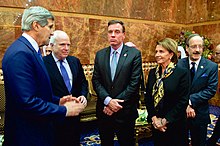
Pelosi before greeting the new King
Salman of Saudi Arabia, Riyadh, January 2015. Saudi Arabia regards Iran as its main regional rival.
In a February 15, 2007, interview, Pelosi noted that Bush consistently said he supports a diplomatic resolution to differences with Iran "and I take him at his word". At the same time, she said, "I do believe that Congress should assert itself, though, and make it very clear that there is no previous authority for the president, any president, to go into Iran".
[55][56] On January 12, 2007, Congressman
Walter B. Jonesof
North Carolina introduced a resolution
[57] requiring that – absent a national emergency created by an attack, or a demonstrably imminent attack, by Iran upon the United States or its armed forces – the President must consult with Congress and receive specific authorization prior to initiating any use of military force against Iran.
[58] This resolution was removed from a military spending bill for the war in Iraq by Pelosi on March 13, 2007.
Turkey
In mid-October 2007, after the House Foreign Affairs Committee passed a resolution to label
the 1915 killing of Armenians by Ottoman Turks as genocide, Pelosi pledged to bring the measure to a vote.
[59] The draft resolution prompted warnings from President Bush and fierce criticism from Turkey, with Turkey's prime minister saying that approval of the resolution would endanger U.S.-Turkey relations.
[60]After House support eroded, the measure's sponsors dropped their call for a vote, and in late October Pelosi agreed to set the matter aside.
[61]
Use of government aircraft
In March 2009, the
New York Post wrote that the conservative watchdog group
Judicial Watch obtained emails sent by Pelosi's staff that requested that the
United States Air Force (USAF) provide specific aircraft—a
Boeing 757—for Pelosi to use for taxpayer-funded travel.
[62][63][64] Pelosi responded that the policy was initiated by President Bush due to post-
9/11 security concerns (Pelosi was third in line for
presidential succession) and was initially provided for the previous Speaker,
Dennis Hastert. The
Sergeant at Armsrequested, for security reasons, that the plane provided be capable of non-stop flight, requiring a larger aircraft. The Pentagon said "no one has rendered judgment" that Pelosi's use of aircraft "is excessive."
[65]
Abortion
Pelosi voted against the
Partial-Birth Abortion Ban Act of 2003 and earlier attempts at similar bans, and voted against the criminalization of certain situations where a minor is transported across state lines for an abortion (HR 748, passed).
[66]
She has voted in favor of lifting the ban on privately funded abortions at U.S. military facilities overseas (HA 209, rejected), in favor of an amendment that would repeal a provision that forbids service women and dependents from getting an abortion in overseas military hospitals (HA 722, rejected), in favor of stripping the prohibition of funding for organizations working overseas that uses its own funds to provide abortion services or engage in advocacy related to abortion services (HA 997, rejected). She also voted in favor of the 1998 Abortion Funding Amendment, which would have allowed the use of district funds to promote abortion-related activities, but would have prohibited the use of federal funds.
[66]
Gun laws
Pelosi stands in favor of increased background checks for potential gun owners, as well as the controversial
banning of
assault weapons. In February 2013, she called for the "Boldest possible move" on gun control, similar to a stance made just weeks earlier by former Representative, mass shooting victim and fellow gun control advocate,
Gabriel Giffords.
[69] In 2012, she was given 0% ratings by both the
National Rifle Association and
Gun Owners of America for her stances on gun control.
[70]
Fiscal/monetary policy
As Speaker of the House, she also spearheaded the
Fair Minimum Wage Act of 2007 as part of the
100-Hour Plan. The Act raises the
minimum wage in the United States and the territories of the
Northern Marianas Islands and
American Samoa. American Samoa was initially absent from the act, but as part of
HR 2206 it was included. One Republican congressman who voted against the initial bill accused Pelosi of unethically benefiting
Del Monte Foods (headquartered in her district) by the exclusion of the territory, where Del Monte's
StarKist Tuna brand is a major employer.
[75] Pelosi co-sponsored legislation that omitted American Samoa from a raise in the minimum wage as early as 1999, prior to Del Monte's acquisition of StarKist Tuna in 2002.
[76] As of the 2002, 2004, and 2006 election cycles, Del Monte has not contributed to Democratic candidates.
[77]
Pelosi opposed the
welfare reform proposed by President Bush as well as reforms proposed and passed under President Clinton.
[78]
Civil liberties
Contraception
In a January 25, 2009, interview with
George Stephanopoulos for
ABC News, Pelosi said, "Well, the family planning services reduce cost. They reduce cost. The states are in terrible fiscal budget crises now and part of what we do for children's health, education and some of those elements are to help the states meet their financial needs. One of those – one of the initiatives you mentioned, the contraception, will reduce costs to the states and to the federal government."
[82]
Education
In 1999, Pelosi voted against the Ten Commandments being in public buildings, including schools
[83] Pelosi voted for the
No Child Left Behind Act, which instituted testing to track students' progress and authorized an increase in overall education spending.
[84]
Environment
Pelosi has supported the development of new technologies to reduce U.S. dependence upon foreign oil and remediate the adverse environmental effects of burning fossil fuels.
[85] Pelosi has widely supported conservation programs and energy research appropriations. She has also voted to remove an amendment that would allow for oil and gas exploration in the
Arctic National Wildlife Refuge.
[86]
Pelosi has blocked efforts to revive offshore oil drilling in protected areas, reasoning that
offshore drilling could lead to an increase in dependence on fossil fuels.
[87]
Health care
Speaker Pelosi was instrumental in the passage of the
Patient Protection and Affordable Care Act of 2010. Pelosi was a key figure in convincing President
Barack Obama to continue pushing for health care reform after the election of
Massachusetts Sen. Scott Brown in a January
special election, a defeat that was seen as potentially fatal to Democratic reform efforts.
[36] After delivering 219 votes in the House for Obama's signature health care package, Pelosi was both praised and heckled as she made her way to Capitol Hill.
[88]
Immigration
Iraq War
In 2002, Pelosi opposed the
Iraq Resolution authorizing President Bush to use military force against Iraq,
[91] while stating that Iraq, like "other countries of concern", had WMDs.
[92] In explaining her opposition to the resolution, Pelosi noted that
Central Intelligence AgencyDirector
George Tenet had told Congress that the likelihood of Iraq's
Saddam Hussein launching an attack on the U.S. using weapons of mass destruction was low. "This is about the Constitution", Pelosi said. "It is about this Congress asserting its right to declare war when we are fully aware what the challenges are to us. It is about respecting the United Nations and a multilateral approach, which is safer for our troops." Despite Pelosi's opposition, Congress still passed a resolution authorizing President Bush to use the Armed Forces of the United States against Iraq.
[93]
Israel
Pelosi reaffirms that "America and
Israel share an unbreakable bond: in peace and war; and in prosperity and in hardship".
[94] Pelosi emphasized that "a strong relationship between the
United States and Israel has long been supported by both Democrats and Republicans. America's commitment to the safety and security of the State of Israel is unwavering,...[h]owever, the
war in Iraq has made both America and Israel less safe." Pelosi's voting record shows consistent support for Israel. Prior to 2006 elections in the Palestinian Authority, she voted for a Congressional initiative disapproving of participation in the elections by
Hamas and other organizations defined as terrorist by the legislation. She agrees with the current U.S. stance in support of land-for-peace. She has applauded Israeli "hopeful signs" of offering land, while criticizing Palestinian "threats" of not demonstrating peace in turn. She states, "If the Palestinians agree to coordinate with Israel on the evacuation, establish the rule of law, and demonstrate a capacity to govern, the world may be convinced that finally there is a real partner for peace".
[94]
During the
2006 Lebanon War, Pelosi voted in favor of Resolution 921 on the count that "the seizure of Israeli soldiers by
Hezbollah terrorists was an unprovoked attack and Israel has the right, and indeed the obligation, to respond". She argues that organizations and political bodies in the Mideast like
Hamas and
Hezbollah "have a greater interest in maintaining a state of hostility with Israel than in improving the lives of the people they claim to represent". Pelosi asserts that civilians on both sides of the border "have been put at risk by the aggression of Hamas and Hezbollah" in part for their use of "civilians as shields by concealing weapons in civilian areas".
[95]
In September 2008, Pelosi hosted a reception in Washington with Israeli
Knesset speaker
Dalia Itzik, along with 20 members of Congress, where they toasted the "strong friendship" between Israel and the United States. During the ceremony, Pelosi held up the replica dog tags of the three Israeli soldiers captured by Hezbollah and Hamas in 2006 and stated that she keeps them as a "symbol of the sacrifices made, sacrifices far too great by the people of the state of Israel".
[96]
First Gulf War
LGBT rights
Pelosi received a 100% rating from the
Human Rights Campaign for the
107th,
108th, and
109th sessions of
Congress, indicating that she voted in agreement with HRC's slate of pro-gay legislative issues.
[98] In 1996 she voted against the
Defense of Marriage Act,
[99] and in 2004 and 2006, she voted against the proposed
Federal Marriage Amendment, which would amend the
United States Constitution to define marriage federally as being between one man and one woman, thereby overriding states' individual rights to legalize
gay marriage.
[100][101] When the
Supreme Court of California overturned the
state's ban on same-sex marriage, Pelosi released a statement welcoming the "historic decision." She voiced her opposition to
Proposition 8, the
successful ballot initiative, which defined marriage in California as a union between one man and one woman.
[102] Pelosi states that her Catholic faith is behind her position on LGBT rights such as same-sex marriage: "My religion compels me—and I love it for it—to be against discrimination of any kind in our country, and I consider [the ban on gay marriage] a form of discrimination. I think it’s unconstitutional on top of that."
[103] This position in direct contradiction with the
teachings of the Catholic Church on
sexuality, which holds
homosexual relationships and sexual acts to be
sinful,
[104]and maintains that "all
Catholics are
obliged to oppose the legal recognition of homosexual unions".
[105]
Marijuana legalization
Military draft
In regard to Representative
Charles Rangel's (D-NY) plan to introduce legislation that would reinstate the draft, Pelosi stated that she did not support such legislation.
[108]
NSA Spying/PRISM Program
Syria
Pelosi supports the
Syria Accountability Act and
Iran Freedom and Support Act. In a speech at the
AIPAC 2005 annual conference, Pelosi said that "for too long, leaders from both parties haven't done enough" to put pressure on
Russia and China who are providing
Iran with technological information on nuclear issues and missiles. "If evidence of participation by other nations in Iran's nuclear program is discovered, I will insist that the Administration use, rather than ignore, the evidence in determining how the U.S. deals with that nation or nations on other issues."
[110] In April 2007, she visited
Damascus and stated there "the road to Damascus is a road to peace."
[111]
Waterboarding
According to the CIA, while Pelosi was the
ranking member of the
House Intelligence Committee, she was briefed on the ongoing use of so-called "
enhanced interrogation techniques", including waterboarding authorized for a captured terrorist, Abu Zubaydah,
[113][114][115] in one hour-long briefing in 2002. After the briefing, Pelosi said she "was assured by lawyers with the CIA and the Department of Justice that the methods were legal."
[116] Two unnamed former
Bush Administration officials say that the briefing was detailed and graphic, and at the time she didn't raise substantial objections.
[117] One unnamed U.S. official present during the early briefings said, "In fairness, the environment was different then because we were closer to
September 11 and people were still in a panic. But there was no objecting, no hand-wringing. The attitude was, 'We don't care what you do to those guys as long as you get the information you need to protect the American people.' "
[118]
However, several top Democratic lawmakers in the House signed a letter on June 26, 2009, alleging that
CIA Director Leon Panetta had asserted that the CIA misled Congress for a "number of years" spanning back to 2001, casting clouds on the controversy.
[119] Neither letter, lawmakers or the CIA provided details and the circumstances surrounding the allegations make it hard to assess the claims and counterclaims of both sides.
[120]
Officials in Congress say her ability to challenge the practices may have been hampered by strict rules of secrecy that prohibited her from being able to take notes or consult legal experts or members of her own staffs.
[121] In an April 2009 press conference, Pelosi stated, "In that or any other briefing…we were not, and I repeat, were not told that waterboarding or any of these other enhanced interrogation techniques were used. What they did tell us is that they had some legislative counsel – the
Office of Legislative Counsel opinions that they could be used, but not that they would. And they further – further, the point was that if and when they would be used, they would brief Congress at that time"
[122][123] Pelosi's office stated that she later protested the technique and that she concurred with objections raised by Democratic colleague
Jane Harman in a letter to the
CIA in early 2003.
[112]
On President Bush
In mid-July 2008, two days after President
George W. Bush stated that Congress was ineffective and said, "This is not a record to be proud of, and I think the American people deserve better",
[124] Pelosi responded by calling the president "a total failure, losing all credibility with the American people on the war, on the economy, on energy, you name the subject" and that Congress had been "sweeping up after his mess over and over and over again".
[124]
Electoral history
Pelosi's only close race so far has been the special election to succeed Sala Burton's seat after her death in February 1987. In the special election's Democratic primary, Pelosi narrowly defeated San Francisco Supervisor
Harry Britt, considered the more "progressive" candidate, with 36 percent of the vote to his 32 percent.
[12][125] In the runoff against Republican candidate Harriet Ross, Pelosi received more than a 2-to-1 majority of votes cast in a turnout that comprised about 24% of eligible voters.
[126] Since then, Pelosi has enjoyed overwhelming support in her political career, collecting 76 and 77 percent of the vote in
California's 5th congressional district for the 1988 and 1990 Race for U.S. House of Representatives. In 1992, after the redistricting from the
1990 Census, Pelosi ran in
California's 8th congressional district, which now covered the San Francisco area. She has continued to post landslide victories since, dropping beneath 80 percent of the vote only twice.
Personal background
Family
Her husband, since 1963, is
Paul Pelosi. They have five children: Nancy Corinne,
Christine, Jacqueline,
Paul, and
Alexandra, as well as eight grandchildren. Alexandra, a journalist, covered the Republican presidential campaigns in 2000 and made a film about the experience,
Journeys with George. In 2007, Christine published a book,
Campaign Boot Camp: Basic Training for Future Leaders.
[127]
Financial status
Nancy Pelosi is among the richest members of Congress,
[128] with an estimated net worth of approximately $58 million, the 12th highest estimated net worth in Congress, according to the nonpartisan
Center for Responsive Politics.
[129]
While members of Congress are not required to disclose their exact net worth, organizations such as the
Center for Responsive Politics prepare estimated ranges based on public disclosures. The CRP's midpoint estimate of the Pelosis' net worth is $58,436,537 as of 2009, the most recent year for which figures are available, with a possible range from $7 million to $124 million.
[130]
Honors and decorations


.jpg)


