Stress incontinence, also known as
stress urinary incontinence (SUI) or
effort incontinence is a form of
urinary incontinence. It is due to insufficient strength of the closure of the bladder.
Pathophysiology[edit]
It is the loss of small amounts of urine associated with
coughing,
laughing,
sneezing,
exercising or other movements that increase intra-abdominal pressure and thus increase pressure on the bladder. The urethra is supported by
fascia of the pelvic floor. If this support is insufficient, the urethra can move downward at times of increased abdominal pressure, allowing urine to pass.
Some sources distinguish between urethral hypermobility and intrinsic sphincter deficiency.
[1] The latter is more rare, and requires different surgical approaches.
Stress incontinence is rare in men. The most common cause is as a post-surgical complication following a
prostatectomy.
In women, physical changes resulting from pregnancy, childbirth, and menopause often contribute to stress incontinence. Stress incontinence can worsen during the week before the menstrual period. At that time, lowered estrogen levels may lead to lower muscular pressure around the urethra, increasing chances of leakage. The incidence of stress incontinence increases following menopause, similarly because of lowered estrogen levels. In female high-level athletes, effort incontinence occurs in all sports involving abrupt repeated increases in intra-abdominal pressure that may exceed perineal floor resistance.
[2]
Treatment[edit]
Behavioral changes[edit]
In addition to weight loss and exercise there are some behavioral changes that can improve stress incontinence. First decrease the amount of liquid that you are ingesting, and avoid drinking caffeinated beverages because they irritate the bladder. Spicy foods, carbonated beverages, alcohol and citrus also irritate the bladder and should be avoided. Quitting smoking can also improve stress incontinence because smoking irritates the bladder and can make you cough (putting stress on the bladder).
[3]
Weight loss[edit]
Weight loss in overweight women reduced stress incontinence, in women with a
Body Mass Index (BMI) over 25 and at least 10 episodes of urinary incontinence per week. With exercise and restricted diet they had a 70% or greater reduction in overall incontinence episodes.
[4][5]
Exercises[edit]
One of the most common treatment recommendations includes exercising the muscles of the pelvis.
Kegel exercises to strengthen or retrain
pelvic floor muscles and sphincter muscles can reduce stress leakage.
[6] Patients younger than 60 years old benefit the most.
[6] The patient should do at least 24 daily contractions for at least 6 weeks.
[6] It is possible to assess pelvic floor muscle strength using a Kegel
perineometer.
Increasingly there is evidence of the effectiveness of pelvic floor muscle exercise (PFME) to improve bladder control. For example, urinary incontinence following childbirth can be improved by performing PFME.
[7]
Clinical trials
[8] of a Progressive Resistance Vaginal Exerciser concluded that the device was as effective as Supervised Pelvic Floor Muscle Training,.
Incontinence pads[edit]
An
incontinence pad is a multi-layered, absorbent sheet that collects urine resulting from urinary incontinence. Similar solutions include absorbent undergarments and
adult diapers. Absorbent products may cause side effects of leaks, odors, skin breakdown, and UTI. Incontinence pads may also come in the form of a small sheet placed underneath a patient in the hospital, for situations when it is not practical for the patient to wear a diaper.
Electrical stimulation[edit]
Brief doses of electrical stimulation can strengthen muscles in the lower pelvis in a way similar to exercising the muscles
[citation needed]. Electrodes are temporarily placed in the vagina or rectum to stimulate nearby muscles. This can stabilize overactive muscles and stimulate contraction of urethral muscles.
Clinical research published in the British Medical Journal
[9] compared pelvic floor exercises, vaginal weights and electro-stimulation in a randomised trial. The research recommended that pelvic floor exercise should be the first choice of treatment for genuine stress incontinence because simple exercises proved to be far more effective than electro-stimulation or vaginal cones.
This situation was confirmed in a comprehensive review of the treatment of stress incontinence published in the British Journal of Urology International in 2010.
[8] The report author noted that electrical stimulation devices and weighted vaginal cones are not recommended by the UK National Institute for Clinical Excellence (NICE) and "are not universally advocated by clinicians as they have yet to produce sufficient evidence of efficacy".
Biofeedback[edit]
Biofeedback uses measuring devices to help the patient become aware of his or her body's functioning. By using electronic devices or diaries to track when the bladder and urethral muscles contract, the patient can gain control over these muscles.
Pessaries[edit]
A
pessary is a medical device that is inserted into the vagina. The most common kind is ring shaped, and is typically recommended to correct vaginal prolapse. The pessary compresses the urethra against the symphysis pubis and elevates the bladder neck. For some women this may reduce stress leakage
[citation needed]. If a pessary is used, vaginal and urinary tract infections may occur and regular monitoring by a doctor is recommended.
Vaginal cones[edit]
A
vaginal cone, also known as a vaginal weight, is a medical device specifically designed and shaped to exercise pelvic floor muscles and help restore proper bladder functions in women with urinary stress incontinence. The device comes with a cone with a string on the outside. Varying weights are placed inside the cone. Starting with the lowest weight, women insert the cone into the vagina, like they would with a tampon. They then contract their pelvic floor muscles to keep the cone from falling out. As their muscles get stronger, the weights can be increased.
[10]
Surgery[edit]
Doctors usually suggest surgery to alleviate incontinence only after other treatments have been tried. Many surgical options have high rates of success. A Cochrane Review of studies found that the less-invasive variants of the sling operation were equally effective in treating stress incontinence as surgical sling operations.
[11]
Insertion of a sling through the vagina (rather than by opening the lower abdomen) is called
intravaginal slingplasty (IVS). IVS has low complication rates and takes approximately 25 minutes. Objectively, it has lower cure rates than alternative surgical sling insertion techniques, but has similar patient satisfaction rates.
[12]
The procedure of choice for stress urinary incontinence in females is what is called a sling procedure. A
sling implant usually consists of a synthetic mesh material in the shape of a narrow ribbon but sometimes a biomaterial (bovine or porcine) or the patients own tissue that is placed under the urethra through one vaginal incision and two small abdominal incisions. The idea is to replace the deficient pelvic floor muscles and provide a backboard of support under the urethra. Transvaginal mesh has recently come under scrutiny, as patients allege long-term harm and suffering as a result of implanted mesh.
[13][unreliable medical source?]
Tension-free transvaginal tape[edit]
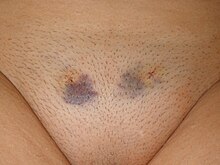
Insertion places of TVT sling, three days after surgery
The tension-free transvaginal (TVT) sling procedure treats urinary stress incontinence by positioning a polypropylene mesh tape underneath the urethra.
[14] Complications, such as bladder perforation, can occur in the retropubic space if the procedure is not done correctly. However, recent advancements have proven that the minimally invasive TVT sling procedure is regarded as a common treatment for SUI
[15] There are many other complications associated with the Tension Free Transvaginal (TVT) Sling including mesh erosion from day 1 up to 7 years later.
[citation needed]
Transobturator tape[edit]
The transobturator tape (TOT or Monarc) sling procedure aims to eliminate stress urinary incontinence by providing support under the urethra. The minimally-invasive procedure eliminates
retropubic needle passage and involves inserting a mesh tape under the urethra through three small incisions in the groin area.
[16]
Readjustable sling[edit]
The readjustable sling consists of a standard synthetic mesh sling combined with sutures that attach to an implantable tensioning device that resides permanently under the skin in the abdominal wall. Once implanted, this Readjustable Mechanical External (REMEEX) device can be re-accessed under local anesthesia to fine-tune the sling should incontinence reappear months or years after the initial surgery.
[17]
Mini-sling[edit]
The
mini-sling procedure was released in the United States in late 2006 by
Gynecare/
Johnson and Johnson under the name of
TVT-Secure. AMS have released a similar version called MiniArc. The
TVT-SECUR was designed to overcome two of the
perioperative complications reported with use of
TVT-Obturator: thigh pain and bladder outlet obstruction. The TVT-SECUR was designed to minimize the operative procedure as much as possible in order to reduce those undesired complications. This new device is composed of an 8 cm long laser cut polypropylene mesh and is introduced to the internal
obturator muscle (Hammock position) by a metallic inserter, while no exit skin cuts are needed. The MiniArc is also quite simple and again eliminates the need for skin incisions other than the vaginal incision.
[18] The reported short term cure rates of minislings range from 67% to 90%.
Needleless sling[edit]
The needleless sling is a single incision TOT. It is implanted via one unique incision. The needleless has approximately 136% more surface area than the mini sling, which may better support the pelvic floor and urethra, and no sharp instruments are required to implant the sling besides the scalpel used to make the incision, which may enhance patient comfort.
Bladder repositioning[edit]
Most stress incontinence in women results from the urethra dropping down toward the vagina. Therefore, common surgery for stress incontinence involves pulling the urethra up to a more normal position. Working through an incision in the vagina or abdomen, the surgeon raises the urethra and secures it with a string attached to muscle, ligament, or bone. For severe cases of stress incontinence, the surgeon may secure the urethra with a wide sling. This not only holds up the bladder but also compresses the bottom of the bladder and the top of the urethra, further preventing leakage.
Marshall-Marchetti-Krantz[edit]
The Marshall-Marchetti-Krantz (MMK) procedure, also known as retropubic suspension or bladder neck suspension surgery, is performed by a surgeon in a hospital setting. Developed in 1949 by doctors Victor F. Marshall (urologist), Andrew A. Marchetti (OB/GYN), and
Kermit E. Krantz (OB/GYN), it is the standard by which new procedures are measured. In 1961 Dr. Burch reported a modification of the MMK operation (the Burch modification).
The patient is placed under general anesthesia, and a long, thin, flexible tube (catheter) is inserted into the bladder through the narrow tube (urethra) that drains the body's urine. An incision is made across the abdomen, and the bladder is exposed. The bladder is separated from surrounding tissues. Stitches (sutures) are placed in these tissues near the bladder neck and urethra. The urethra is then lifted, and the sutures are attached to the pubic bone itself, or to tissue (fascia) behind the pubic bone. The sutures support the bladder neck, helping the patient gain control over urine flow. The Burch modifications involved placing the surgical sutures at the bladder neck and tying them to the Cooper ligament.
Approximately 85% of women who undergo the Marshall-Marchetti-Krantz procedure are cured of their stress incontinence.
[citation needed]
Peri/trans urethral injections[edit]
A variety of materials have been historically used to add bulk to the urethra and thereby increase outlet resistance. This is most effective in patients with a relatively fixed urethra. Blood and fat have been used with limited success. The most widely used substance, gluteraldehyde crosslinked collagen (GAX collagen) proved to be of value in many patients. The main downfall was the need to repeat the procedure over time.
[19]
Artificial urinary sphincter[edit]

CT scan (coronal reconstruction) showing an artificial urethral sphincter in a woman
In rare cases, a surgeon implants an
artificial urinary sphincter,
[20] a doughnut-shaped sac that circles the urethra. A fluid fills and expands the sac, which squeezes the urethra closed. By pressing a valve implanted under the skin, the artificial sphincter can be deflated. This removes pressure from the urethra, allowing urine from the bladder to pass.


