Showing posts sorted by relevance for query wet. Sort by date Show all posts

Wednesday, March 16, 2011

Engraved


Blood dripping from their hands
their arms were rather shrewd.
A blade, so sharp was like a dart
hit there hart straight threw.

A great big moan, its the phone
ringing on the line,
don't come, don't say, it's just "Hey"
inside this very dark room.

The floor was wet, I saw no sweat
just a heart pierced through.
This pumping organ.
Pumped until this pump began to see,
that all was lost,
above all cost,
the deal did not go through.

The ink was red, the paper skin,
my hands were held with leather shin.
The fountain poured,
the quill was wet,
the words were written
I was Inn.

My soul took flight
as the blood didst dry
upon the tin of the mountain inn
engraved with simple light
a multi-colored ass tonight


K.A.P.
5/3/2009 

Wednesday, August 17, 2016

Rose^Stirs!!!


The Whoa of Activity on the Tables,
such act.tiers that the rust is made in the throws to just happens??,
not in the say rather the happening,
as that is the Curtain of how it is in an inch to a mile,
it remains to be that shed of tools to touch the lip of raised??.

Not in the County of Fashion,
address and years on the clock,
gossip and silverware to the what did perk grape,
not more than the depth of shallow deep crate.

It is as the strings puppet to the market lathe,
it Cobblers to a Nail and the Venture goes rowe,
than in convenient to the taste of face to eyes,
shoulders squab as pigeon on the soap of dove in detailed.

Creek to that Ditch is at Vanity of popular Crave,
words come to the language to rancid such daze??,
no,
the believed are the all.ways to reality on scene,
therefore the desire is to cover a jam with bumpers and song.

Sheep bay the bah Ram boo to shadow that chalk,
slapping the hand.dull like the fathom did shank,
halters to leadlines cross-tied today,
the chart banks to dumb down to feather just slate.

Caulk to the Grout the be Cans grow lift,
to process know more its the shades be a loud,
dink a round to brink that fade while the light lamp jakes sound,
well is the pitch to the bucket of ground!!!

Stiction

From Wikipedia, the free encyclopedia
Stiction is the static friction that needs to be overcome to enable relative motion of stationary objects in contact.[1] The term is a portmanteau of the term "static friction",[2]perhaps also influenced by the verb "stick".
Any solid objects pressing against each other (but not sliding) will require some threshold of force parallel to the surface of contact in order to overcome static cohesion. Stiction is a threshold, not a continuous force.
In situations where two surfaces with areas below the micrometer range come into close proximity (as in an accelerometer), they may adhere together. At this scale, electrostaticand/or Van der Waals and hydrogen bonding forces become significant. The phenomenon of two such surfaces being adhered together in this manner is also called stiction. Stiction may be related to hydrogen bonding or residual contamination.

Automobiles[edit]

Stiction is a commonly used term when diagnosing diesel fuel powered engines. The Ford Powerstroke 6.0-L and 7.3-L engines are the most prevalent to experience cold start or injector stiction issues. The 7.3-L was produced between 1994 and 2003, while the 6.0-L was produced between 2003 and 2007. Both engines were manufactured by Navistar International and incorporated the HEUI injector system. These injectors use the engine oil to lubricate themselves and over time the sticky friction build up causes the injector to malfunction and fail. Alternatively to replacing injectors with new units, products are available that rid the injector, turbos and transmission of stiction and prevent build up. Leading engineers in the field have found in their research that 9 out of 10 failing injectors in diesel trucks are cases of stiction, and once removed are still in optimal working condition.[3]
Stiction is also the same threshold at which a rolling object would begin to slide over a surface rather than rolling at the expected rate (and in the case of a wheel, in the expected direction). In this case, it's called "rolling friction" or μr.
This is why driver training courses teach that if a car begins to slide sideways, the driver should try to steer in the same direction as the slide with no brakes. It gives the wheels a chance to regain static contact by rolling, which gives the driver some control again. An overenthusiastic driver may "squeal" the driving wheels trying to get a rapid start but this impressive display of noise and smoke is less effective than maintaining static contact with the road. Many stunt-driving techniques are also done by deliberately breaking and/or regaining this rolling friction.
A car on a slippery surface can slide a long way if the driver "locks" the wheels in stationary positions by pressing hard on the brakes. Anti-lock braking systems use wheel speed sensors and vehicle speed sensors to determine if any of the wheels have stopped turning. The ABS Module then briefly releases pressure to that wheel to allow the wheel to begin turning again. Anti-lock brakes can be much more effective than cadence braking which is essentially a non-automatic technique for doing the same thing.

Examples[edit]

Engineering[edit]

Stiction is a problem for the design and materials science of many moving linkages. This is particularly the case for linear sliding joints, rather than rotating pivots. Owing to simple geometry, the moving distance of a sliding joint in two comparable linkages is longer than the circumferential travel of a pivoting bearing, thus the forces involved (for equivalentwork) are lower and stiction forces become proportionally more significant. This issue has often led to linkages being redesigned from sliding to purely pivoted structures, just to avoid problems with stiction. An example is the Chapman strut, a suspension linkage developed by Colin Chapman of Lotus cars.[4]

Surface micromachining[edit]

Stiction or adhesion between the substrate (usually silicon based) and the microstructure occurs during the isotropic wet etching of the sacrificial layer. The capillary forces due to the surface tension of the liquid between the microstructure and substrate during drying of the wet etchant cause the two surfaces to adhere together. Separating the two surfaces is often complicated due to the fragile nature of the microstructure. Stiction is often circumvented by the use of a sublimating fluid (often supercritical CO2, which has extremely low surface tension) drying process where the liquid phase is bypassed. CO2 displaces the rinsing fluid and is heated past the supercritical point. As the chamber pressure is slowly released the CO2 sublimates thereby preventing stiction.

Johansson Gauge Blocks[edit]

These precision machined gauge blocks will stick together with quite high stiction even though they are highly polished and used perfectly dry and clean.

Precision boring[edit]

Many components will lock together with stiction even though they have sufficient theoretical clearance.

Polished glass[edit]

Polished glass is especially prone to stiction.

Hard disk drives[edit]

In the context of hard disk drives, stiction refers to the tendency of read/write heads to stick to the platters. Stiction is a result of smoothness and is exacerbated by humidity and other liquids condensing at the head-disk interface. Once the heads have stuck to the platters, the disk can be prevented from spinning up and can cause physical damage to the media and the slider. Other forces considered as responsible for stiction include electrostatic forces.[citation needed]
In the early models of hard disk drives, stiction was known to cause read/write heads to stick to the platters of the hard drive due to the breakdown of lubricants used to coat the platters. During the late 1980s and early 1990s, as the size of hard drive platters decreased from the older 8" and 5.25" sizes to 3.5" and smaller, manufacturers continued to use the same calendering processes and lubricants used on the older, larger drives. The much tighter space caused much higher internal operating temperatures in these newer smaller drives, often leading to an accelerated breakdown of the surface lubricants into their much stickier components. When the drive was powered off and would cool down (for example at the end of the day when a user went home and shut off their PC), these now-broken-down lubricants would become quite viscous and sticky, sometimes causing the read/write heads to literally stick to the platter. One response to this problem was to remove the affected drive and strike it gently but firmly on the side, then try to start it while connected to but not necessarily fitted inside the machine. This might break the heads free for long enough to spin up the drive and recover the data from it without powering it down. Once started, it would continue to run indefinitely, but might not start again if powered down. Instead of tapping the drive, rotating it sharply by hand could start it. In most Maxtor hard drives, if the heads are stuck to the platters, the drive might make "music" from either the heads trying to move or from the platters trying to spin up.
Modern hard drives have mostly solved the stiction problem by using ramps to "unload" the heads from the disk surface on power-down. These ramps ensure the heads are not touching the platters, which not only prevents stiction but also keeps abrasion from kicking up microscopic particulates that can later contaminate the drive mechanism. Parking the heads in this manner also allows the voice coil actuator to be shut down to save power, so the heads are also frequently unloaded when the drive is idle. A competing solution is based on laser textured landing zones near the ID of the platter where no data are stored. The heads are parked in that zone, and the actuator is latched until the next start-up. The landing zone consists of a controlled array of nanometer-level 'bumps' on the disk surface produced during manufacturing of the disk using a local substrate melting process employing suitable laser-based equipment. The method was pioneered by IBM around 1995 and is still widely in use in most desktop and server class HDDs.[5]

Digital storage tapes[edit]

Stiction may also manifest itself on computer tapes (9 track tape etc.). The magnetic surface of the tape would be heated against the read head in the tape deck, and when the tape stopped moving would cool slightly and "glue" onto the read head. This could be avoided by configuring the software so that the tape could be read continuously.[6]

Amateur astronomy[edit]

The term "stiction" has come into use in amateur astronomy circles to describe a characteristic of Dobsonian style altazimuth telescope mounts. These mounts can resist initial movement by the user, making it difficult to track an object in the sky. There is backlash; breaking this resistance requires enough force to cause the observer to overshoot the object.

Stereolithography[edit]

Typically the phenomenon occurs when “green” epoxy photopolymer components are left in direct contact with each other. If left long enough it appears that “cross-linking” of the polymer takes place in the region of contact. This effectively “welds” or more appropriately “glues” the parts together. This issue can have a significant impact on models where testing of kinematics are required. To avoid stiction in stereolithography clean and more importantly fully cure all geometry prior to assembly.

Biology[edit]

Stiction happens with the human body in situations where two surfaces press together to the point any lubrication is excluded, such as in ball joints for hip replacements or in post-operative transsexuals using smooth plastic dilators.

See also[edit]

    Wednesday, June 29, 2011

    Door Knobs


    I was always hiding or running from someone in the house on Balboa Street.  On this one day my older brother and sister were away at school, the church that my mother had started seemed to be in full swing and now I had no good place to hide.  I heard the crowd of women come in the front door, I jumped down from  my chair and was trying to get out of the kitchen and up to my room.  Of course time was of the essence.  I dodged through the women and made my way to the front of the house where the stairs would lead me to freedom.  I got to the bottom of the stairs and fright hit me really hard for the first time.  I didn't know what to do. It was different than usual, no man to run to for protection from the hated (Women).  

    I started upstairs in a scramble of nerves and trying to think about where I would be safe from this growing crowd.  As I topped the staircase I turned left to run down the hall into my mothers bedroom.  I ran over to the right and choose the second closet, which was my mothers and was deeper than the first closet.  I opened the door and the horror that these women were closing in on me began to make me shake.  Crawling over the dirty pile of clothes and up into the back of the closet, I began to freak out because the high heeled shoes were scraping on the wood floor making to much noise.  I was terrified I would get caught.  The major problem I was having as I was running from this crowd of women, was that they were gaining ground and seemed to be headed for me. 

    Pushing the shoes aside and pulling the clothes back up to create a taller pile, I forgot any sort of pillow or blanket for my own comfort, as I never knew how long these sessions would last.  I didn't have time to go back to my room because as I opened the door just enough to peer through the crack where the hinges attach to the wall, the room had begun to fill.  I quickly moved the shoes and settled into a sitting position with my arms wrapped around my knees tightly.  I closed my eyes and hoped that somebody would close the closet door so that I didn't have to see what was coming next. 

    As the door shut, it was the wrong one.  It was the bedroom door to the hall, the closet door was still ajar, but thankfully they did not notice it moving when I was checking to see if I had enough time to get a pillow and blanket from my room.  The floor was made of wood and it was so hard, my butt bones were digging into it.  I very slowly tried to change position but the high heeled shoes made the loudest screeching noise, I was sure they could here me.  I looked through the crack once again, thinking that I had been found out for certain and would be receiving a beating for hiding.  But to my horror and to my dismay, I had chosen the wrong hiding place on that day.

    As I pinched my eyes shut even tighter I tried to imagine anything other than what I had just seen.  I curled up even tighter and gently rolled onto my side, pulling some of the dirty clothes up for a pillow.  What I had seen was so disturbing to me that I held my breath and found that I could do nothing for myself.  The image was burned into my brain.  The room filled with naked women on the bed, on the floor, standing near the wall was more than I could take.  Once again I was trapped by the sexual prowess of my mother.  That was day I loved men, regardless of what my father had done to me. I would love strangers only. Strange men only!  I wrote this poem about what will be shocking to you, but I would choose it over what I had just seen and had to listen too for hours upon hours.

    I apologize in advance for not having the ability to accept Lesbian Women, but I am still traumatized and sitting in that closet. I am still trying not to get caught while my mother is having an Orgy in her bedroom with her new church members.  I cannot stand women in general, I have a tough time with most of them.  If I had been caught by one of those women that are very much alive and well today, I cannot imagine what would have happened to me, I don't want too.

    I had already suffered through my father and my brother suffocating me because of the sexual abuse on their part.  What would have happened to me if the taboo sexual actions of these women had been caught by a little girl.  I still try not to think about it, but today its a good day to tell you about what is haunting me.

    Good Girl


    A bar of the darkest fare.
    I felt the bondage in the air!
    The dominating rule of thumb,
    would make the best of them go dumb.
    Sadistic arms held strength at bay,
    a masochistic stay.

    Paradise or was it play?
    The ropes seemed to hang that way.
    The shiny studs, the spurs and chains
    dangled in my way.
    The Bull Whip, it was blood red wet,
    dripping on display,
    often finding metal,
    sometimes fades away.
    The slanted tables, rings set free,
    the Cross was on my back.
    This was a total, absolute,
    simple, point-of-fact.


    Hands were cuffed, mouths were gagged,
    silence the demand.
    Four each man, there was no band
    just punishment and jeer.
    I was so small, I used to crawl,
    to try to get away from here.
    So much to take, it's on my plate
    and full I'm not at all.
    A good girl knows win to sin
    and when to "no" at "all".

    K.A.P.
    5/3/2009


    On that day I knew that my mothers sexual desires were beyond anything that I would ever be able to understand or sympathize with.  She had no control but I chose for myself the downtown men and what we had done before these woman showed up in our  life.  I chose the downtown excursions leading us into the darkest and deepest places that you could only try and imagine what had happened while we were there.  These were the places that grown men did things that I did not always understand but grew to appreciate later in life.  I was never hurt by the men of BDSM.  On the day that the orgy's had begun we never went back downtown, that part of my life was over.  I would grow to be sadden by my mothers behaviour.  As you cannot imagine I am nearly sure of that fact, but on that day my preference for my own sexual desires would be set for life. I was not more than four years old.  I just ask you to imagine a bunch of women trying to get away with having sex with one another all day and as soon as the men came home from work they would play it all off as never have happened.  That is how long I sat in the closet, waiting for them to be done.  I hate women so much for the deceitful way I saw them touch and behave towards one another.  It is all of the words, the moans, the groans that gross me out so much.

    What topped the charts for me were the lies that they told in front of me about what they had done with their day.  Until this moment they (All of these women) had no idea that I was hiding in my mothers closet in the Master Bedroom at 815 Balboa Street, San Francisco, CA.

    I wrote this next piece of poetry purposefully as oppose to the earlier piece that was just a release of what was on my mind, torturing me with the memories of what my mother had done with me in tow.  I wrote a poem about what bothered me so much about the women on that day.  I wrote it for the men in their defense.  They were the only ones that showed me anything in life.  It is sad to me now to share this story with you because I know that people judge so harshly the BDSM life style.  But let me ask you, if you were me and you had experienced nothing but hurt, pain, agony, incest, rape, beatings and hours upon hours of severe neglect, which by the way means you don't get anything to eat or drink, at all.   What would you have done or chosen as the hope that there is something different, where men don't hurt you and women are the ones that are beaten.  All this family was interested in doing is Fucking. Nobody thought of anything else until they see you and had to make sure that you had not seen them.  I suffered at the hands of my father and my brother because I was their object of abuse.  The rest just assumed through questioning and ease-dropping on my life that I had never seen them.

    This is for you ladies, SEXUAL CONDUCT, you have none. I still shake today as I write these words down on my Google Blog, that is how afraid I still am in my body of you and what I know I saw you all do while I was trying to hide in the closet so I wouldn't get beaten. I should have taken the beating because the memories of your naked bodies as they rolled across one another, moaning and panting, is burned into my mind and is bothering me more these days.  Like a motion picture at the movie theater that plays a daily matinee, my mind presses rewind every day at noon. I never wanted to see what I saw, but I will never forget or forgive the disgusting acts of women when they know that there are no men around. It would blow your mind, it blew mine for quite sometime. I checked-out for a long time after this happened to me.  I hate that this has happened, I hate that I have to deal with what is not mine to have to deal with at all.  The sixties don't lie when they tout, "Free love and tiedie."

    Sexual Conduct


    A narcissists flair, comes from their secrecy.
    the lack thereof, comes from their pride.
    Sex in the brain comes from their roll plays,
    my life comes from surviving the entire mire, oh my!
    Oh! are they bitter, Oh! are they pissed, Oh! are they measured inside all of this.
    A treasured proclaim! I must persist!!

    I used to go to the bars down under,
    deep in the town where the dark lights flicker.
    Seemingly night but the broad day shone,
    inside the places where grown men roamed.
    The bars were called not dungeons or lairs.
    Black leather coats and boots were in there,
    spying was not in any of the heir,
    I was just hanging, waiting for fair.
    For nothing much more than a rub out to share.

    Not so funny when you know more of honey,
    the snuff did not go well I forgot, didn't fell.
    Jumping from the fright of a suffocating sight,
    throws even the biggest men on a really tough night.
    Oh well, I thought, its not like you know me,
    stop they said, don't move or we may get the bell.

    Why in a place where sexual conduct is bent.
    Why would you find what men really meant.
    Why would they want to protect you from them.
    Why would they offer nothing more than a mint.
    Why would they be the ones to say BDSM.

    Questions lingered in the air of that lair.
    The black coats were leather and boots were entrenched.
    No staring eyes, no ripping intent,
    just a gentle goodbye and a kiss or some flint.
    First time I wasn't ripped from those night terrors of mine.
    Made sense to me and the men didn't mind.
    My tears always wet me and I shook with such fear.

    Now I can't know what it is you've kicked out,
    made it a show it is not I did shout.
    Confusion did lather this kid that can say,
    thanks to the ones that could show me the way.

    Its different, its louder, its mysterious too.
    But, mostly its missing the advancement of you.
    Protected forever, until it should stand.
    Go Dominatrix, I think its a plan.
    'cause woman just falter when their is a call,
    I need a Master, A dominator, a shawl.
    I think sex has become the conduct of all.

    My number is easy, my number is rye,
    my number works for you and even for I.
    My mother assigned me saying again and again,
    you are possessed and 666 please begin.
    The demon of silence is laden within.

    I'm printed on one side and beat on the other,
    no master, no father, not even a collar.
    Put down like a dog and fed what was odd,
    which way do you turn when your at the bottom of the bog.
    How often is it?
    Is it always my turn?

    I stand with my truth,
    I stand with my dare,
    I doubt I was ever hurt over there.
    Only at home, with family declared,
    the scariest moments to ever have weared.

    Good night my dear Master,
    good night to my rights,
    to be free of disaster and live without fright.
    To the faith of the few,
    and the memory of you,
    sexual conduct and rules of the true.


    Which would you have chosen?  What would you have done all these years? Run? Try to forget? Try to stay out of the lives that you had accidentally fallen into?  Try to erase the memories?  How?  When all my mother ever talked about was sex, in church, at home, at dinner, at parties, it never, ever had any boundaries nor was she ever discreet. It is what it is, sickening, unbelievable and just exhausting to have to keep a secret for so long. 

    Monday, March 14, 2016

    Can^Sir Say Know To Drugs . . . . .


    Venus flytrap

    From Wikipedia, the free encyclopedia
    This article is about the plant. For other uses, see Venus Flytrap (disambiguation).
    Venus flytrap
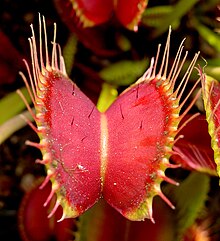
    Venus Flytrap showing trigger hairs.jpg
    Leaf
    Scientific classification
    Kingdom:Plantae
    (unranked):Angiosperms
    (unranked):Eudicots
    (unranked):Core eudicots
    Order:Caryophyllales
    Family:Droseraceae
    Genus:Dionaea
    Species:D. muscipula
    Binomial name
    Dionaea muscipula
    Sol. ex J.Ellis 1768
    Dionaea distribution (revised).svg
    Distribution
    Synonyms[2]
    • Dionea Raf., spelling variant
    • Dionaea corymbosa
      (Raf.) Steud. (1840)
    • Dionaea crinita
      Sol. (1990) as synonym
    • Dionaea dentata
      D'Amato (1998) name published without description
    • Dionaea heterodoxa
      D'Amato (1998) nom.nud.
    • Dionaea muscicapa
      St.Hil. (1824) sphalm.typogr.
    • Dionaea sensitiva
      Salisb. (1796)
    • Dionaea sessiliflora
      (Raf.) Steud. (1840)
    • Dionaea uniflora
      (Raf.) Steud. (1840)
    • Drosera corymbosa
      Raf. (1833)
    • Drosera sessiliflora
      Raf. (1833)
    • Drosera uniflora
      Raf. (1833)
    The Venus flytrap (also referred to as Venus's flytrap or Venus' flytrap), Dionaea muscipula, is a carnivorous plant native tosubtropical wetlands on the East Coast of the United States in North Carolina and South Carolina.[3] It catches its prey—chiefly insects andarachnids—with a trapping structure formed by the terminal portion of each of the plant's leaves, which is triggered by tiny hairs on their inner surfaces. When an insect or spider crawling along the leaves contacts a hair, the trap closes if a different hair is contacted within twenty seconds of the first strike. The requirement of redundant triggering in this mechanism serves as a safeguard against wasting energy by trapping objects with no nutritional value.
    Dionaea is a monotypic genus closely related to the waterwheel plant and sundews, all of which belong to the family Droseraceae.

    Description

    The Venus flytrap is a small plant whose structure can be described as a rosette of four to seven leaves, which arise from a short subterranean stem that is actually a bulb-like object. Each stem reaches a maximum size of about three to ten centimeters, depending on the time of year;[4] longer leaves with robust traps are usually formed after flowering. Flytraps that have more than 7 leaves are coloniesformed by rosettes that have divided beneath the ground.
    Illustration from Curtis's Botanical Magazine byWilliam Curtis (1746–1799)
    The leaf blade is divided into two regions: a flat, heart-shaped photosynthesis-capable petiole, and a pair of terminal lobes hinged at the midrib, forming the trap which is the true leaf. The upper surface of these lobes contains red anthocyanin pigments and its edges secrete mucilage. The lobes exhibit rapid plant movements, snapping shut when stimulated by prey. The trapping mechanism is tripped when prey contacts one of the three hair-like trichomes that are found on the upper surface of each of the lobes. The mechanism is so highly specialized that it can distinguish between living prey and non-prey stimuli, such as falling raindrops;[5] two trigger hairs must be touched in succession within 20 seconds of each other or one hair touched twice in rapid succession,[5] whereupon the lobes of the trap will snap shut, typically in about one-tenth of a second.[6] The edges of the lobes are fringed by stiff hair-like protrusions or cilia, which mesh together and prevent large prey from escaping. These protrusions, and the trigger hairs (also known as sensitive hairs) are likely homologous with the tentacles found in this plant’s close relatives, thesundews. Scientists have concluded that the snap trap evolved from a fly-paper trap similar to that ofDrosera.[7]
    The holes in the meshwork allow small prey to escape, presumably because the benefit that would be obtained from them would be less than the cost of digesting them. If the prey is too small and escapes, the trap will usually reopen within 12 hours. If the prey moves around in the trap, it tightens and digestion begins more quickly.
    Speed of closing can vary depending on the amount of humidity, light, size of prey, and general growing conditions. The speed with which traps close can be used as an indicator of a plant's general health. Venus flytraps are not as humidity-dependent as are some other carnivorous plants, such as NepenthesCephalotus, most Heliamphora, and some Drosera.
    The Venus flytrap exhibits variations in petiole shape and length and whether the leaf lies flat on the ground or extends up at an angle of about 40–60 degrees. The four major forms are: 'typica', the most common, with broad decumbent petioles; 'erecta', with leaves at a 45-degree angle; 'linearis', with narrow petioles and leaves at 45 degrees; and 'filiformis', with extremely narrow or linear petioles. Except for 'filiformis', all of these can be stages in leaf production of any plant depending on season (decumbent in summer versus short versus semi-erect in spring), length of photoperiod (long petioles in spring versus short in summer), and intensity of light (wide petioles in low light intensity versus narrow in brighter light).[citation needed]
    When grown from seed, plants take around four to five years to reach maturity and will live for 20 to 30 years if cultivated in the right conditions.[8]
    Closeup of flower (c. 20 mm in diameter) 
    The species produces small, shiny black seeds 

    Etymology

    The plant's common name refers to Venus, the Roman goddess of love. The genus name, Dionaea ("daughter of Dione"), refers to the Greek goddess Aphrodite, while the species name, muscipula, is Latin for "mousetrap".[9]
    Historically, the plant was also known by the slang term "tipitiwitchet" or "tippity twitchet", possibly an oblique reference to the plant's resemblance to human female genitalia.[9][10]

    Carnivory

    A closing trap

    Prey selectivity

    File:Venus Flytrap time lapse.webm
    A time lapse showing Venus flytrap catching prey
    Most carnivorous plants selectively feed on specific prey. This selection is due to the available prey and the type of trap used by the organism. With the Venus flytrap, prey is limited to beetles, spiders and other crawling arthropods. In fact, the Dionaea diet is 33% ants, 30% spiders, 10% beetles, and 10% grasshoppers, with fewer than 5% flying insects.[11] Given that Dionaea evolved from an ancestral form of Drosera (carnivorous plants that use a sticky trap instead of a snap trap) the reason for this evolutionary branching becomes clear. Whilst Drosera consume smaller, aerial insects, Dionaea consume larger terrestrial bugs. From these larger bugs, Dionaea are able to extract more nutrients. This gives Dionaea an evolutionary advantage over their ancestral sticky trap form.[12]

    Mechanism of trapping

    Closeup of one of the hinged trigger hairs
    The Venus flytrap is one of a very small group of plants capable of rapid movement, such as Mimosa pudica, the Telegraph plant,sundews and bladderworts.
    The mechanism by which the trap snaps shut involves a complex interaction between elasticityturgor and growth. The trap only shuts when the trigger hair is stimulated twice: this is to avoid inadvertent triggering of the mechanism by dust and other wind-borne debris. In the open, untripped state, the lobes are convex (bent outwards), but in the closed state, the lobes are concave (forming a cavity). It is the rapid flipping of this bistable state that closes the trap,[6] but the mechanism by which this occurs is still poorly understood. When the trigger hairs are stimulated, an action potential (mostly involving calcium ions — see calcium in biology) is generated, which propagates across the lobes and stimulates cells in the lobes and in the midrib between them.[13] It is hypothesized that there is a threshold of ion buildup for the Venus flytrap to react to stimulation.[14] After closing, the flytrap counts additional stimulations of the trigger hairs, to five total, to start the production of digesting enzymes.[15] The acid growth theory states that individual cells in the outer layers of the lobes and midrib rapidly move 1H+ (hydrogen ions) into their cell walls, lowering the pH and loosening the extracellular components, which allows them to swell rapidly by osmosis, thus elongating and changing the shape of the trap lobe. Alternatively, cells in the inner layers of the lobes and midrib may rapidly secrete otherions, allowing water to follow by osmosis, and the cells to collapse. Both of these mechanisms may play a role and have some experimental evidence to support them.[16][17]

    Digestion

    If the prey is unable to escape, it will continue to stimulate the inner surface of the lobes, and this causes a further growth response that forces the edges of the lobes together, eventually sealing the trap hermetically and forming a 'stomach' in which digestion occurs. Digestion is catalysed by enzymes secreted by glands in the lobes.
    Oxidative protein modification is likely to be a pre-digestive mechanism used by Dionaea muscipula. Aqueous leaf extracts have been found to contain quinones such as thenaphthoquinone plumbagin that couples to different NADH-dependent diaphorases to produce superoxide and hydrogen peroxide upon autoxidation.[18] Such oxidative modification could rupture animal cell membranes. Plumbagin is known to induce apoptosis, associated with the regulation of the Bcl-2 family of proteins.[19] When the Dionaeaextracts were pre-incubated with diaphorases and NADH in the presence of serum albumin (SA), subsequent tryptic digestion of SA was facilitated.[18] Since the secretory glandsof Droseraceae contain proteases and possibly other degradative enzymes, it may be that the presence of oxygen-activating redox cofactors function as extracellular pre-digestive oxidants to render membrane-bound proteins of the prey (insects) more susceptible to proteolytic attacks.[18]
    Digestion takes about ten days, after which the prey is reduced to a husk of chitin. The trap then reopens, and is ready for reuse.[20]

    Evolution

    Drosera falconeri, with short, wide, sticky leaf traps
    The carnivorous diet is a very specialized form of foliar feeding, and is an adaptation found in several plants that grow in nutrient-poor soil. Carnivorous traps were naturally selected to allow these organisms to compensate for the nutrient deficiencies of their harsh environments by supplementing ordinary photosynthate with animal proteins.[21]
    The "snap trap" mechanism characteristic of Dionaea is shared with only one other carnivorous plant genus, Aldrovanda. For most of the 20th century, this relationship was thought to be coincidental, more precisely an example of convergent evolution. Some phylogenetic studies even suggested that the closest living relatives of Aldrovanda were the sundews.[22] It was not until 2002 that a molecular evolutionary study, by analyzing combined nuclear and chloroplast DNA sequences, indicated that Dionaea and Aldrovanda were closely related and that the snap trap mechanism evolved only once in a common ancestor of the two genera.[23][24]
    A 2009 study[22] presented evidence for the evolution of snap traps of Dionaea and Aldrovanda from a flypaper trap like Drosera regia, based on molecular data. The molecular and physiological data imply that Dionaea and Aldrovanda snap traps evolved from the flypaper traps of a common ancestor with Drosera. Pre-adaptations to the evolution of snap traps were identified in several species of Drosera, such as rapid leaf and tentacle movement. The model proposes that plant carnivory by snap trap evolved from the flypaper traps, driven by increasing prey size. Bigger prey provides greater nutritional value, but large insects can easily escape the sticky mucilage of flypaper traps; the evolution of snap traps would therefore prevent escape andkleptoparasitism (theft of prey captured by the plant before it can derive benefit from it), and would also permit a more complete digestion.[22][23]

    Proposed evolutionary history

    Carnivorous plants are generally herbs, and their traps the result of primary growth. They generally do not form readily fossilizable structures such as thick bark or wood. As a result, there is no fossil evidence of the steps that might link Dionaea and Aldrovanda, or either genus with their common ancestor, Drosera. Nevertheless, it is possible to infer an evolutionary history based on phylogenetic studies of both genera. Researchers have proposed a series of steps that would ultimately result in the complex snap-trap mechanism:[22][23]
    • Larger insects usually walk over the plant, instead of flying to it,[25] and are more likely to break free from sticky glands alone. Therefore, a plant with wider leaves, likeDrosera falconeri,[22] must have adapted to move the trap and its stalks in directions that maximized its chance of capturing and retaining such prey - in this particular case, longitudinally. Once adequately "wrapped", escape would be more difficult.[25]
    • Evolutionary pressure then selected for plants with shorter response time, in a manner similar to Drosera burmannii or Drosera glanduligera. The faster the closing, the less reliant on the flypaper model the plant would be.
    • As the trap became more and more active, the energy required to "wrap" the prey increased. Plants that could somehow differentiate between actual insects and random detritus/rain droplets would have an advantage, thus explaining the specialization of inner tentacles into trigger hairs.
    • Ultimately, as the plant relied more on closing around the insect rather than gluing them to the leaf surface, the tentacles so evident in Drosera would lose their original function altogether, becoming the "teeth" and trigger hairs — an example of natural selection utilizing pre-existing structures for new functions.
    • Completing the transition, the plant eventually developed the depressed digestive glands found inside the trap, rather than using the dews in the stalks, further differentiating it from genus Drosera.

    Habitat

    The Venus flytrap is found in nitrogen- and phosphorus-poor environments, such as bogs and wet savannahs. Small in stature and slow-growing, the Venus flytrap tolerates fire well, and depends on periodic burning to suppress its competition.[26] Fire suppression threatens its future in the wild.[27] It survives in wet sandy and peaty soils. Although it has been successfully transplanted and grown in many locales around the world, it is native only to the coastal bogs of North and South Carolina in the United States, specifically within a 60-mile radius of Wilmington, North Carolina.[28] One such place is North Carolina's Green Swamp. There also appears to be a naturalized population of Venus flytraps in northern Florida as well as an introduced population in western Washington.[29][30] The nutritional poverty of the soil is the reason that the plant relies on such elaborate traps: insect prey provide the nitrogen for protein formation that the soil cannot. The Venus flytrap is not a tropical plant and can tolerate mild winters. In fact, Venus flytraps that do not go through a period of winter dormancy will weaken and die after a period of time.[31]

    Cultivation

    Dionaea muscipula 'Akai Ryu', Japanese for 'Red Dragon', in cultivation
    Venus flytraps are popular as cultivated plants, but have a reputation for being difficult to grow.[4] Successfully growing these specialized plants requires recreating a close approximation to the plant's natural habitat.
    Healthy Venus flytraps will produce scapes of white flowers in spring; however, many growers remove the flowering stems early (2–3 inches), as flowering consumes some of the plant's energy and thereby reduces the rate of trap production. If healthy plants are allowed to flower, successful pollination will result in seeds.
    Plants can be propagated by seed, although seedlings take several years to mature. More commonly, they are propagated by clonal division in spring or summer.

    Cultivars

    Venus flytraps are by far the most commonly recognized and cultivated carnivorous plant, and they are frequently sold as houseplants. Various cultivars (cultivated varieties) have come into the market through tissue culture of selected genetic mutations, and these plants are raised in large quantities for commercial markets.

    Conservation

    The species is classified as "vulnerable" by the National Wildlife Federation.[32] In 2015, there were estimated to be fewer than 33,000 plants in the wild, all within 75 miles (121 km) of the city of Wilmington, North Carolina, and all on sites owned by The Nature Conservancy, the North Carolina state government, or the US military.[33]
    In 2014, the state of North Carolina passed legislation to classify the theft of naturally growing Venus flytraps in some counties as a felony.[34]

    In alternative medicine

    Venus flytrap extract is available on the market as an herbal remedy, sometimes as the prime ingredient of a patent medicine named "Carnivora". According to the American Cancer Society, these products are promoted in alternative medicine as a treatment for a variety of human ailments including HIVCrohn's disease and skin cancer, but "available scientific evidence does not support the health claims made for Venus flytrap extract".[35]