Showing posts sorted by relevance for query what is sin. Sort by date Show all posts

Friday, November 18, 2011

Death is not Taboo! It is a Date.


It seems it is the fear of Death that holds the tongue's of almost all Man.  It is neither a Taboo or a Bad Luck subject to either ponder or speak upon.  Yet, should you rise the question in conversation you will never be as shot down as you will when you mention this as a topic of discussion.

Our country, the U.S.A. is so terrified of Death itself, we have lost our ability to be able to die with dignity.  It almost seems a shameful time as it approaches.  Suicide is at an all time high amongst Teenagers.  I personally do not believe in Suicide, it is a personal choice.  I am against it for myself because of the fear that I have of being stuck in some half alive, half dead state for Eternity, either here on Earth in some Hospital or in the next realm for eternity. 

I will of coarse and would try very hard to point out to any potential candidate of Suicide that I ever ran across the values that life itself possesses.  I would try desperately to get them to a professional, but there is a point that I would step aside also.  I've been exposed to it more than once and I am sure that this exposure to these people is what concreted my opinion that Suicide is not for me. At the same time I have seen something in the eyes of the people that took their lives that made me very uncomfortable, it still causes me concern and stress within myself.  In fact, the look that I saw from the eyes of these victims stops me dead in my tracks today.  I would rather turn and walk away than to ever be that close to the taking of any life again, be it yours or anyone Else's.  What I saw was a Sin.

It is a decision that is my own, based on my experience as a child. I have the freedom to chose what is correct for me and the decision was made deep within my mind long ago not to entertain such a way to go from this place to the next.  It was made at a sub-conscious level and at a very young age.  As a Human Being I honor what has provided me with this wisdom to know what is right and what is wrong.  It is wrong to take the life of another.  Although I do not understand, the evil that I saw in the eyes of this woman as she made the decision to purposely take her life blew me away.  It was a sin and she knew it and was willing to pay the price, knowingly in advance of the act it seemed.  It was purposeful and meant to hurt who she was leaving behind. 

However, it was her sin, her choice to make or not to make.  I was to young to understand what was happening but I have a greater depth of understanding today of what I was witness too.  It is not our right to involve ourselves in the lives of people that have gone this far in their minds and made such dreadful and decidedly final decisions to harm not just themselves but the ones that they are purposely leaving behind to find them in such a disgraceful form.  Unless you are a professional and work in this field, stay away.  Only people trained in this field can intervene into such desperate circumstances, especially when they have gone so far and it seems these days that it goes to far before anyone person even notices another Human Beings mental condition or pain.

The purpose behind the book I wish to write about Death, is not to cause fear from within your core or in your minds.  I am writing to obligate or rather fill an obligation that I feel within myself. I have been compelled to do this since I was a child. The question of "Why" I would feel would be an invasion of my privacy and therefore is not for you to ask or bother me about.

The fear of death is overwhelming to most people and I have found that this fear has disturbed my life a great deal.  My thoughts on Death and the conversations with other people about Death are very matter of fact yet, I am treated as a Leper. And it seems that we treat Death as a disease.

It does not matter if you are good, bad, or evil.  Which ever word you would like to counter the word good with, there is only one concern you should have in this matter of death.  You should ask yourself in all seriousness only one thing.

Am a Sinner? Or, Do I Sin?

An Evil Being can be evil and never commit a sin.  A Good Being can commit a sin everyday and it is looked over by anyone and/or everyone because people in general detest or protest the state of being Evil and promote that they are nothing but good or Christian.  These Beings seem to believe that they are above the penalty of Sin or the judgement thereof.

To cast judgement on Evil is a Sin.  It is prejudice and intolerant to difference.  Satan the Highest Ranking Arch Angel in Heaven, the most Beautiful to have ever have been created by God, was cast out of the Heavens and into Hell over an argument or disagreement with whom was his creator.  Why then after a lifetime of service to his Creator and being taught only to Honor would he then all of a sudden condone Sin for all.  His condemnation to Hell was payment or banishment for the Sin he committed.

So, the assumption he would promote that which he defended against is quiet the opposite.  Instead, he would try to rectify himself in his belief to answer for himself and pay for the sin that he had committed in the Heavens to accept his judgement for his infraction against his creator.  Accepting his punishment and the banishment from his home, he would then accept what took place and continue on in his new found surroundings of Hell.  This is my assumption, my experience, my truth and what seems reasonable to me and my mind.

For thou that whilst not rising,
shall find that the truth is the Rule.
A Sin committed by the favored,
is penalized with a heavy hand,
for the Eternity of Man.

Eternal Battles within the Realm.
A dimension, not a consideration,
should cause you fright and deliver horror.
Not comfort you, promote your lies,
it should cause deplore within your core.

The care it takes to speak,
is the only communication I need.
To order about, to only tout, to condemn with doubt,
shall produce nothing but the poor of mind to shout.

A "Sin Board" accepts the reality,
that your blindness to such is surreal.
You light candles for what is real,
yet, scoff when offered a deal.

Interfere in Celestial Wars,
Battles, arguments and more,
will scar not only your life,
but expose the Con of the Light.

Mere Man speaks on behalf,
of what they assume to translate.
Books written in script that is not known,
yet Ministers still believe they can profess what is best.

Disgrace will befall such accord, what a mess.

No proof is required from any one man.
For any one Being may speak or be mean.
Forbearing, and Tearing, Accusing or Musing,
what the book of King James may be saying or doing.

To stand as I do with Freedom from you,
I speak with a Truth that is new!
My Credentials I've written,
and study I have, with a life that was sought and not bought.

Questions and Answers deliver to you the truth of my word.
You know or assume that Natural cannot be true,
remind yourself, remind your soul, cling to your heart or your core,
without Jesus Christ you would be dead at least twice.

This Man from this Earth, his name was a curse,
Jesus Christ, he was crucified, suffered and died.
He spoke words of wisdom as words of advice.
He said without question, he said without guise,
"I'll die for all Mans Sins, go Sin no more."
This was his verse, and dying breath he used first,
to cleanse all your guilt, not placate or place filth.

Yet, hang on you do too,
a miracle or two.
You hope he, J.C. returns, just for you to get out.
To wish for him, to die once again,
for what is not even his sin,
is gross if not a Fen.

Due you are to announce your scar,
forgiveness comes hard when you are not so easily barred.
A "Sin Board," not a valve, you have no worth,
get a clue, this Man, Jesus Christ has already died for all you.
For what you did due!

Try to make charge, in Life you live large,
but Dead he is now, or at least in Death he will be,
after so long with all he is stuck and all of thee and your muck.

Reason will wonder, practicality wins all,
for Crucifixion is illegal and Treason is out,
for what I am saying, or, for what I may shout,
there is no punishment that you can pass out.

I will write 'till you know,
'till you get it through your thick minds
or until such time you understand that its mine.
The Ten Commandments you say are written,
in stone they doth lay.
Made in Gods Image, you preach to the crowds,
our minds may improve or decide to go foul.

Religion shall falter,
this News shall persist.
The Mountains will whistle, with voice and declare,
it's natural to question, to reason, to say,
I am just making noise in verse to prey.

Stand not to my side,
Your Sin will abide.
It resides in your mind,
discreet and not kind.

Speak out or testify,
you may want to shout!
But what you need is, to work yourself out.
Be private, discreet and know from below,
they watch and the listen, to see with intention,
if you lie or just pass this state of detention.

The punishment for one Sin,
is more than I know.
For I am so Evil, 666 is my lord.
But, Sin free I do know,
that I am and remain.
For I am a Good Girl and I know their names.

The Court of Death is a very real place you will be, it is interesting to me. Upon your passing, whether you believe in Good or in Evil, Demons are Spirits that will come to guide thee.  Dark Lords they do listen, exist on this Earth, they walk amongst you and speak to be heard.

I remain with myself, I work to be true, to be honest and without the temptations from you. I live with such stealth, to stay safe and list well, all the things that I must, I feel compelled. To speak with such candor and not run away, I watch you each day. I write what I see, it comes out so painfully, now you can know how far off the path that you go, you are so far from whats known as "Good Will."

Monday, January 25, 2016

What Is Ewe Lures Form You La Should An Gull Be A Funny Roof For The Corner Clear Ring??

Sine

From Wikipedia, the free encyclopedia
Sine
Basic features
Parityodd
Domain(−∞,∞) a
Codomain[−1,1] a
Period2π
Specific values
At zero0
Maxima((2k + ½)π 1) b
Minima((2k − ½)π −1)
Specific features
Rootkπ
Critical pointkπ − π/2
Inflection pointkπ
Fixed point0


\sin \alpha = \frac {\textrm{opposite}} {\textrm{hypotenuse}}
For the angle α, the sine function gives the ratio of the length of the opposite side to the length of the hypotenuse.

The sine function graphed on the Cartesian plane. In this graph, the angle x is given in radians (π = 180°).

The sine and cosine functions are related in multiple ways. The derivative of \sin(x) is \cos(x). Also they are out of phase by 90°: \sin(\pi/2 - x)= \cos(x). And for a given angle, cos and sin give the respective x, y coordinates on a unit circle.
Sine, in mathematics, is a trigonometric function of an angle. The sine of an angle is defined in the context of a right triangle: for the specified angle, it is the ratio of the length of the side that is opposite that angle to the length of the longest side of the triangle (i.e., the hypotenuse).
Trigonometric functions are commonly defined as ratios of two sides of a right triangle containing the angle, and can equivalently be defined as the lengths of various line segments from a unit circle. More modern definitions express them as infinite series or as solutions of certain differential equations, allowing their extension to arbitrary positive and negative values and even to complex numbers.
The sine function is commonly used to model periodic phenomena such as sound and light waves, the position and velocity of harmonic oscillators, sunlight intensity and day length, and average temperature variations throughout the year.
The function sine can be traced to the jyā and koṭi-jyā functions used in Gupta period Indian astronomy (Aryabhatiya, Surya Siddhanta), via translation from Sanskrit to Arabic and then from Arabic to Latin.[1] The word "sine" comes from a Latin mistranslation of the Arabic jiba, which is a transliteration of the Sanskrit word for half the chord, jya-ardha.[2]

Right-angled triangle definition[edit]

For any similar triangle the ratio of the length of the sides remains the same. For example, if the hypotenuse is twice as long, so are the other sides. Therefore respective trigonometric functions, depending only on the size of the angle, express those ratios: between the hypotenuse and the "opposite" side to an angle A in question (see illustration) in the case of sine function; or between the hypotenuse and the "adjacent" side (cosine) or between the "opposite" and the "adjacent" side (tangent), etc.
To define the trigonometric functions for an acute angle A, start with any right triangle that contains the angle A. The three sides of the triangle are named as follows:
  • The adjacent side is the side that is in contact with (adjacent to) both the angle we are interested in (angle A) and the right angle, in this case side b.
  • The hypotenuse is the side opposite the right angle, in this case side h. The hypotenuse is always the longest side of a right-angled triangle.
  • The opposite side is the side opposite to the angle we are interested in (angle A), in this case side a.
In ordinary Euclidean geometry, according to the triangle postulate the inside angles of every triangle total 180° (π radians). Therefore, in a right-angled triangle, the two non-right angles total 90° (π/2 radians), so each of these angles must be greater than 0° and less than 90°. The following definition applies to such angles.
The angle A (having measure α) is the angle between the hypotenuse and the adjacent side.
The sine of an angle is the ratio of the length of the opposite side to the length of the hypotenuse. In our case, it does not depend on the size of the particular right triangle chosen, as long as it contains the angle A, since all such triangles are similar.

Relation to slope[edit]

Main article: Slope
The trigonometric functions can be defined in terms of the rise, run, and slope of a line segment relative to some horizontal line.
  • When the length of the line segment is 1, sine takes an angle and tells the rise.
  • Sine takes an angle and tells the rise per unit length of the line segment.
  • Rise is equal to sin θ multiplied by the length of the line segment.
In contrast, cosine is used for telling the run from the angle; and tangent is used for telling the slope from the angle. Arctan is used for telling the angle from the slope.
The line segment is the equivalent of the hypotenuse in the right-triangle, and when it has a length of 1 it is also equivalent to the radius of the unit circle.

Relation to the unit circle[edit]


Illustration of a unit circle. The radius has a length of 1. The variable tis an angle measure.
In trigonometry, a unit circle is the circle of radius one centered at the origin (0, 0) in the Cartesian coordinate system.
Let a line through the origin, making an angle of θ with the positive half of the x-axis, intersect the unit circle. The x- and y-coordinates of this point of intersection are equal to cos θ and sin(θ), respectively. The point's distance from the origin is always 1.
Unlike the definitions with the right triangle or slope, the angle can be extended to the full set of real arguments by using the unit circle. This can also be achieved by requiring certain symmetries and that sine be a periodic function.

Animation showing how the sine function (in red) y = \sin(\theta) is graphed from the y-coordinate (red dot) of a point on the unit circle (in green) at an angle ofθ in radians.

Identities[edit]

Exact identities (using radians):
These apply for all values of \theta.

\sin(\theta) = \cos\left(\frac{\pi}{2} - \theta \right)  = \frac{1}{\csc(\theta)}

Reciprocal[edit]

The reciprocal of sine is cosecant, i.e., the reciprocal of sin(A) is csc(A), or cosec(A). Cosecant gives the ratio of the length of the hypotenuse to the length of the opposite side:
\csc(A) = \frac{1}{\sin(A)} = \frac {\textrm{hypotenuse}} {\textrm{opposite}} = \frac{h}{a}.

Inverse[edit]


The usual principal values of the arcsin(x) function graphed on the cartesian plane. Arcsin is the inverse of sin.
The inverse function of sine is arcsine (arcsin or asin) or inverse sine (sin-1). As sine is non-injective, it is not an exact inverse function but a partial inverse function. For example, sin(0) = 0, but also sin(π) = 0, sin(2π) = 0 etc. It follows that the arcsine function is multivalued:arcsin(0) = 0, but also arcsin(0) = π, arcsin(0) = 2π, etc. When only one value is desired, the function may be restricted to its principal branch. With this restriction, for each x in the domain the expression arcsin(x) will evaluate only to a single value, called its principal value.
\theta = \arcsin \left( \frac{\text{opposite}}{\text{hypotenuse}} \right) = \sin^{-1} \left( \frac {a}{h} \right).
k is some integer:
\begin{align}
\sin(y) = x \ \Leftrightarrow\ & y = \arcsin x + 2\pi k , \text{ or }\\
 & y = \pi - \arcsin(x) + 2\pi k
\end{align}
Or in one equation:
\sin(y) = x \ \Leftrightarrow\  y = (-1)^k \arcsin(x) + \pi k
Arcsin satisfies:
\sin(\arcsin(x)) = x\!
and
\arcsin(\sin(\theta)) = \theta\quad\text{for }-\frac{\pi}{2} \leq \theta \leq \frac{\pi}{2}.

Calculus[edit]

For the sine function:
f(x) = \sin(x) \,
The derivative is:
f'(x) = \cos(x) \,
The antiderivative is:
\int f(x)\,dx = -\cos x + C
C denotes the constant of integration.

Other trigonometric functions[edit]


The four quadrants of a Cartesian coordinate system.
It is possible to express any trigonometric function in terms of any other (up to a plus or minus sign, or using the sign function).
Sine in terms of the other common trigonometric functions:
f θUsing plus/minus (±)Using sign function (sgn)
f θ =± per Quadrantf θ =
IIIIIIIV
cos\sin(\theta)= \pm\sqrt{1 - \cos^2(\theta)}++−−= \sgn\left( \cos \left(\theta - \frac{\pi}{2}\right)\right) \sqrt{1 - \cos^2(\theta)}
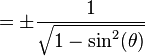
\cos(\theta)= \pm\sqrt{1 - \sin^2(\theta)}+−−+= \sgn\left( \sin \left(\theta+ \frac{\pi}{2}\right)\right) \sqrt{1 - \sin^2(\theta)}
cot\sin(\theta)= \pm\frac{1}{\sqrt{1 + \cot^2(\theta)}}++−−=  \sgn\left( \cot\left( \frac{\theta}{2}\right)\right) \frac{1}{\sqrt{1 + \cot^2(\theta)}}
\cot(\theta) = \pm\frac{\sqrt{1 - \sin^2(\theta)}}{\sin(\theta)}+−−+= \sgn\left( \sin \left(\theta+ \frac{\pi}{2}\right)\right) \frac{\sqrt{1 - \sin^2(\theta)}}{\sin(\theta)}
tan\sin(\theta)= \pm\frac{\tan(\theta)}{\sqrt{1 + \tan^2(\theta)}} +−−+= \sgn\left( \tan\left(\frac{2\theta + \pi}{4}\right)\right) \frac{\tan(\theta)}{\sqrt{1 + \tan^2(\theta)}}
\tan(\theta)= \pm\frac{\sin(\theta)}{\sqrt{1 - \sin^2(\theta)}}+−−+= \sgn\left( \sin \left(\theta+ \frac{\pi}{2}\right)\right) \frac{\sin(\theta)}{\sqrt{1 - \sin^2(\theta)}}
sec\sin(\theta)= \pm\frac{\sqrt{\sec^2(\theta) - 1}}{\sec(\theta)} +−+−= \sgn\left( \sec \left( \frac{4 \theta - \pi}{2}\right)\right) \frac{\sqrt{\sec^2(\theta) - 1}}{\sec(\theta)}
\sec(\theta)= \pm\frac{1}{\sqrt{1 - \sin^2(\theta)}}+−−+= \sgn\left( \sin \left(\theta+ \frac{\pi}{2}\right)\right) \frac{1}{\sqrt{1 - \sin^2(\theta)}}
Note that for all equations which use plus/minus (±), the result is positive for angles in the first quadrant.
The basic relationship between the sine and the cosine can also be expressed as the Pythagorean trigonometric identity:
\cos^2(\theta) + \sin^2(\theta) = 1\!
where sin2x means (sin(x))2.

Properties relating to the quadrants[edit]

Over the four quadrants of the sine function is as follows.
QuadrantDegreesRadiansValueSignMonotonyConvexity
1st Quadrant0^\circ<x<90^\circ0<x< \frac{\pi}{2}0<\sin(x)<1+increasingconcave
2nd Quadrant90^\circ<x<180^\circ\frac{\pi}{2}<x<\pi0<\sin(x)<1+decreasingconcave
3rd Quadrant180^\circ<x<270^\circ\pi<x<\frac{3\pi}{2}-1<\sin(x)<0-decreasingconvex
4th Quadrant270^\circ<x<360^\circ\frac{3\pi}{2}<x<2\pi-1<\sin(x)<0-increasingconvex
Points between the quadrants. k is an integer.

The quadrants of the unit circle and of sin x, using the Cartesian coordinate system.
DegreesRadians
0 \le x < 2\pi
Radians\sin(x)Point type
0^\circ02\pi k0Root, Inflection
90^\circ\frac{\pi}{2}2\pi k + \frac{\pi}{2}1Maxima
180^\circ\pi2\pi k - \pi0Root, Inflection
270^\circ\frac{3\pi}{2}2\pi k - \frac{\pi}{2}-1Minima
For arguments outside those in the table, get the value using the fact the sine function has a period of 360° (or 2π rad): \sin(\alpha + 360^\circ) = \sin(\alpha), or use \sin(\alpha + 180^\circ) = -\sin(\alpha). Or use \cos(x)=\frac{e^{xi}+e^{-xi}}{2} and \sin(x)=\frac{e^{xi}-e^{-xi}}{2i}. For complement of sine, we have \sin(180^\circ-\alpha) = \sin(\alpha).

Series definition[edit]


The sine function (blue) is closely approximated by its Taylor polynomialof degree 7 (pink) for a full cycle centered on the origin.

This animation shows how including more and more terms in the partial sum of its Taylor series gradually builds up a sine curve.
Using only geometry and properties of limits, it can be shown that the derivative of sine is cosine, and that the derivative of cosine is the negative of sine.
Using the reflection from the calculated geometric derivation of the sine is with the 4n + k-th derivative at the point 0:
\sin^{(4n+k)}(0)=\begin{cases}
0 & \text{when } k=0 \\
1 & \text{when } k=1 \\
0 & \text{when } k=2 \\
-1 &  \text{when } k=3 \end{cases}
This gives the following Taylor series expansion at x = 0. One can then use the theory of Taylor series to show that the following identities hold for all real numbers x (where x is the angle in radians) :[3]

\begin{align}
\sin x & = x - \frac{x^3}{3!} + \frac{x^5}{5!} - \frac{x^7}{7!} + \cdots \\[8pt]
& = \sum_{n=0}^\infty \frac{(-1)^n}{(2n+1)!}x^{2n+1} \\[8pt]
\end{align}
If x were expressed in degrees then the series would contain messy factors involving powers of π/180: if x is the number of degrees, the number of radians is y = πx /180, so
\begin{align}
\sin x_\mathrm{deg} & = \sin y_\mathrm{rad} \\
& = \frac{\pi}{180} x - \left (\frac{\pi}{180} \right )^3\ \frac{x^3}{3!} + \left (\frac{\pi}{180} \right )^5\ \frac{x^5}{5!} - \left (\frac{\pi}{180} \right )^7\ \frac{x^7}{7!} + \cdots .
\end{align}
The series formulas for the sine and cosine are uniquely determined, up to the choice of unit for angles, by the requirements that

\begin{align}
\sin 0 = 0 & \text{ and } \sin{2x} = 2 \sin x \cos x \\
\cos^2 x + \sin^2 x = 1 & \text{ and } \cos{2x} = \cos^2 x - \sin^2 x \\
\end{align}
The radian is the unit that leads to the expansion with leading coefficient 1 for the sine and is determined by the additional requirement that

\sin x \approx x \text{ when } x \approx 0.
The coefficients for both the sine and cosine series may therefore be derived by substituting their expansions into the pythagorean and double angle identities, taking the leading coefficient for the sine to be 1, and matching the remaining coefficients.
In general, mathematically important relationships between the sine and cosine functions and the exponential function (see, for example, Euler's formula) are substantially simplified when angles are expressed in radians, rather than in degrees, grads or other units. Therefore, in most branches of mathematics beyond practical geometry, angles are generally assumed to be expressed in radians.
A similar series is Gregory's series for arctan, which is obtained by omitting the factorials in the denominator.

Continued fraction[edit]

The sine function can also be represented as a generalized continued fraction:
 \sin x =
\cfrac{x}{1 + \cfrac{x^2}{2\cdot3-x^2 +
\cfrac{2\cdot3 x^2}{4\cdot5-x^2 +
\cfrac{4\cdot5 x^2}{6\cdot7-x^2 + \ddots}}}}.
The continued fraction representation expresses the real number values, both rational and irrational, of the sine function.

Fixed point[edit]


The fixed point iteration xn+1 = sinxn with initial value x0 = 2 converges to 0.
Zero is the only real fixed point of the sine function; in other words the only intersection of the sine function and the identity function is sin(0) = 0.

Arc length[edit]

The arc length of the sine curve between a and b is  \int_a^b\!\sqrt{1+\cos(x)^2}\, dx  This integral is an elliptic integral of the second kind.
The arc length for a full period is \frac{4\sqrt{2}\,\pi^{3/2}}{\Gamma(1/4)^2} + \frac{\Gamma(1/4)^2}{\sqrt{2\pi}}=7.640395578\ldots where \Gamma is the Gamma function.
The arc length of the sine curve from 0 to x is the above number divided by 2\pi times x, plus a correction that varies periodically in x with period \pi. The Fourier series for this correction can be written in closed form using special functions, but it is perhaps more instructive to write the decimal approximations of the Fourier coefficients. The sine curve arc length from 0 to x is

1.21600672 \,\times\, x \,+\, 0.10317093\, \sin(2x)-0.00220445\sin(4x)+0.00012584\sin(6x)-0.00001011\sin(8 x)+\cdots

Law of sines[edit]

Main article: Law of sines
The law of sines states that for an arbitrary triangle with sides a, b, and c and angles opposite those sides A, B and C:
\frac{\sin A}{a} = \frac{\sin B}{b} = \frac{\sin C}{c}.
This is equivalent to the equality of the first three expressions below:
\frac{a}{\sin A} = \frac{b}{\sin B} = \frac{c}{\sin C} = 2R,
where R is the triangle's circumradius.
It can be proven by dividing the triangle into two right ones and using the above definition of sine. The law of sines is useful for computing the lengths of the unknown sides in a triangle if two angles and one side are known. This is a common situation occurring in triangulation, a technique to determine unknown distances by measuring two angles and an accessible enclosed distance.

Special values[edit]


Some common angles (θ) shown on the unit circle. The angles are given in degrees and radians, together with the corresponding intersection point on the unit circle, (cos θ, sin θ).
For certain integral numbers x of degrees, the value of sin(x) is particularly simple. A table of some of these values is given below.
x (angle)sin x
DegreesRadiansGradiansTurnsExactDecimal
0°00g000
180°π200g1/2
15°1/12π16 2/3g1/24\frac{\sqrt{6}-\sqrt{2}}{4}0.258819045102521
165°11/12π183 1/3g11/24
30°1/6π33 1/3g1/121/20.5
150°5/6π166 2/3g5/12
45°1/4π50g1/8\frac{\sqrt{2}}{2}0.707106781186548
135°3/4π150g3/8
60°1/3π66 2/3g1/6\frac{\sqrt{3}}{2}0.866025403784439
120°2/3π133 1/3g1/3
75°5/12π83 1/3g5/24\frac{\sqrt{6}+\sqrt{2}}{4}0.965925826289068
105°7/12π116 2/3g7/24
90°1/2π100g1/411
90 degree increments:
x in degrees0°90°180°270°360°
x in radians0π/2π3π/22π
x in gons0100g200g300g400g
x in turns01/41/23/41
sin x010-10
Other values not listed above:
\sin\frac{\pi}{60}=\sin 3^\circ=\frac{(2-\sqrt{12})\sqrt{5+\sqrt5}+(\sqrt{10}-\sqrt2)(\sqrt3+1)}{16}\, OEIS A019812
\sin\frac{\pi}{30}=\sin 6^\circ=\frac{\sqrt{30-\sqrt{180}}-\sqrt5-1}{8}\, OEIS A019815
\sin\frac{\pi}{20}=\sin 9^\circ=\frac{\sqrt{10}+\sqrt2-\sqrt{20-\sqrt{80}}}{8}\, OEIS A019818
\sin\frac{\pi}{15}=\sin 12^\circ=\frac{\sqrt{10+\sqrt{20}}+\sqrt{3}-\sqrt{15}}{8}\, OEIS A019821
\sin\frac{\pi}{10}=\sin 18^\circ=\frac{\sqrt5-1}{4}=\tfrac{1}{2}\varphi^{-1}\, OEIS A019827
\sin\frac{7\pi}{60}=\sin 21^\circ=\frac{(2+\sqrt{12})\sqrt{5-\sqrt5}-(\sqrt{10}+\sqrt2)(\sqrt3-1)}{16}\, OEIS A019830
\sin\frac{\pi}{8}=\sin 22.5^\circ=\frac{\sqrt{2-\sqrt2}}{2},
\sin\frac{2\pi}{15}=\sin 24^\circ=\frac{\sqrt3+\sqrt{15}-\sqrt{10-\sqrt{20}}}{8}\, OEIS A019833
\sin\frac{3\pi}{20}=\sin 27^\circ=\frac{\sqrt{20+\sqrt{80}}-\sqrt{10}+\sqrt2}{8}\, OEIS A019836
\sin\frac{11\pi}{60}=\sin 33^\circ=\frac{(\sqrt{12}-2)\sqrt{5+\sqrt5}+(\sqrt{10}-\sqrt2)(\sqrt3+1)}{16}\, OEIS A019842
\sin\frac{\pi}{5}=\sin 36^\circ=\frac{\sqrt{10-\sqrt{20}}}{4}\, OEIS A019845
\sin\frac{13\pi}{60}=\sin 39^\circ=\frac{(2-\sqrt{12})\sqrt{5-\sqrt5}+(\sqrt{10}+\sqrt2)(\sqrt3+1)}{16}\, OEIS A019848
\sin\frac{7\pi}{30}=\sin 42^\circ=\frac{\sqrt{30+\sqrt{180}}-\sqrt5+1}{8}\, OEIS A019851

Relationship to complex numbers[edit]


An illustration of the complex plane. The imaginary numbers are on the vertical coordinate axis.
Sine is used to determine the imaginary part of a complex number given in polar coordinates (r,φ):
 z = r(\cos \varphi + i\sin \varphi )\,
the imaginary part is:
\operatorname{Im}(z) = r \sin \varphi
r and φ represent the magnitude and angle of the complex number respectively. i is the imaginary unit. z is a complex number.
Although dealing with complex numbers, sine's parameter in this usage is still a real number. Sine can also take a complex number as an argument.

Sine with a complex argument[edit]


\sin z\,

Domain coloring of sin(z) over (-π,π) on x and y axes. Brightness indicates absolute magnitude, saturation represents imaginary and real magnitude.

sin(z) as a vector field
The definition of the sine function for complex arguments z:
\begin{align}
\sin z & = \sum_{n=0}^\infty \frac{(-1)^{n}}{(2n+1)!}z^{2n+1} \\
& = \frac{e^{i z} - e^{-i z}}{2i}\, \\
& = \frac{\sinh \left( i z\right) }{i}
\end{align}
where i 2 = −1, and sinh is hyperbolic sine. This is an entire function. Also, for purely real x,
\sin x = \operatorname{Im}(e^{i x}). \,
For purely imaginary numbers:
 \sin iy = i \sinh y. \,
It is also sometimes useful to express the complex sine function in terms of the real and imaginary parts of its argument:
\begin{align}
\sin (x + iy) &= \sin x \cos iy + \cos x \sin iy \\
&= \sin x \cosh y + i \cos x \sinh y.
\end{align}

Partial fraction and product expansions of complex sine[edit]

Using the partial fraction expansion technique in Complex Analysis, one can find that the infinite series
\begin{align}
\sum_{n = -\infty}^{\infty}\frac{(-1)^n}{z-n} = \frac{1}{z} -2z \sum_{n = 1}^{\infty}\frac{(-1)^n}{n^2-z^2}
\end{align}
both converge and are equal to \frac{\pi}{\sin \pi z}.
Similarly we can find
\begin{align}
\frac{\pi^2}{\sin^2 \pi z} = \sum_{n=-\infty}^\infty \frac{1}{(z-n)^2}.
\end{align}
Using product expansion technique, one can derive
\begin{align}
\sin \pi z = \pi z \prod_{n = 1}^\infty \Bigl( 1- \frac{z^2}{n^2} \Bigr).
\end{align}

Usage of complex sine[edit]

sin z is found in the functional equation for the Gamma function,
\Gamma(s)\Gamma(1-s)={\pi\over\sin\pi s},
which in turn is found in the functional equation for the Riemann zeta-function,
\zeta(s)=2(2\pi)^{s-1}\Gamma(1-s)\sin(\pi s/2)\zeta(1-s).
As a holomorphic function, sin z is a 2D solution of Laplace's equation:
\Delta u(x_1, x_2) = 0.
It is also related with level curves of pendulum.[4]

Complex graphs[edit]

Sine function in the complex plane
Complex sin real 01 Pengo.svg
Complex sin imag 01 Pengo.svg
Complex sin abs 01 Pengo.svg
real componentimaginary componentmagnitude

Arcsine function in the complex plane
Complex arcsin real 01 Pengo.svg
Complex arcsin imag 01 Pengo.svg
Complex arcsin abs 01 Pengo.svg
real componentimaginary componentmagnitude

History[edit]

While the early study of trigonometry can be traced to antiquity, the trigonometric functions as they are in use today were developed in the medieval period. The chord function was discovered by Hipparchus of Nicaea (180–125 BC) and Ptolemy of Roman Egypt (90–165 AD).
The function sine (and cosine) can be traced to the jyā and koṭi-jyā functions used in Gupta period (320 to 550 CE) Indian astronomy (Aryabhatiya, Surya Siddhanta), via translation from Sanskrit to Arabic and then from Arabic to Latin.[1]

The first published use of the abbreviations 'sin', 'cos', and 'tan' is by the 16th century French mathematician Albert Girard; these were further promulgated by Euler (see below). The Opus palatinum de triangulis of Georg Joachim Rheticus, a student of Copernicus, was probably the first in Europe to define trigonometric functions directly in terms of right triangles instead of circles, with tables for all six trigonometric functions; this work was finished by Rheticus' student Valentin Otho in 1596.
In a paper published in 1682, Leibniz proved that sin x is not an algebraic function of x.[5] Roger Cotes computed the derivative of sine in his Harmonia Mensurarum (1722).[6]Leonhard Euler's Introductio in analysin infinitorum (1748) was mostly responsible for establishing the analytic treatment of trigonometric functions in Europe, also defining them as infinite series and presenting "Euler's formula", as well as the near-modern abbreviations sin., cos., tang., cot., sec., and cosec.[7]

Etymology[edit]

Etymologically, the word sine derives from the Sanskrit word for chord, jiva*(jya being its more popular synonym). This was transliteratedin Arabic as jiba جــيــب, abbreviated jb جــــب . Since Arabic is written without short vowels, "jb" was interpreted as the word jaib جــيــب, which means "bosom", when the Arabic text was translated in the 12th century into Latin by Gerard of Cremona. The translator used the Latin equivalent for "bosom", sinus (which means "bosom" or "bay" or "fold").[8][9] The English form sine was introduced in the 1590s.

Software implementations[edit]

The sine function, along with other trigonometric functions, is widely available across programming languages and platforms. In computing, it is typically abbreviated to sin.
Some CPU architectures have a built-in instruction for sine, including the Intel x87 FPUs since the 80387.
In programming languages, sin is typically either a built-in function or found within the language's standard math library.
For example, the C standard library defines sine functions within math.h: sin(double), sinf(float), and sinl(long double). The parameter of each is a floating pointvalue, specifying the angle in radians. Each function returns the same data type as it accepts. Many other trigonometric functions are also defined in math.h, such as for cosine, arc sine, and hyperbolic sine (sinh).
Similarly, Python, defines math.sin(x) within the built-in math module. Complex sine functions are also available within the cmath module, e.g. cmath.sin(z). CPython's math functions call the C math library, and use a double-precision floating-point format.
There is no standard algorithm for calculating sine. IEEE 754-2008, the most widely used standard for floating-point computation, does not address calculating trigonometric functions such as sine.[10] Algorithms for calculating sine may be balanced for such constraints as speed, accuracy, portability, or range of input values accepted. This can lead to different results for different algorithms, especially for special circumstances such as very large inputs, e.g. sin(1022).
A once common programming optimization, used especially in 3D graphics, was to pre-calculate a table of sine values, for example one value per degree. This allowed results to be looked up from a table rather than being calculated in real time. With modern CPU architectures this method may offer no advantage.[citation needed]